Forget-Me-Not Meaning: What the Little Blue Flower Really Says
A forget-me-not means remembrance and faithful love. When you give one, you are saying “I will keep you in my thoughts,” which is why these tiny blue flowers appear at funerals, weddings, war memorials and dementia charities around the world.
This guide explains where the name really comes from, which stories are history and which are legend, what the flower means in different countries, and how to make sure the plant you have is a true forget-me-not. If you found small blue flowers and are not sure what they are, you can upload a photo to our flower identifier.
Quick Answer: What Does a Forget-Me-Not Mean?
A forget-me-not (genus Myosotis, borage family Boraginaceae) symbolizes remembrance, faithful love and a lasting bond between two people. The meaning comes straight from its name, which asks the person receiving it not to forget the giver.
- Grief and memorials: remembering someone who has died.
- Love and friendship: loyalty and a promise to stay connected, even at a distance.
- Memory loss: support for people living with dementia and the people who care for them.
- War remembrance: honoring soldiers, especially in Newfoundland and Labrador and in Germany.
Where the Name “Forget-Me-Not” Comes From
The name is a translation of a medieval phrase. According to the Metropolitan Museum of Art’s Cloisters garden blog, the flower was already called ne m’oubliez mye in Old French and vergiz min niht in Middle High German, and English borrowed the name from French in the 1500s. Merriam-Webster dates the first known English use of “forget-me-not” to 1532.
The botanical name tells a different story. Myosotis comes from Greek words meaning “mouse ear,” a reference to the short, soft, pointed leaves, as NC State Extension explains.
What History Actually Records
The documented history is about love poetry and art, not one dramatic event. The Met notes that several 15th-century German love poets used the forget-me-not as a token of steadfastness, and that the flower appears in paintings by artists such as Rogier van der Weyden and Stefan Lochner.
Henry Bolingbroke adopted the forget-me-not as his personal emblem while in exile and kept it after he became King Henry IV of England. One historian cited by the Met suggests that blue, a color linked with fidelity in the Middle Ages, helped give the flower its meaning. That is a reasonable interpretation, not a proven fact.
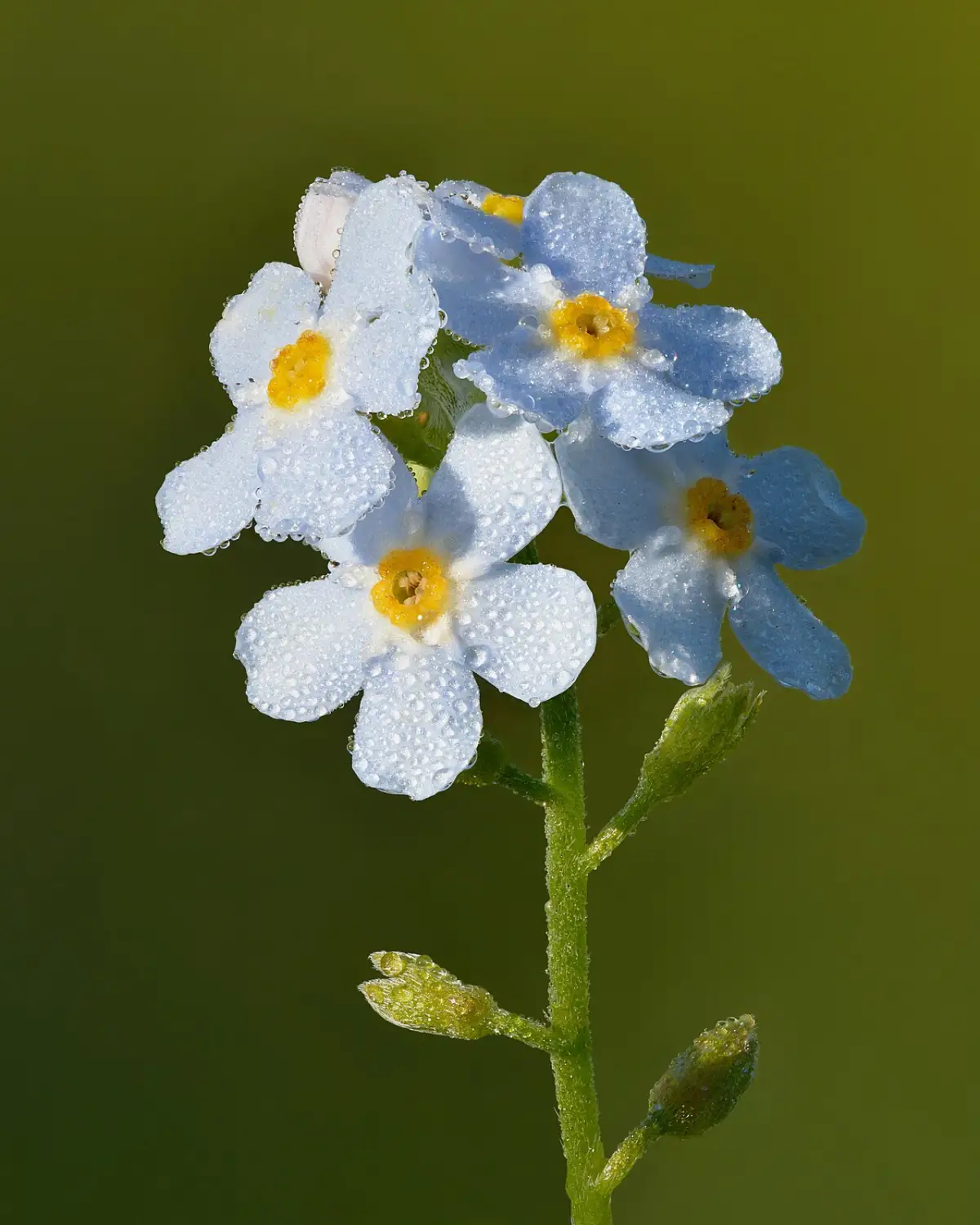
Water forget-me-not (Myosotis scorpioides), shown above, is the species the Met associates with the medieval names. Its species name means “scorpion-like,” after the coiled flower spray.
The Legends Behind the Name
The best-known origin story is a legend, not a recorded event. A knight walking by a river (often said to be the Danube) picks blue flowers for his lady, falls in under the weight of his armor, and throws her the bouquet while calling out “forget me not.” The Met places this tale firmly in the “as legend has it” category.
A second legend says that when God was naming the plants, one tiny flower was nearly overlooked and cried “Forget me not, O Lord,” which became its name. Retellings set the knight story in France or Germany and change the details, which shows how freely it has been passed along.
Some websites claim the poet Samuel Taylor Coleridge created the English name in the 1800s. That claim does not fit the dictionary record, which places the first English use in 1532.
What Forget-Me-Nots Symbolize Today
Today the flower carries three main meanings: remembrance, faithful love, and support for people with memory loss. Which one applies depends on who gives it and why.
Remembrance and Grief
Forget-me-nots are a common choice for funerals, memorial gardens and sympathy gifts because the name says what many grieving people want to say. Seed packets are sometimes handed out at memorials so families can grow a living tribute to a person or a pet.
Faithful Love and Friendship
In love and friendship, the forget-me-not stands for loyalty and a promise to remember someone across time or distance. That makes it a fitting addition to wedding bouquets, anniversary gifts and goodbye gifts for someone moving away. If you are comparing flowers with similar messages, our guides to lily of the valley meaning and magnolia flower symbolism cover two other spring favorites.
Memory Loss and Dementia Awareness
Several dementia charities use the forget-me-not as their emblem, including the Alzheimer’s Society in the UK, Alzheimer Nederland and Alzheimers New Zealand. In some UK hospitals, a forget-me-not symbol is placed on notes or near a bed so staff know a patient has dementia.
Forget-Me-Not Symbolism Around the World
The same small flower carries specific meanings in different places. This table summarizes the best-documented uses.
| Place or group | What it stands for | Key details |
|---|---|---|
| Newfoundland and Labrador, Canada | First World War remembrance | Worn around July 1 to remember the Royal Newfoundland Regiment at Beaumont-Hamel, France, on July 1, 1916 (Veterans Affairs Canada) |
| Germany | Soldiers who died in the world wars | Used in a similar way to the remembrance poppy in the UK |
| Freemasons | Brotherhood and remembering persecuted members | A Masonic emblem in Germany from 1926; worn as a quiet sign of membership during the Nazi era and readopted in 1948 |
| Armenia | Remembrance of the Armenian genocide | Official emblem of the 100th anniversary in 2015 |
| Lithuania | Remembrance of the January 1991 events | One of the symbols used at commemorations |
| Alaska, USA | State flower | Alpine forget-me-not (Myosotis alpestris), adopted by the Pioneers of Alaska in 1917 and made the official flower in 1949 |
| International | Missing children | Symbol of International Missing Children’s Day, May 25 |
| UK, Netherlands, New Zealand | Dementia awareness | Logo of national Alzheimer’s and dementia charities |
Do Forget-Me-Not Colors Change the Meaning?
No historical source gives separate meanings to different forget-me-not colors. The classic flower is sky blue with a yellow or white eye, and the meaning of remembrance and faithful love applies to every color.
The colors themselves are real, though. Many forget-me-nots open from pink buds that turn blue, a trait shared with other plants in the borage family. Garden cultivars of woodland forget-me-not come in blue (‘Victoria Blue’), pink (‘Victoria Rose’) and white (‘Snowball’), according to NC State Extension.
Charts online that say pink means new romance or white means purity are modern inventions. Choose a color because it suits the person or the setting, not because of a rule.
When to Give or Plant Forget-Me-Nots
The flower works for both sad and happy occasions because its core message, “remember me,” fits both. Use this table to match the gesture to the moment.
| Occasion | What the flower says | Practical tip |
|---|---|---|
| Funeral or memorial | You will not be forgotten | A potted plant or seed packet lasts longer than small cut stems |
| Loss of a pet | Remembering a companion | Sow seeds where the pet liked to rest, if the spot stays moist |
| Wedding or anniversary | Faithful, lasting love | Tuck small sprigs into bouquets or buttonholes |
| Someone moving away | Think of me | A small pot is easier to carry than a bouquet |
| Dementia support event | Solidarity with people affected | A pin or badge is more practical than fresh flowers |
| September birthday | A traditional birth flower in some lists | Pair it with asters for a fuller arrangement |
How to Tell a Real Forget-Me-Not From Look-Alikes
Several blue spring flowers are sold or described as “forget-me-nots,” so it is worth checking before you buy seeds or plant a memorial. True forget-me-nots belong to the genus Myosotis, with about 156 accepted species, most native to Europe and western Asia and around 40 found only in New Zealand.
Features You Can Check
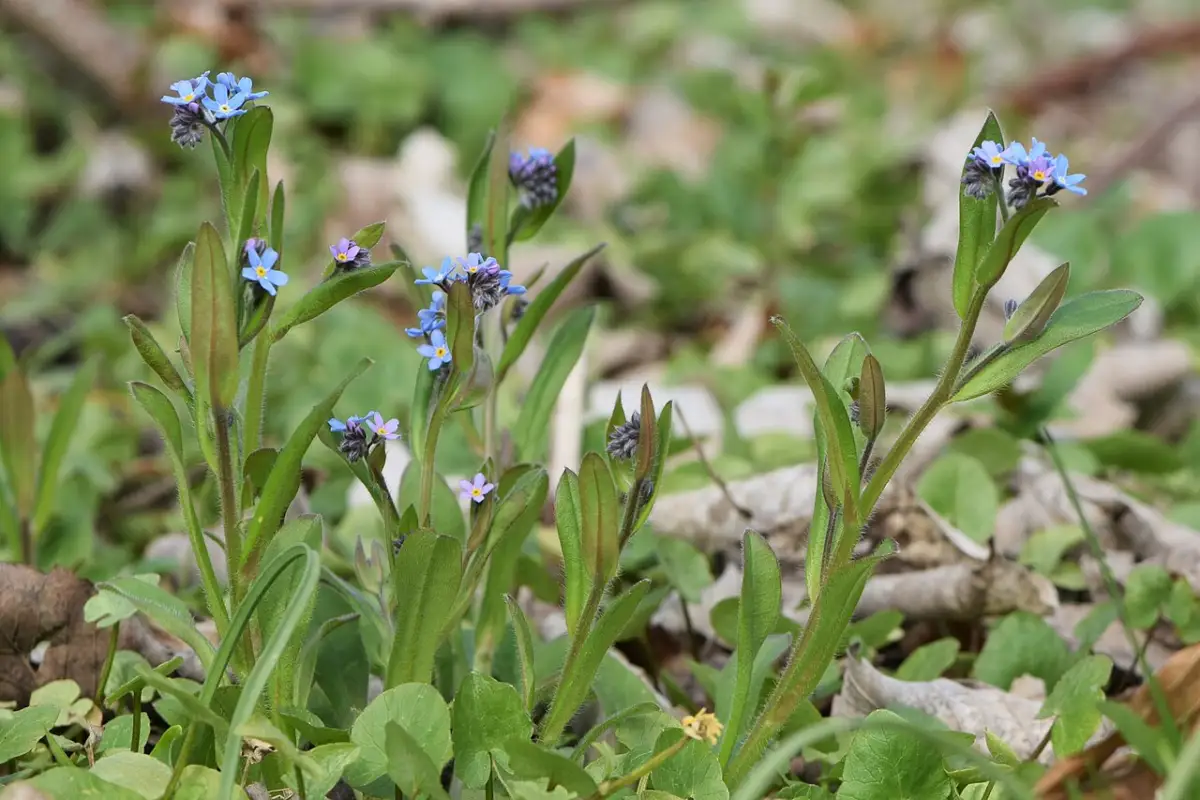
- Flowers: five rounded, flat-faced petals, usually under 1 cm (about 3/8 inch) across, sky blue with a yellow or white eye.
- Flower spray: a coiled cluster (scorpioid cyme) that unrolls as new flowers open, like a scorpion’s tail.
- Buds: often pink before they open blue.
- Leaves: alternate, simple, oblong to lance-shaped, 1 to 3 inches long, hairy and rough, with smooth edges (NC State Extension).
- Height: about 6 to 12 inches for woodland forget-me-not.
- Seeds: tiny nutlets in small pods that cling to clothing and fur.
- Season and habitat: blooms in spring in moist, shady places such as woodland edges, stream banks and garden borders in cool temperate climates.
For a second opinion on the foliage, try our leaf identifier with a clear photo of one leaf.
Forget-Me-Not vs Brunnera vs Chinese Forget-Me-Not
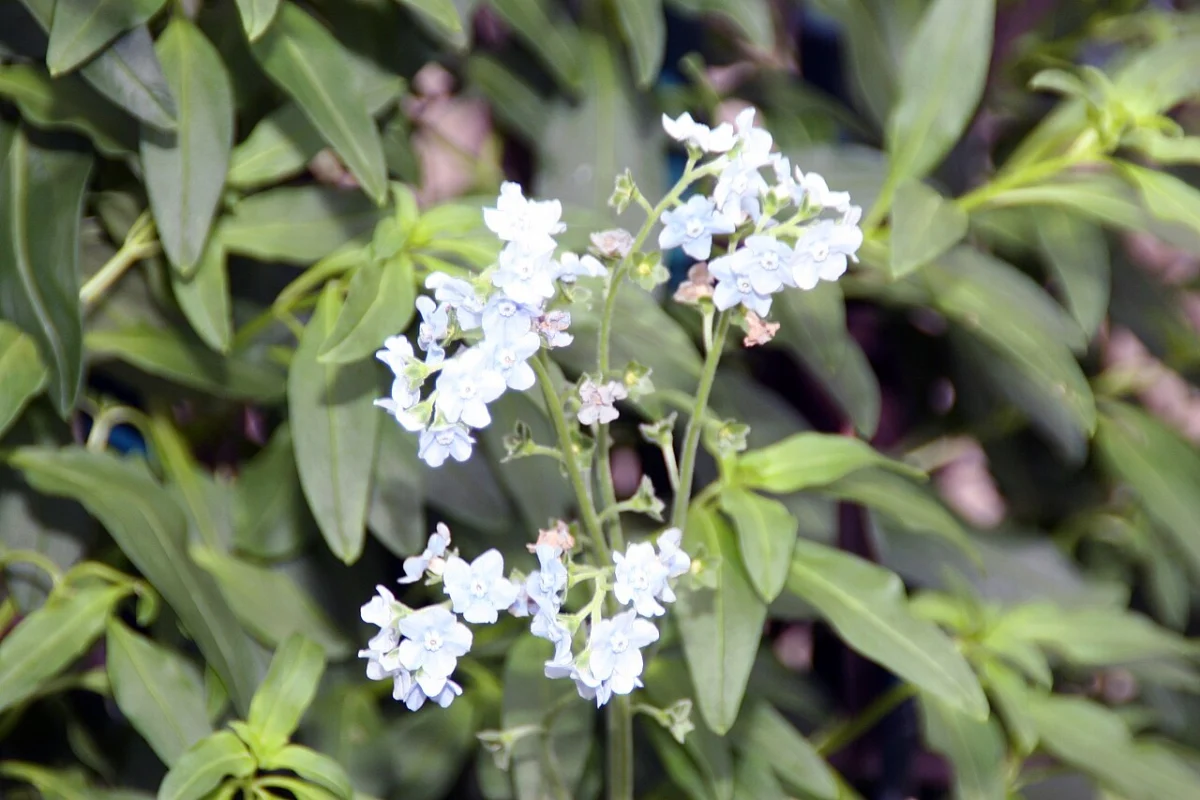
Leaves are the fastest way to separate these three plants, because their flowers look almost identical at a glance. All three belong to the borage family, Boraginaceae.
| Feature | Woodland forget-me-not | Brunnera (Siberian bugloss) | Chinese forget-me-not |
|---|---|---|---|
| Scientific name | Myosotis sylvatica | Brunnera macrophylla | Cynoglossum amabile |
| Other names | Wood forget-me-not | False forget-me-not, great forget-me-not | Chinese hound’s tongue |
| Leaves | Small, narrow, hairy, 1 to 3 inches | Large, heart-shaped leaves at the base | Gray-green and hairy |
| Flowers | Sky blue, yellow or white eye, under 1 cm | Sky blue with a white eye, in airy sprays | Sky blue, in loose clusters |
| Bloom time | Spring | Spring | Late summer |
| Life cycle | Biennial or short-lived perennial | Herbaceous perennial | Annual or biennial |
| Animal safety note | Reported as not toxic to cats in vet-reviewed guidance | Ask your vet; no source reviewed here | Toxic to horses (ASPCA) |
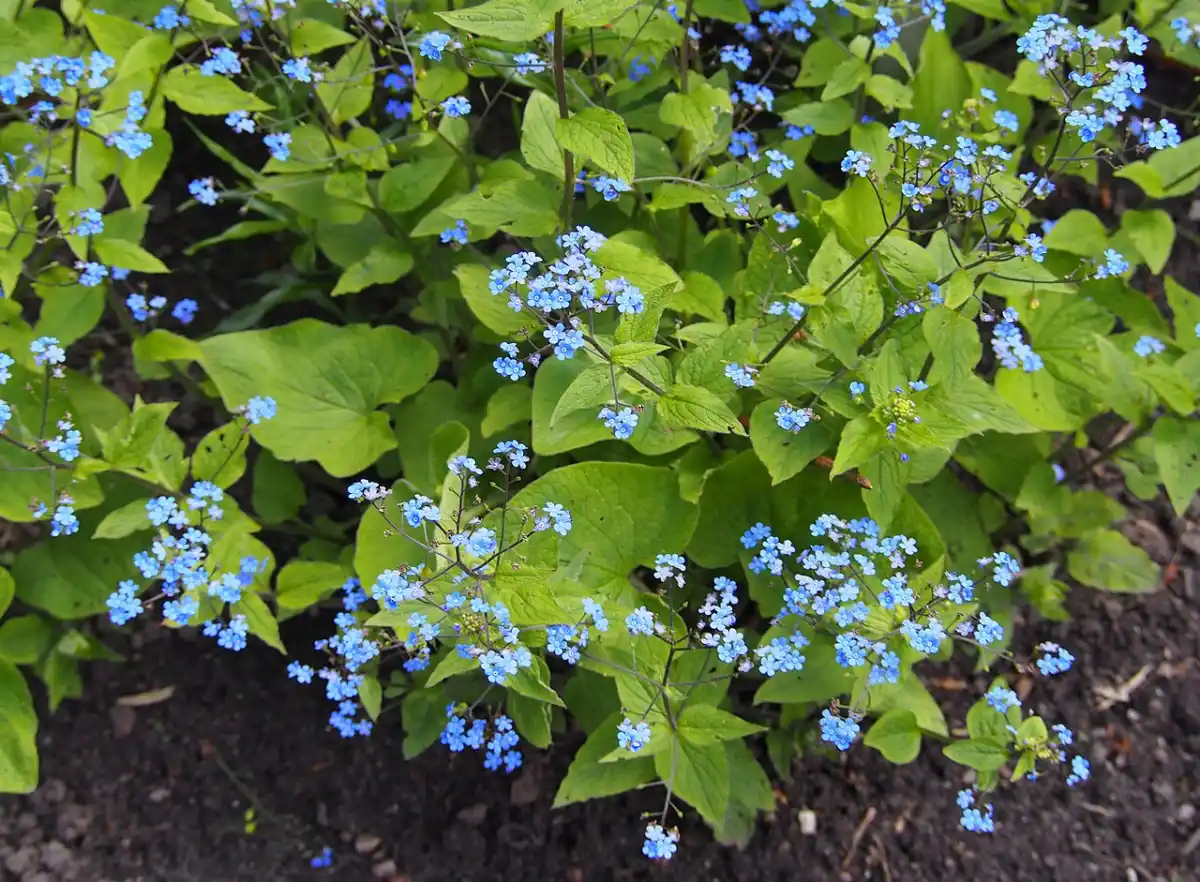
Even true forget-me-nots differ from each other. A University of Wisconsin weed science fact sheet separates them by the calyx, the small green cup under each flower. Water forget-me-not has calyx lobes shorter than the tube with hairs pressed flat, while woodland forget-me-not has lobes longer than the tube with spreading hairs, some minutely hooked.
How to Check It Yourself
- Photograph one open flower straight on in daylight, so the five petals and the eye are sharp.
- Photograph a single leaf flat, top side up, with a coin or ruler for scale.
- Look at the flower spray from the side to see whether the tip is coiled.
- Check the calyx under a flower with a magnifying glass and compare lobe length and hair direction.
- Upload your photos to our flower identifier and compare the result with the table above.
Photo identification, including our tool, can be wrong, especially with tiny blue flowers that look alike. When safety matters, for example where horses graze or children play, confirm the plant with a local extension office, botanical garden or experienced botanist.
Are Forget-Me-Nots Safe for Pets and People?
True forget-me-nots are not considered toxic to cats in vet-reviewed guidance, and the main safety concern is the look-alike Chinese forget-me-not. Here is what the sources say.
- Woodland forget-me-not (Myosotis sylvatica): Catster’s vet-reviewed guide reports that it is not poisonous to cats. Not toxic does not mean edible, and eating any plant in quantity can upset a pet’s stomach.
- Chinese forget-me-not (Cynoglossum amabile): the ASPCA lists it under hound’s tongue as toxic to horses because of pyrrolizidine alkaloids. NC State Extension rates its poison severity as low and notes liver disease in horses that eat large amounts or graze it over a long time.
- People: do not eat any wild or garden forget-me-not based on an article or an app result. Several borage family plants, including Chinese forget-me-not and heliotrope, contain pyrrolizidine alkaloids that can damage the liver.
If a person or pet has eaten a plant and shows symptoms such as vomiting, drooling or weakness, contact your local poison control center or a veterinarian right away. In the US, the ASPCA Animal Poison Control Center can be reached at (888) 426-4435.
Planting Forget-Me-Nots as a Living Memorial
Woodland forget-me-not grows easily from seed in USDA zones 3 to 8. It prefers rich, consistently moist, well-drained soil in full sun to part shade, and it appreciates afternoon shade where summers are hot (NC State Extension). In hot, dry climates it behaves more like a short-lived cool-season annual.
- Sow seed outdoors in midsummer for flowers the following spring, or start seed indoors 8 to 10 weeks before your last spring frost for flowers the same year. Our guide on the best time to plant flower seeds covers timing by season.
- Pick a spot with morning sun and afternoon shade. For a balcony or patio, use a container and follow our tips on growing flower plants in pots.
- Keep the soil evenly moist through spring.
- Cut off faded flower sprays if you want to limit self-seeding.
In my experience with growing plants, checking the soil with a finger before watering helps prevent overwatering far better than watering on a fixed schedule. I have also found that a spot with indirect sunlight makes a real difference to growth, and that watching a plant regularly and adjusting its care works better than any rigid routine. Those habits suit forget-me-nots, which need steady moisture to flower well.
Plan for spread before you plant. NC State Extension notes that woodland forget-me-not self-seeds freely, sometimes aggressively, and is listed as a noxious weed in one or more Midwestern US states. The University of Wisconsin lists both woodland and water forget-me-not as invasive in Wisconsin, so near streams, ponds or wild areas, check your local invasive species list first or keep plants in containers.
Pests are rarely a problem. NC State Extension reports no serious insect or disease issues, although plants can get mildew and rust in damp conditions.
Final Thoughts
The forget-me-not means remembrance and faithful love, a message that has stayed the same since medieval poets and painters used it. The drowning knight is a legend, but the meaning is well documented, and it now reaches from Newfoundland war memorials to dementia charities.
If you plan to give or plant forget-me-nots, confirm you have a true Myosotis, keep Chinese forget-me-not away from grazing horses, and contain the seedlings near wild areas. Not sure what your blue flowers are? Start with a clear photo in our flower identifier.
Frequently Asked Questions
What does it mean when someone gives you forget-me-nots?
It means they want you to remember them and that they will keep you in their thoughts. Depending on the moment, it can express faithful love, friendship, or remembrance of someone who has died.
Is the story of the knight and the forget-me-not true?
No. The drowning knight is a legend. What history does record is that the flower was called ne m’oubliez mye in Old French and vergiz min niht in Middle High German, and that 15th-century German poets used it as a token of steadfast love.
Are forget-me-nots appropriate for a funeral?
Yes. Their meaning of remembrance makes them one of the most fitting funeral and memorial flowers. A potted plant or a seed packet lasts longer than small cut stems and can become a living memorial.
What is the difference between a forget-me-not and brunnera?
Brunnera (Brunnera macrophylla), often called false forget-me-not, has large heart-shaped leaves, while true forget-me-nots (Myosotis) have small, narrow, hairy leaves 1 to 3 inches long. The flowers look almost the same, so check the leaves.
Is the forget-me-not the state flower of Alaska?
Yes. The alpine forget-me-not (Myosotis alpestris) was adopted by the Pioneers of Alaska in 1917 and became the official state flower in 1949, ten years before statehood.
Featured image: Photo: Johannes Robalotoff / Wikimedia Commons, CC BY-SA 3.0 de