

Allamanda Plant Care: Sun, Water, Pruning and Winter Guide
Allamanda is a tropical flowering vine that rewards you with large yellow trumpets from summer into fall, but only when it gets enough sun, steady moisture and warmth. This guide covers allamanda plant care for gardens and containers, explains why plants stop flowering, and shows how to keep one alive through winter in colder climates.
Quick Answer: How to Care for Allamanda
Give allamanda (Allamanda cathartica) at least 6 hours of direct sun, rich well-drained soil that stays evenly moist, and a bloom fertilizer every 2 to 3 weeks from spring to late summer. Prune once in late winter, because flowers form on new growth. Keep it above freezing: the plant is killed at about -1°C (30°F), so bring container plants indoors before the first frost.
- Light: full sun, 6 or more hours a day
- Water: when the top 2 to 3 cm (about 1 inch) of soil is dry; less in winter
- Soil: rich in organic matter, with good drainage
- Feeding: a phosphorus-leaning bloom fertilizer, spring to late summer only
- Safety: the milky sap irritates skin and eyes, and all parts are considered toxic if eaten
Which Allamanda Do You Have?
Most plants sold as “allamanda” are golden trumpet (Allamanda cathartica), a member of the dogbane family, Apocynaceae. It is native to Central and South America and is grown in warm regions worldwide, according to NC State Extension. Two relatives are also common in nurseries, and their care is similar but not identical.
The easiest check is the leaves. Golden trumpet has glossy, lance-shaped leaves about 10 cm long, set in whorls of three or four around the stem or in opposite pairs, as described by Queensland Poisons Information Centre. A broken leaf or stem bleeds white, milky sap.
| Plant | Habit | Leaves | Flowers | Fruit |
|---|---|---|---|---|
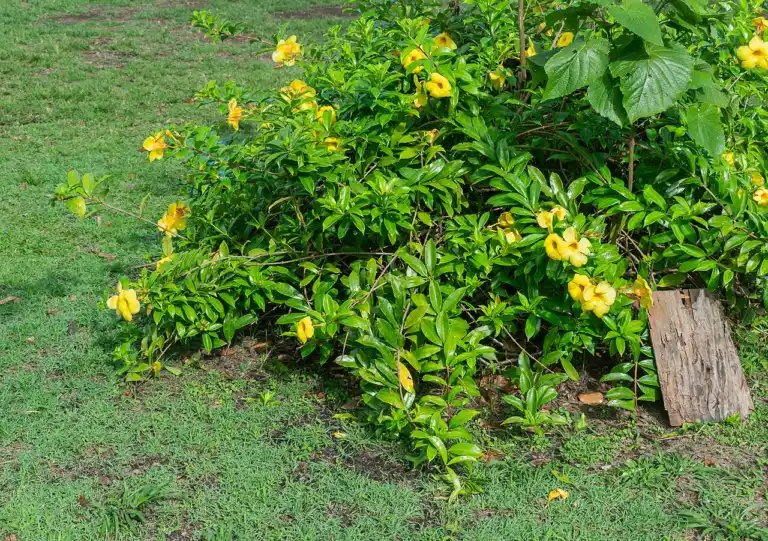
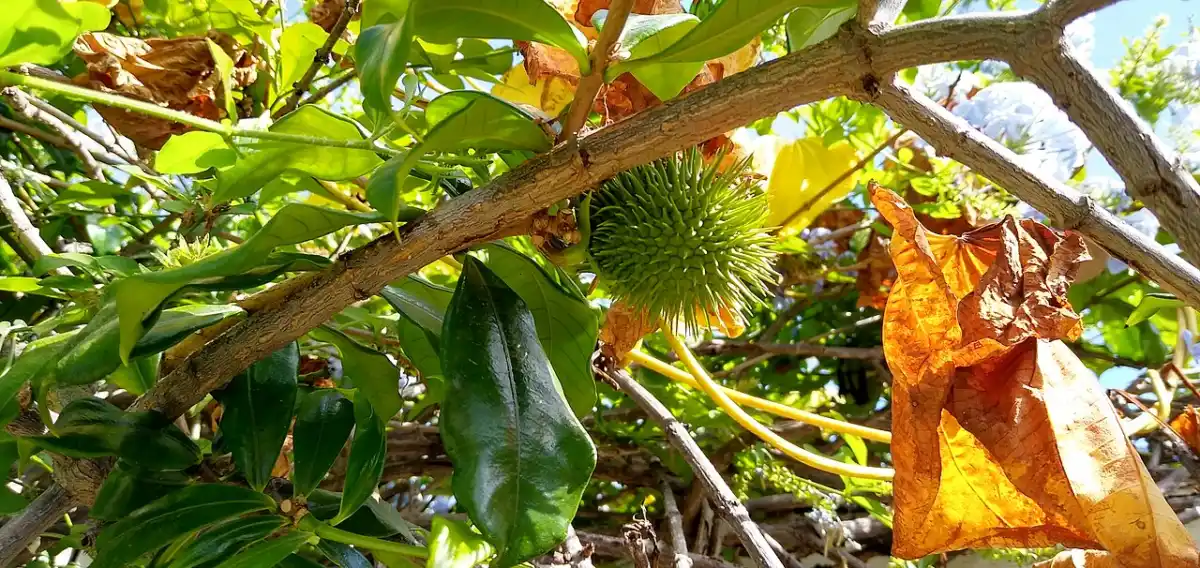
| Golden trumpet (Allamanda cathartica) | Sprawling vine or woody climber; stems can twine past 5.8 m (19 ft) | Glossy, lance-shaped, in whorls of 3 or 4 or in pairs | Bright yellow trumpets with 5 rounded lobes, up to about 9 cm (3.5 in) wide | Prickly round capsule with winged seeds |
| Bush allamanda (Allamanda schottii) | Shrubby, more upright and compact | Glossy, in whorls | Yellow trumpets | Prickly capsule |
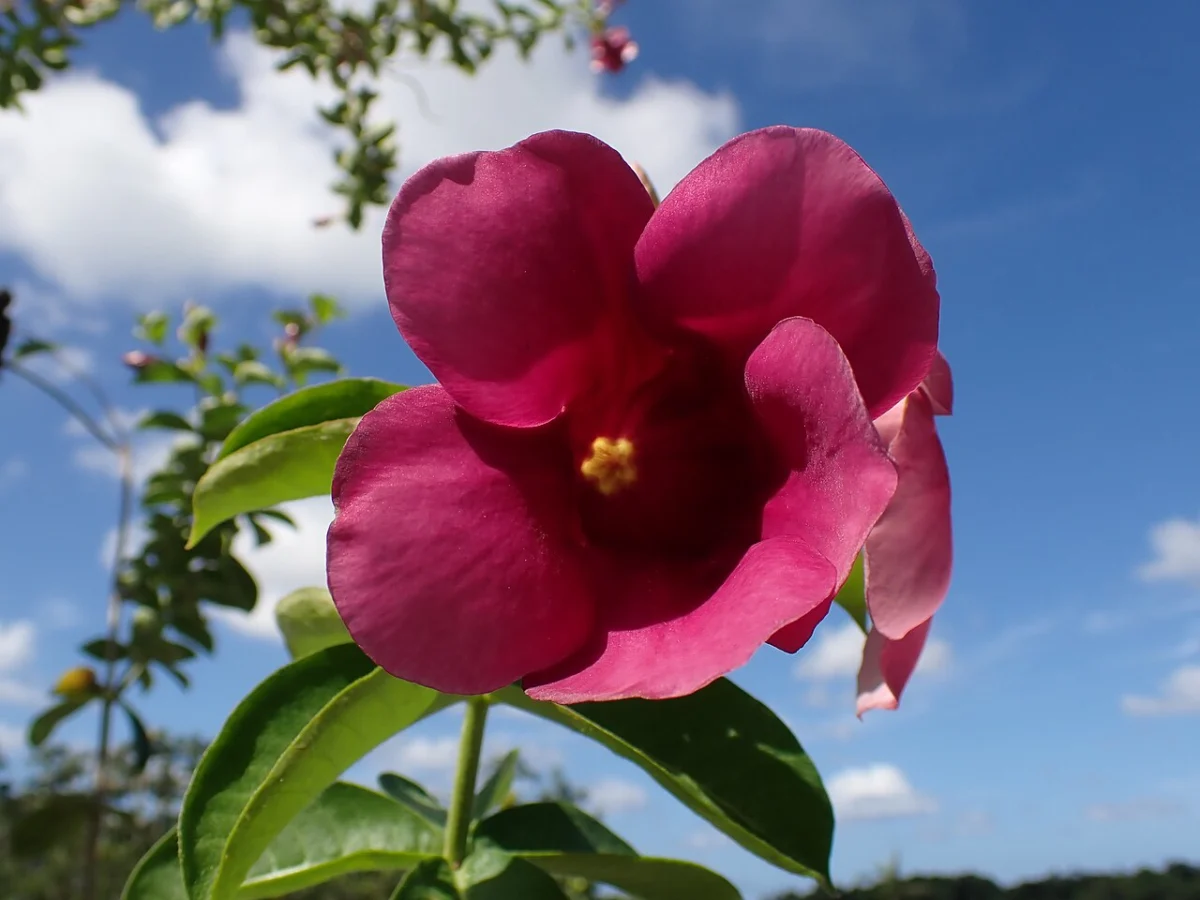
| Purple allamanda (Allamanda blanchetii) | Evergreen vine or climbing shrub | Oval, 10 to 20 cm (4 to 8 in), in whorls | Reddish purple fading to pink, about 7.5 cm (3 in) long | Spiky capsule that turns brown |
Sources: NC State Extension for golden trumpet size and flowers, and UF/IFAS fact sheet FP032 for purple allamanda.
Allamanda Look-Alikes
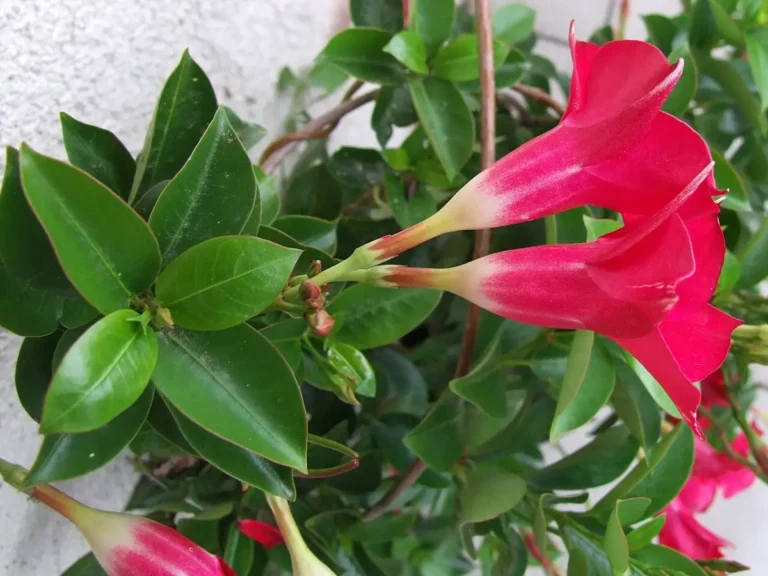
Two yellow vines in the same family are often confused with golden trumpet. Leaf arrangement and fruit separate them quickly.
| Feature | Golden trumpet (Allamanda cathartica) | Mandevilla (Mandevilla spp.) | Wild allamanda (Pentalinon luteum) |
|---|---|---|---|
| Family | Apocynaceae | Apocynaceae | Apocynaceae |
| Leaf arrangement | Whorls of 3 or 4, sometimes pairs | Opposite pairs | Opposite pairs |
| Flower color | Golden yellow | Mostly pink, red or white; some yellow | Yellow |
| Fruit | Round, prickly capsule | Long, slender paired pods | Long, slender paired pods |
| Native range | Central and South America | Central and South America | Native to Florida |
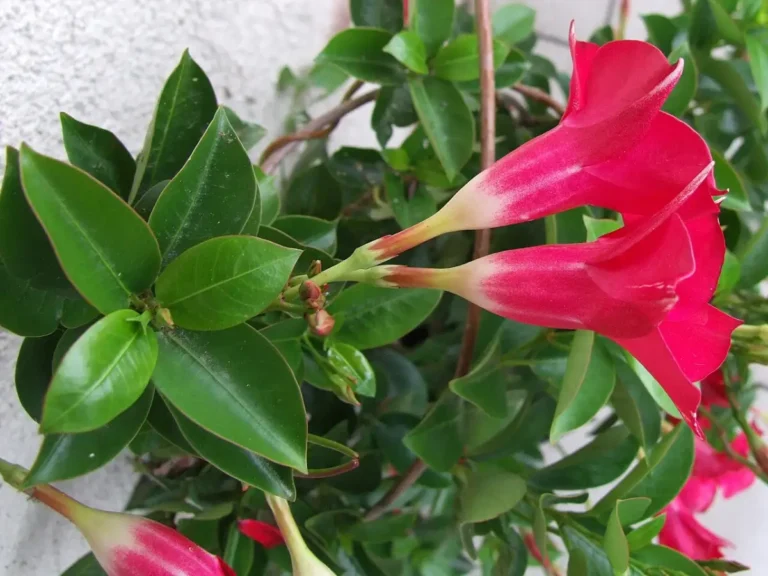
If you are not sure which plant you have, take a clear daylight photo of one flower and one leaf node and try our flower identifier or leaf identifier. Photo identification, including our tool, can be wrong, so confirm with the leaf and fruit checks above or ask a local extension office when safety matters. For pink and red vines, our guide on dipladenia vs mandevilla explains the differences in detail.
Allamanda Care at a Glance
| Need | What golden trumpet wants |
|---|---|
| Light | Full sun, 6 or more hours of direct light a day |
| Water | Ample, evenly moist soil with good drainage; reduce in winter |
| Soil | Loamy, high in organic matter, well drained |
| Hardiness | USDA zones 9b to 11; killed at about -1°C (30°F) |
| Feeding | Bloom fertilizer every 2 to 3 weeks, spring to late summer |
| Pruning | Late winter, before new growth starts |
| Bloom time | Summer and fall in most climates; longer in the tropics |
| Propagation | Stem cuttings |
| Toxicity | All parts considered toxic if eaten; sap irritates skin and eyes |
How Much Sun Does Allamanda Need?
Allamanda needs full sun, meaning 6 or more hours of direct sunlight a day, according to NC State Extension. Less light gives you long green stems with few or no flowers.
Outdoors, choose the sunniest wall, fence or trellis you have. In very hot, dry climates, a little afternoon shade protects the leaves, but the plant should still get a full morning of sun. Indoors, use an unobstructed south-facing window in the Northern Hemisphere (north-facing in the Southern Hemisphere) or a west window, or add a grow light in winter.
I have found that placing plants in a suitable spot with the right light makes a difference in their growth. For allamanda, that spot is the sunniest one you have.
How Often to Water Allamanda
Water allamanda when the top 2 to 3 cm (about 1 inch) of soil feels dry, then water deeply until it drains. NC State Extension describes the plant as needing ample moisture and good drainage, so the goal is moist soil, never soggy soil.
There is no fixed schedule, because heat, pot size and sun change how fast the soil dries. A plant in a small pot on a hot balcony may need water every day in summer, while the same plant indoors in winter may need it once every week or two.
- Spring and summer: keep the soil evenly moist while the plant grows and blooms.
- Fall and winter: let the top few centimeters dry out more between waterings while growth slows.
- Containers: empty the saucer within 30 minutes so roots never sit in water.
I have learned that checking the soil before watering helps prevent overwatering and keeps plants healthy, and it is the simplest habit to build with allamanda.
Best Soil and Pot for Allamanda
Allamanda grows best in loamy soil high in organic matter that drains well. In the ground, mix compost into the planting hole. Avoid heavy clay that stays wet, and avoid salty or very alkaline soil, which the plant does not tolerate, according to the Hawaii weed risk assessment for Allamanda cathartica.
For containers, use a quality potting mix with extra compost and a few handfuls of perlite or coarse sand. Pick a pot with drainage holes and move up only one size at a time in spring. Give vining types a trellis or obelisk to climb, because the stems need to be tied to a support. Our guide to growing flower plants in pots covers drainage and pot choice in more detail.
Best Fertilizer for More Allamanda Flowers
Feed allamanda every 2 to 3 weeks from spring to late summer with a water-soluble bloom fertilizer that is higher in phosphorus (the middle number) than nitrogen, such as a 5-10-5 mixed at half strength. Stop feeding in fall and winter while the plant rests.
Too much nitrogen pushes leafy growth at the expense of flowers. Too much fertilizer of any kind can also burn roots and cause yellow leaves, so more is not better. If your plant is in the ground in rich soil, feeding once a month is often enough.
Temperature, Hardiness Zones and Winter Care
Allamanda is a tropical plant that grows outdoors all year only in USDA zones 9b to 11, and it is killed by temperatures of about -1°C (30°F), according to the Hawaii weed risk assessment. It grows and flowers best in warm weather, and growth slows sharply once nights stay below about 13°C (55°F).
NC State Extension advises that plants grown outdoors in cooler areas should be cut back and brought indoors as container plants before the first freeze.
Care by Climate
| Your climate | Where to grow it | Winter plan |
|---|---|---|
| Tropical, frost-free (zones 10b to 12) | In the ground on a fence, arbor or as a sprawling shrub | None needed; reduce water in the cooler, drier season |
| Subtropical with rare frost (zones 9b to 10a) | In the ground against a warm, sheltered wall, or in a large pot | Cover on frost nights; expect some dieback and regrowth |
| Cold winters (zone 9a and colder) | In a container outdoors from late spring to early fall | Move indoors before nights drop below about 13°C (55°F) |
These zones use the US system. If you live elsewhere, compare your average coldest winter night with the -1°C limit: if it regularly falls below freezing, treat allamanda as a container plant.
How to Overwinter Allamanda Indoors
- Check the plant for pests before bringing it in, and rinse the leaves.
- Cut long stems back by about a third so it fits indoors. Wear gloves because of the sap.
- Place it in the brightest window you have, away from heaters and cold drafts.
- Water only when the top few centimeters are dry, and do not fertilize.
- Expect some leaf drop as it adjusts. This is normal.
- In spring, start feeding again and move it back outside once nights stay above about 13°C (55°F).
Pruning Allamanda Without Losing Blooms
Prune allamanda once a year in late winter or very early spring, just before new growth starts. UF/IFAS notes for purple allamanda that the plant blooms on new growth and that over-pruning reduces flowering, so a hard cut in midsummer removes the next round of buds.
- Late winter: remove dead, weak or crossing stems and shorten the rest to shape the plant.
- Growing season: pinch the soft tips of long shoots to make the plant bushier.
- Any time: tie new stems to the support so the vine stays tidy.
Always wear gloves and eye protection when you cut allamanda. The white sap can irritate skin and eyes, and it is sticky enough to wipe onto your face by accident.
How to Propagate Allamanda From Cuttings
Stem cuttings are the recommended way to propagate allamanda, according to NC State Extension. Late spring and early summer, when stems are firm but still green, give the best results.
- Cut a 10 to 15 cm (4 to 6 in) piece of healthy stem with at least two leaf nodes.
- Remove the lower leaves and let the milky sap stop flowing. Wear gloves.
- Dip the cut end in rooting hormone, if you have it.
- Insert it into a moist mix of potting soil and perlite.
- Cover loosely with a clear bag and keep it warm and in bright, indirect light.
- Keep the mix moist but not wet. Gentle resistance when you tug the cutting means roots have formed, often after several weeks.
Allamanda can also be grown from the seeds inside its spiny capsules, but cuttings are faster and produce a plant identical to the parent.
Common Allamanda Problems and Fixes
Most allamanda problems come from too little light, the wrong amount of water, cold, or feeding mistakes. Pests are usually minor.
Allamanda Not Blooming
| Likely cause | How to check | Fix |
|---|---|---|
| Not enough sun | Fewer than 6 hours of direct sun | Move it to the sunniest spot you have |
| Pruned at the wrong time | Cut back in late spring or summer | Prune only in late winter; pinch tips instead |
| Too much nitrogen | Lush leaves, long stems, no buds | Switch to a phosphorus-leaning bloom feed |
| Too cold | Nights below about 13°C (55°F) | Wait for warm weather or keep it indoors |
| Dry or rootbound pot | Roots circling, soil dries in hours | Repot one size up in spring |
The same causes stop flowering in other tropical vines. Our guide to mandevilla not blooming walks through a similar checklist.
Yellow Leaves or Leaf Drop
Yellow leaves on allamanda usually point to overwatering, overfeeding or cold. Feel the soil first: if it is wet days after watering, let it dry and check that the pot drains. If the plant was fed heavily, flush the pot with plain water. A few yellow leaves after moving indoors for winter are normal. For a wider look at causes, see why plant leaves turn yellow.
Pests
NC State Extension lists no major pests or diseases for golden trumpet, but container and indoor plants can pick up spider mites, mealybugs, scale, aphids and whiteflies. UF/IFAS lists scale, mites and nematodes as occasional pests of purple allamanda.
- Spray the leaves with water to knock off spider mites, especially indoors in dry air.
- Wipe mealybugs and scale off with a cotton swab dipped in rubbing alcohol.
- Use insecticidal soap or neem oil for heavier infestations, following the label.
Our step-by-step guide to getting rid of aphids on indoor plants also works for most soft-bodied pests on allamanda.
Is Allamanda Toxic to People and Pets?
Yes. All parts of allamanda are considered toxic if eaten, and the milky sap can irritate skin and eyes. NC State Extension rates the poison severity as low and notes that serious effects are expected only if large quantities are eaten, with possible symptoms of nausea, diarrhea, fever, swollen lips and thirst.
The Queensland Poisons Information Centre says eating the plant may cause vomiting and diarrhea and skin contact may cause dermatitis, while noting the evidence is limited. UF/IFAS advises caution around children and pets for purple allamanda.
- Children and adults: stomach upset if eaten; skin and eye irritation from sap.
- Dogs and cats: allamanda is not on the ASPCA toxic and non-toxic plant list, which is not complete, so absence does not mean it is safe. Keep pets from chewing it.
- Livestock: the Hawaii weed risk assessment cites a feeding trial in which allamanda caused fatal poisoning in cattle.
If a person or pet has eaten allamanda and shows symptoms, contact your local poison control center or a veterinarian right away.
Is Allamanda Invasive?
In some warm regions, yes. UF/IFAS Extension reports that the UF/IFAS Assessment of Non-native Plants in Florida’s Natural Areas rates golden trumpet a “High Invasion Risk” and does not recommend planting it in Florida. The Hawaii weed risk assessment also rates it high risk, and it is regarded as an environmental weed in northern Queensland, Australia.
If you garden in Florida, Hawaii or tropical Australia, consider growing allamanda in a container and removing seed capsules before they ripen. In Florida, UF/IFAS suggests the native wild allamanda (Pentalinon luteum) as a non-invasive alternative with similar yellow flowers. In cold climates, where the plant cannot survive winter outdoors, it poses no spread risk.
Check Your Allamanda Yourself: A Simple Weekly Routine
A short weekly check catches most problems before they cost you flowers. I believe that observing plants regularly and adjusting care to what you see matters more than following a fixed calendar, and this routine is built on that idea.
- Soil: push a finger 2 to 3 cm into the soil and water only if it is dry.
- Sun: confirm the plant still gets 6 or more hours of direct light as the seasons change.
- New growth: look for buds at the stem tips; no buds for weeks means checking light and feeding.
- Leaves: look under leaves for webbing, white cottony spots or sticky residue.
- Temperature: watch the forecast in fall and move containers indoors before nights drop below about 13°C (55°F).
- Support: tie new stems to the trellis so they do not snap or sprawl.
Growing indoor plants has helped me appreciate how small changes in plant care can support healthier growth, and the same patient approach works well for allamanda.
Final Thoughts
Allamanda plant care comes down to four things: full sun, moist but well-drained soil, a light bloom feed in the warm months, and protection from frost. Prune in late winter, wear gloves around the sap, and check your local invasive plant guidance before planting it in the ground in a frost-free region. If you are unsure whether your vine is a golden trumpet, a bush allamanda or a mandevilla, start with the leaf arrangement and fruit, then confirm with our flower identifier.
Frequently Asked Questions
Does allamanda need full sun?
Yes. Allamanda needs 6 or more hours of direct sun a day to bloom well, according to NC State Extension. In very hot climates, light afternoon shade is fine as long as it gets full morning sun.
Why is my allamanda not flowering?
The most common causes are too little sun, pruning in late spring or summer (flowers form on new growth), too much nitrogen fertilizer, and cool nights below about 13°C (55°F). Fix the light first, then switch to a phosphorus-leaning bloom feed.
How often should I water allamanda?
Water when the top 2 to 3 cm (about 1 inch) of soil is dry, then soak it until water drains. Keep it evenly moist in spring and summer and let it dry a little more between waterings in winter.
Can allamanda survive winter outdoors?
Only in frost-free or near frost-free areas (USDA zones 9b to 11). The plant is killed at about -1°C (30°F), so in colder climates grow it in a pot and bring it indoors before the first freeze.
Is allamanda poisonous to dogs and cats?
All parts of allamanda are considered toxic if eaten and the sap irritates skin. It is not on the ASPCA plant list, but that list is incomplete, so keep pets from chewing it and call a vet if your pet eats some and shows symptoms.
How do I make my allamanda bushy?
Prune once in late winter to shape the plant, then pinch the soft tips of long shoots during the growing season. Pinching encourages side shoots without removing the new growth that carries flowers.
Featured image: Photo: Mokkie / Wikimedia Commons, CC BY-SA 3.0

2 Comments