Mandevilla (Dipladenia) Not Blooming? Find the Cause and Fix It
A Mandevilla (often sold as Dipladenia) that stays green but refuses to flower is almost always healthy. It is simply putting its energy into leaves instead of buds. This guide helps you find the exact cause from what you can see on your plant, fix it, and know how long to wait before flowers return.
Quick Answer
A Mandevilla or Dipladenia stops blooming for three main reasons: it gets less than 6 hours of direct sun, its nights are cooler than about 60°F (15°C), or it is fed a high-nitrogen fertilizer that grows leaves instead of flowers. Move it to full sun, feed it every 2 weeks with a phosphorus-rich fertilizer such as 10-20-10, water only when the top inch of soil is dry, and avoid heavy pruning in summer. New buds usually form on fresh growth within a few weeks once conditions are right.
Mandevilla or Dipladenia: Does It Change the Fix?
No. Dipladenia is an older genus name, and the plants sold under it are now classified as Mandevilla, in the dogbane family (Apocynaceae). University of Florida IFAS Extension notes that compact types such as ‘Rio Pink’ and Sun Parasol were once classified as Dipladenia and are now in the Mandevilla genus.
The bloom triggers are the same for both. What differs is growth habit, which changes how you support and prune the plant. For a full side-by-side, see our guide to Dipladenia vs Mandevilla.

How to tell which one you have
| Feature | Climbing Mandevilla (for example Mandevilla × amabilis ‘Alice du Pont’, M. splendens) | “Dipladenia” type (for example Mandevilla sanderi, Rio, Sun Parasol compact lines) |
|---|---|---|
| Habit | Twining vine that climbs a trellis | Bushy, mounding, little or no climbing |
| Leaves | Larger, often with a wrinkled or textured surface | Smaller, glossy, smooth |
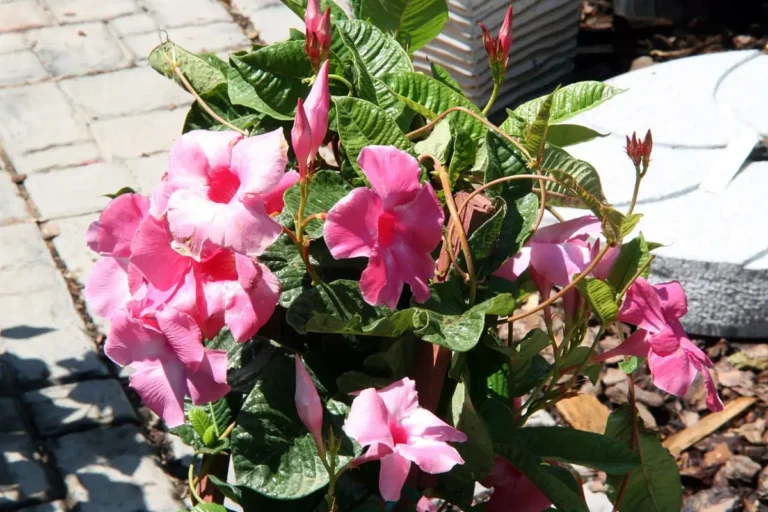
| Flowers | Trumpet-shaped, 5 flared petal lobes, 2 to 4 inches across | Trumpet-shaped, 5 lobes, usually smaller |
| Needs support? | Yes, or vines tangle and buds sit in shade | No, works as a container filler |
| Bloom trigger | Sun, warmth, new growth | Sun, warmth, new growth |
The habit and leaf-size differences come from Mississippi State University Extension, which describes Mandevilla as vining and Dipladenia as shrub-like with smaller flowers and foliage. Flower sizes for ‘Alice du Pont’ and ‘Splendens’ come from the Clemson Home and Garden Information Center.
Diagnose It First: Symptom Checklist
Match what you see to the most likely cause before you change anything. Changing several things at once makes it hard to know what worked.
| What you see | Most likely cause | First fix |
|---|---|---|
| Lush, dark green leaves, long stems, no buds | Too little sun or too much nitrogen | Move to 6+ hours of direct sun; switch to a phosphorus-rich feed |
| Buds form, then turn brown and drop | Cold nights or watering swings | Check night temperatures; water by soil feel |
| Yellow leaves, leaves falling, few flowers | Overwatering or poor drainage | Let the top 1 to 2 inches dry; check drainage holes |
| White cottony spots, sticky leaves, fine webbing | Mealybugs, scale, whiteflies or spider mites | Hose off pests; use insecticidal soap |
| Plant was cut back hard in summer | Pruning removed new growth | Stop pruning; feed and wait for new shoots |
| Recently moved outside or brought out of winter storage | Recovery period | Give it steady sun and warmth for several weeks |
| Pale, scorched leaves in very hot weather | Afternoon heat stress | Give afternoon shade, keep soil evenly moist |
9 Reasons Your Mandevilla Is Not Blooming
1. Less than 6 hours of direct sun
Light is the most common cause, and no fertilizer can make up for it. UF IFAS states that Mandevilla needs full sun to flower well, and Mississippi State recommends at least 6 hours of direct sun for Dipladenia types.
A bright spot is not the same as direct sun. A covered porch or a north-facing balcony can feel bright but give only an hour or two of sun on the leaves. Count the hours the sun actually hits the plant on a clear day.
2. Nights are too cool
Mandevilla is a tropical American plant, native from Mexico to South America, and it sets buds best when nights stay warm. Clemson notes it grows actively with nights of 60 to 65°F (15 to 18°C) and tolerates a minimum of about 45 to 50°F (7 to 10°C). Toronto Master Gardeners linked browning buds in late spring to nights dropping into that 7 to 10°C range.
In cool climates, this explains why plants sit idle in May and early June. The fix is often patience, or waiting longer before moving the plant outdoors.
3. Too much nitrogen fertilizer
Nitrogen (the first number on a fertilizer label) drives leaf and stem growth. A general lawn or houseplant food high in nitrogen gives a big green plant with few flowers. Clemson recommends feeding every 2 weeks in spring and summer with a high-phosphorus fertilizer such as 10-20-10.
If your plant is very leafy and dark green, stop the current fertilizer and switch. Phosphorus (the middle number) supports flowering, while nitrogen supports leaves.
4. Soil kept too wet or too dry
Mandevilla likes soil that is moist but never soggy. An Ask Extension expert advised letting the top inch or two dry before watering thoroughly, and another noted that Mandevilla is sensitive to overwatering, which shows up as yellowing and dropping leaves.
Very dry soil causes the opposite problem: buds dry up and fall. In hot weather, pots can dry out within a day, so check daily. If yellow leaves are the main sign, our guide on why plant leaves turn yellow walks through the other causes.

5. Pot too big, too small, or soil worn out
Pot size affects blooming in both directions. A pot far larger than the root ball holds extra water and pushes root growth instead of flowers, so repot only one size up. A plant that has filled its pot with circling roots, or sits in soil that is several years old, runs short of nutrients.
Use a fast-draining mix. Clemson suggests equal parts peat moss, potting mix and builder’s sand for containers. Our guide to growing flower plants in pots covers drainage and pot choice in more detail.
6. Pruning at the wrong time
Mandevilla flowers on new growth, according to Mississippi State Extension. Light tip pinching during the season encourages more branches and more flower clusters. Cutting the plant back hard in mid or late summer removes the shoots that were about to bloom.
Do major pruning in late winter or early spring, before growth starts. Clemson notes plants can be cut almost to the ground at that time and still bloom the same summer on new shoots.
7. Pests draining the plant
Sap-sucking pests weaken the plant and cut flower production, and competitor guides rarely mention them. Clemson lists mealybugs, scales, whiteflies and red spider mites as the main Mandevilla pests, and UF IFAS mentions scale and mealybugs.

Look under leaves and where leaves join stems. Signs include:
- Mealybugs: white, cottony clusters in leaf joints.
- Scale: small brown or tan bumps on stems that do not move.
- Whiteflies: tiny white insects that fly up when the plant is touched.
- Spider mites: fine webbing and pale speckling on leaves, worse in hot, dry air.
Spray pests off with a strong stream of water, wipe mealybugs and scale with a cotton swab dipped in rubbing alcohol, then use insecticidal soap if needed, following the label. Our guide on getting rid of aphids on indoor plants uses similar gentle methods.
8. Still recovering from a move or from winter
A plant moved from a greenhouse or garden center, or one brought out of winter storage, needs time to adjust to new light and temperatures. Toronto Master Gardeners noted that an overwintered plant not prepared from late winter may need several weeks outdoors before it sets buds.
Sudden full sun after months indoors can also scorch leaves. Move the plant gradually, from shade to morning sun to full sun, over about a week.
9. Afternoon heat stress in hot climates
In very hot regions, intense afternoon sun can stall flowering even though the plant needs full sun elsewhere. Mississippi State notes that partial shade in very hot locations helps prevent scorched leaves. This applies to places such as the US Gulf Coast, the Middle East, South Asia and inland Australia in summer.
The plant does best there with morning sun and light afternoon shade, plus steady watering. For a similar tropical flowering plant with the same problem, see tropical hibiscus not blooming.
A 6-Week Plan to Get Flowers Back
This plan fixes the most likely causes in order. Timings are a practical guide, not a guarantee, because temperature and plant age change how fast new buds appear.
- Day 1: Check light, night temperatures, soil moisture and pests using the checklist above. Treat any pests first.
- Days 1 to 7: Move the plant to a spot with at least 6 hours of direct sun (morning sun plus light afternoon shade in very hot climates). Add a trellis for climbing types so stems get light.
- Week 1: Stop high-nitrogen feeding. Start a phosphorus-rich water-soluble fertilizer every 2 weeks, mixed exactly as the label says.
- Weeks 1 to 6: Water only when the top inch of soil feels dry. Make sure water drains freely and the pot never sits in a full saucer.
- Weeks 2 to 3: Pinch the soft tips of long, bare stems to encourage side shoots. Remove spent flowers if any appear.
- Weeks 3 to 6: Look for new shoots with small bud clusters at the tips. This is the sign the plant has switched from leaf growth to flowering.
If nothing changes after 6 weeks of warm nights and full sun, check the roots. A pot full of circling roots or rotting, brown roots needs repotting into fresh, well-drained mix.

Bloom Booster, Balanced Feed or Epsom Salt?
Advice online conflicts here, so it helps to know where each claim comes from. Clemson Extension recommends a high-phosphorus fertilizer such as 10-20-10 every 2 weeks in spring and summer. Some gardening blogs prefer a balanced 10-10-10 and argue against bloom boosters, but they do not cite research for that view.
A practical middle path: if your plant is leafy and dark green, a phosphorus-rich feed makes sense. If it is pale and slow-growing, a balanced feed may be the better start. In either case, feeding more often than the label says can burn roots and will not force flowers.
Epsom salt (magnesium sulfate) appears in some guides as a bloom trick. We found no extension source that recommends it for Mandevilla, and it only helps if the soil is actually short of magnesium. Fix light, temperature and nitrogen first.
What Changes by Climate
| Where you grow it | What to expect | Main focus |
|---|---|---|
| USDA zones 10 to 11 and frost-free tropics | Grows outdoors all year; UF IFAS notes some flowers year-round in zones 10 and 11 | Prune in late winter, control heat stress, watch for scale |
| Temperate climates (northern US, Canada, UK, much of Europe) | Grown in pots or as an annual; often slow to bloom until nights warm in early summer | Warm nights, full sun, overwinter indoors |
| Very hot summers (Gulf Coast, Middle East, South Asia, inland Australia) | Flowering can pause in peak heat | Afternoon shade, steady watering, mite checks |
Mississippi State notes that most gardeners outside the tropics treat Mandevilla as a flowering annual, because fall frosts usually kill the top growth.
Overwintering So It Blooms Next Year
A plant that winters well blooms sooner the next summer. Bring it inside before nights fall below about 50°F (10°C), since Clemson gives 45 to 50°F as its minimum.
- Check carefully for pests and treat before bringing it in.
- Trim it back by about a third so it fits and is easier to manage.
- Place it in your sunniest window. If light is weak, a grow light helps; see which light color is best for plant growth.
- Water less often, because growth slows in cool, low light. Stop fertilizing until late winter.
- In late winter, prune old crowded stems and start feeding again so new growth is ready for summer.
- Move it outdoors only after nights stay above about 50°F, and harden it off gradually.
For month-by-month care of the compact types, see our Dipladenia care guide.
How I Check a Plant Before Changing Its Care
I have learned that checking the soil before watering helps prevent overwatering and keeps plants healthy. With a Mandevilla that has stopped blooming, I would start there: push a finger into the soil before reaching for the watering can or the fertilizer.
I also believe that observing a plant regularly and adjusting care to what it shows is essential. Growing plants has taught me that small changes, like a better spot or a different watering habit, can support healthier growth. Change one thing at a time, then watch the new shoots for a few weeks.
Is Mandevilla Sap Safe Around Pets and Children?
Treat it with care. UF IFAS notes that the milky sap can irritate skin and the plant may be toxic if eaten, so wear gloves when pruning and keep clippings away from children, dogs and cats. Reliable data on how toxic it is to pets is limited, so do not assume it is safe.
If a person or pet ate part of a plant and shows symptoms, contact a poison control center or your vet right away.
Not Sure Which Plant You Have?
If your plant came without a label, a clear daylight photo of a flower and a few leaves helps confirm it. Try our Flower Identifier for the bloom, or the Leaf Identifier if it is not flowering yet.
Photo identification, including our tool, can be wrong. It is not a substitute for an expert when safety matters, such as when a pet or child may have eaten the plant.
The Bottom Line
A Mandevilla or Dipladenia that will not bloom usually needs more direct sun, warmer nights and less nitrogen. Use the symptom checklist to find your cause, fix one thing at a time, and give the plant 3 to 6 weeks of warm, sunny weather to grow new flowering shoots.
Frequently Asked Questions
Why is my Mandevilla green and healthy but not flowering?
A healthy, leafy Mandevilla without flowers usually has less than 6 hours of direct sun, cool nights below about 60°F (15°C), or a high-nitrogen fertilizer. Fix the light first, then switch to a phosphorus-rich feed.
How long does it take a Mandevilla to bloom again after fixing its care?
Once it has full sun, warm nights and the right feeding, new flowering shoots usually appear within about 3 to 6 weeks. Cool weather or a recent move can make it take longer.
Why are my Mandevilla buds turning brown and falling off?
Bud drop is most often caused by cold nights (around 45 to 50°F or 7 to 10°C) or by soil swinging between soggy and dry. Keep the soil evenly moist, make sure the pot drains, and wait to move the plant outdoors until nights stay warm.
What is the best fertilizer to make Mandevilla bloom?
Clemson Extension recommends a high-phosphorus fertilizer such as 10-20-10 every 2 weeks in spring and summer. Avoid high-nitrogen foods, which grow leaves instead of flowers, and never feed more than the label says.
Does Mandevilla bloom on new or old growth?
Mandevilla flowers on new growth. Light tip pinching during the season helps, but heavy pruning in summer removes the shoots that would bloom, so do major pruning in late winter or early spring.
Is Dipladenia care different from Mandevilla care?
No. Dipladenia is an older name for compact Mandevilla types, and both need the same sun, warmth and feeding to bloom. The main difference is that climbing Mandevilla needs a trellis, while Dipladenia types grow as bushy plants.
Featured image: Photo: Jerzy Opioła / Wikimedia Commons, CC BY-SA 4.0