Buddleia Butterfly Bush Care: Pruning, Watering and a Year-Round Calendar
A butterfly bush (Buddleja davidii, also spelled buddleia) is one of the easiest flowering shrubs to keep healthy, as long as you get three things right: full sun, soil that drains fast, and one hard prune in early spring. Most problems people search for, such as a bush that looks dead in May, flowers out of reach, or no flowers at all, trace back to one of those three.
This guide covers how to identify your plant, plant it, water and feed it, prune each type correctly, and fix the common problems. It also includes a month-by-month calendar for both hemispheres and clear notes on invasive rules and pet safety.
Quick Answer
To care for a butterfly bush, follow five rules:
- Sun: give it at least 6 hours of direct sun a day, and 8 or more for the best flowering.
- Drainage: plant it where water never sits around the roots. Cold, wet soil kills more butterfly bushes than cold weather does.
- Water: keep the soil moist but not soggy for the first 18 months, then water only in long dry spells.
- Feeding: skip fertilizer in average garden soil. Extra feeding gives leaves instead of flowers.
- Pruning: cut Buddleja davidii hard in early spring, once green buds appear, because it flowers on stems that grow the same year. Remove faded flower spikes in summer to stop seeds from spreading.
Butterfly Bush Care at a Glance
The table below summarizes the needs of the common butterfly bush, Buddleja davidii, family Scrophulariaceae. Figures come from the RHS growing guide and the Clemson Cooperative Extension factsheet.
| Need | What works |
|---|---|
| Light | Full sun, 6 to 8+ hours a day |
| Soil | Well drained, average fertility; pH about 6.0 to 7.0 |
| Water | Regular for the first 18 months; drought tolerant once established |
| Feeding | None in fertile soil; a yearly mulch of compost is enough |
| Hardiness | USDA zones 5 to 9; RHS H6 (hardy across the UK) |
| Size | 6 to 10 ft (1.8 to 3 m) tall unpruned; dwarf types 3 to 4 ft (1 to 1.2 m) |
| Bloom time | Midsummer to the first frost, peak in July and August (Northern Hemisphere) |
| Main pruning | Early spring, after buds swell |
| Main problems | Root rot in wet soil, spider mites in drought, invasive self-seeding |
How to Identify a Butterfly Bush
You can confirm a butterfly bush by checking its leaves, stems and flowers. The Washington State Noxious Weed Control Board and Clemson Extension describe these features:
- Habit: a deciduous shrub with long, arching branches, up to 15 ft tall if never pruned.
- Leaves: opposite (in pairs), lance-shaped or egg-shaped, up to 10 inches long, green to gray-green on top and whitish and fuzzy underneath.
- Stems: young stems are green, hairy and square in cross-section. Older stems develop gray-brown bark that peels.
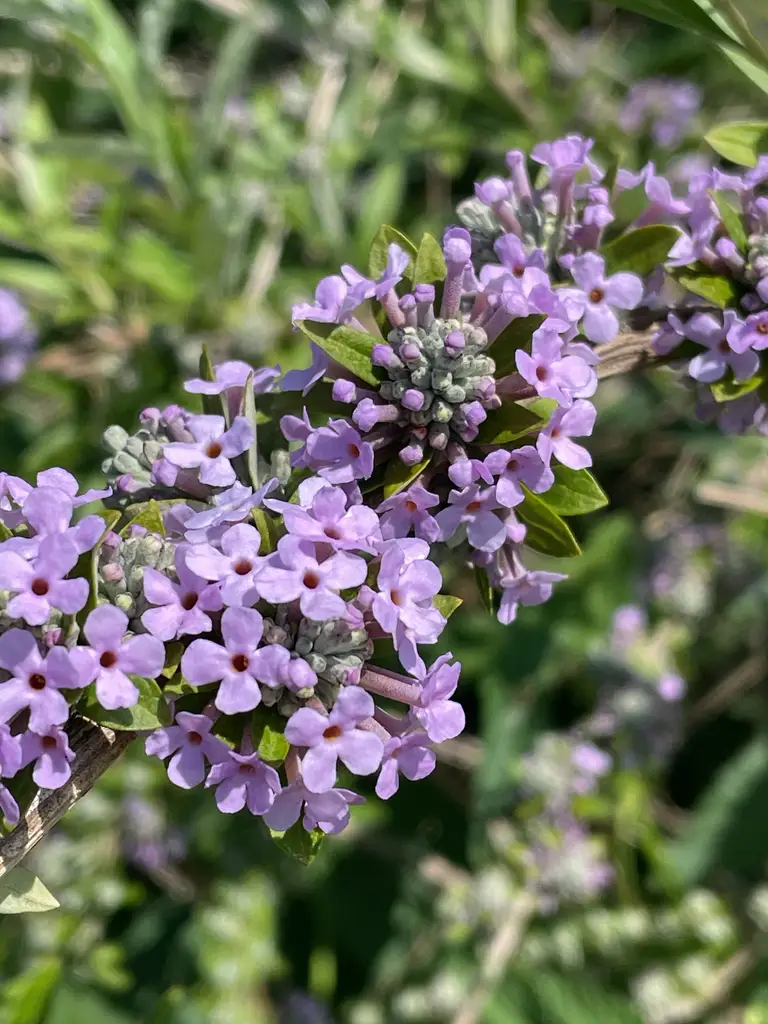
- Flowers: tiny four-petaled flowers, often purple with an orange center, packed into cone-shaped spikes (panicles) 4 to 10 inches long. White, pink, red and yellow cultivars exist.
- Seeds: small, winged seeds in brown capsules left on the old flower spike.

Not sure what you have? Upload a clear daylight photo of a flower spike to our flower identifier, or a photo of a single leaf to the leaf identifier. Photo identification, including our tools, can be wrong, so confirm the result with the features listed here.
Butterfly Bush vs Lilac and Other Buddleja Species
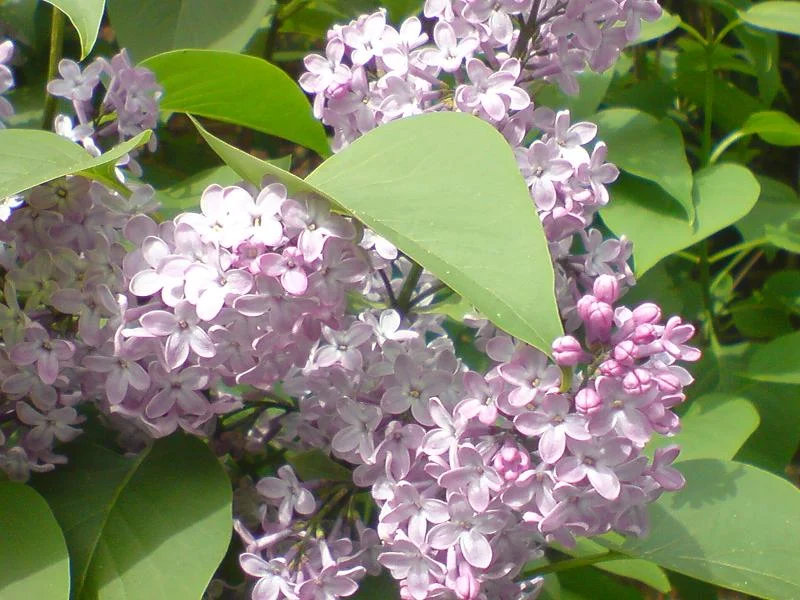
Butterfly bush is often called “summer lilac,” and many people confuse it with common lilac (Syringa vulgaris, family Oleaceae). The care is different, so it matters which one you have. Bloom season and leaf shape are the fastest checks.
| Feature | Butterfly bush (Buddleja davidii) | Fountain butterfly bush (Buddleja alternifolia) | Common lilac (Syringa vulgaris) |
|---|---|---|---|
| Family | Scrophulariaceae | Scrophulariaceae | Oleaceae |
| Leaf arrangement | Opposite | Alternate | Opposite |
| Leaf shape | Long, narrow, pointed; fuzzy white underside | Small, narrow, gray-green | Oval to heart-shaped, 2 to 5 in, smooth |
| Flowers | Long cone-shaped spikes on new stems | Clusters along last year’s weeping stems | Pyramid-shaped clusters, strongly scented |
| Bloom time | Midsummer to frost | Late spring to early summer | Spring (around May) |
| When to prune | Hard, in early spring | Lightly, right after flowering | Right after flowering |
The lilac details come from UMass Extension’s lilac identification page. If your shrub flowers in spring with heart-shaped leaves, it is a lilac, and the hard spring prune below would remove its flower buds.
Where and When to Plant a Butterfly Bush
Plant a butterfly bush in the sunniest spot you have, sheltered from strong wind. Proven Winners recommends at least 8 hours of direct sun and never fewer than 6, even in hot climates. In shade, the plant grows thin and flowers poorly.
Wind matters more than most guides say. The RHS warns that long branches can snap in summer gales and that the whole bush can rock, opening a gap around the base that exposes the roots. A spot near a fence or wall solves this.
Spring is the best planting time because the plant gets a full season to root before winter. In cold regions (USDA zones 5 and 6), plant between spring and midsummer. If a potted plant is still waiting at the end of the season, the gardening channel Garden Answer points out that it is better to plant it than leave it, because soil insulates the roots far better than a thin nursery pot. For general timing rules for woody plants, see our guide on the best time to plant trees.
Soil and Drainage (Including Clay)
Drainage is the single most important soil factor. According to Proven Winners, most butterfly bushes lost over winter die from sitting in cold, wet soil in autumn or spring, not from low temperatures. The RHS reports the same: roots rot in waterlogged soil.
If you have heavy clay:
- Do not dig a deep hole and fill it with rich compost. That creates a basin that collects water around the roots.
- Set the plant slightly high, with the top of the root ball an inch or two above the surrounding soil, so water runs away from the stem.
- Consider a raised bed or a spot near a house wall, both suggested by the RHS for wet sites.
- Keep mulch a few inches away from the main stems.
How to Plant
- Water the plant in its pot an hour before planting.
- Dig a hole two to three times wider than the root ball but only as deep as the root ball (shallower in clay).
- Loosen circling roots gently and set the plant so it sits at the same depth it grew in the pot, or slightly higher in clay.
- Backfill with the soil you removed and firm it lightly to remove air pockets.
- Water slowly and deeply, then add a 2 inch (5 cm) layer of mulch, keeping it off the stems.
Watering and Feeding a Butterfly Bush
A new butterfly bush needs steady moisture; an established one needs very little. The RHS advises keeping the soil moist but not soggy for about 18 months after planting, after which the plant should cope on rainfall alone in most climates. During long summer dry spells, a deep soak once a week is enough.
From caring for my own indoor plants, I have learned that checking the soil before watering is what prevents overwatering. The same habit is the safest way to water a butterfly bush: push a finger or trowel 4 to 5 inches into the soil near the roots, and water only if it feels dry at that depth.
Overwatering shows up as weak stems, fewer flowers and dieback, according to Proven Winners. If you use irrigation, check that it is not running on the butterfly bush every day.
Fertilizer is rarely needed. The RHS says no feeding is required on fertile soil; a yearly layer of compost or well-rotted manure is enough. Heavy feeding pushes soft leafy growth at the expense of flowers. Plants in pots are the exception (see the container section below).
How to Prune a Butterfly Bush
Buddleja davidii flowers on stems that grow in the current year, so a hard prune in early spring gives you more flowers at eye level. Without pruning, the plant keeps adding height and the flowers form only at the very top.
When to Prune Each Type
Different Buddleja species flower on different wood, so check which one you have before you cut. The timings below follow the RHS and Clemson Extension.
| Type | Flowers on | When to prune | How hard |
|---|---|---|---|
| Buddleja davidii and cultivars | New growth | Early spring, once buds swell (late March to mid April in the UK) | Hard, to a low framework of stems |
| Buddleja × weyeriana | New growth | Early spring | Hard |
| Dwarf types (Buzz, Lo & Behold, Pugster) | New growth | Early spring | Lighter; shape and reduce |
| Buddleja alternifolia | Last year’s stems | Right after flowering, early to mid summer | Light; thin old stems |
| Buddleja globosa (orange ball tree) | Last year’s stems | Late winter, only if needed | Minimal; shorten overlong branches |
Avoid autumn and winter pruning of Buddleja davidii. Clemson Extension notes that it increases the risk of cold damage, because fresh cuts and any soft regrowth face frost with no protection.
Step-by-Step Hard Prune
- Wait for buds. Prune only after you see green buds swelling on the stems, so you know which wood survived winter.
- Use clean, sharp tools. Bypass pruners for thin stems, loppers or a pruning saw for thick ones.
- Remove dead wood first. Cut out stems that snap when bent or show no buds.
- Cut the rest low. Shorten each healthy stem to 1 to 3 ft (30 to 90 cm) from the ground, just above a pair of healthy buds. Clemson recommends going to within about 1 ft for the best display; leave more height if you want a taller shrub.
- Thin the center. Take out weak, spindly and crossing stems so air and light reach the middle.
- Finish with compost. Spread a thin layer of compost and fresh mulch, kept away from the stems.
An overgrown bush that has not been pruned for years can be cut back hard in one go. The RHS notes that even after hard annual pruning, Buddleja davidii typically regrows to about 6 to 8 ft (1.8 to 2.4 m) by late summer.
Deadheading and Seed Control
Deadheading means cutting off faded flower spikes, and it does two jobs. It can bring a second flush of smaller flowers, and it stops seed from forming. Cut each spent spike back to the first pair of leaves below it.
Seed control is the more important job. The Washington State Noxious Weed Control Board reports that one flower head can produce around 40,000 seeds, that plants can set seed in their first year, and that seeds stay viable for 3 to 5 years. If you grow a seed-producing type, remove spikes before they turn brown.
Year-Round Butterfly Bush Care Calendar
Use the season column first; the month columns are a guide for temperate climates. In mild or tropical climates, the plant may stay partly evergreen, so time the hard prune for the end of your coolest season.
| Season | Northern Hemisphere | Southern Hemisphere | Tasks |
|---|---|---|---|
| Late winter | Feb to Mar | Aug to Sep | Leave stems standing. Check for buds. Prune B. globosa lightly if needed. |
| Early spring | Mar to Apr | Sep to Oct | Hard prune B. davidii once buds swell. Add compost and mulch. |
| Late spring | May | Nov | Plant new shrubs. Be patient with late leaf-out. |
| Early summer | Jun | Dec | Take softwood cuttings. Water new plants in dry weather. Prune B. alternifolia after it flowers. |
| Midsummer | Jul to Aug | Jan to Feb | Deadhead weekly. Water deeply in long dry spells. Check leaf undersides for mites. |
| Autumn | Sep to Oct | Mar to Apr | Remove remaining seed heads. Take semi-ripe cuttings. No hard pruning. |
| Winter | Nov to Jan | May to Jul | Leave the plant alone. Take hardwood cuttings if wanted. Protect pots from hard frost. |
Is My Butterfly Bush Dead? How to Check
Probably not, if it is still spring. Butterfly bush is one of the last shrubs to leaf out, and Proven Winners notes that in cold climates it may show no sign of life until early June. Many gardeners pull out healthy plants in April for this reason.
- Bend a thin stem. A living stem bends; a dead one snaps cleanly and is dry and brown inside.
- Look low. In cold winters the top can die while new shoots appear from the base. Clemson notes the plant often resprouts vigorously from the crown after being killed to the ground.
- Wait until early summer. If there are no buds or shoots anywhere by then, the plant has likely died, most often from wet roots over winter.
- Cut out dead wood only. Once green shoots appear, prune the dead stems back to the live growth.
Why Isn’t My Butterfly Bush Blooming?
A healthy butterfly bush should flower from midsummer until frost. When it does not, one of these causes is usually responsible.
| What you see | Likely cause | What to do |
|---|---|---|
| Thin growth, few pale flowers | Less than 6 hours of sun | Move it to full sun or remove the shade source |
| Lush leaves, almost no flowers | Too much fertilizer or very rich soil | Stop feeding; mulch only |
| Flowers only at the very top | No pruning for a year or more | Hard prune next early spring |
| Late, sparse flowering after a summer cut | Pruned after new shoots had grown | Prune in early spring only |
| First season after planting, few flowers | Roots still establishing | Water steadily and wait one season |
| Weak stems, dieback, few flowers | Overwatering or poor drainage | Water less; improve drainage or replant high |
| Fountain-shaped shrub, no spring flowers | B. alternifolia pruned in spring | Prune only after it flowers |
Butterfly Bush Pests and Diseases
Butterfly bushes are rarely troubled when they have sun and good drainage. Most problems start with stress: drought, wet roots or crowding. Clemson Extension advises against spraying pesticides while the plant is in bloom because of the many beneficial insects visiting it.
| Symptom | Cause | Response |
|---|---|---|
| Fine pale speckles on leaves, fine webbing, bronze leaves | Spider mites, mostly on drought-stressed plants | Water deeply; hose leaf undersides; insecticidal soap if severe |
| Curled, puckered leaves with pale or yellow patches | Aphids (reported increasingly in the UK since 2023, per the RHS) | Hose off; encourage ladybirds; see our aphid control guide |
| Distorted or holed shoot tips | Capsid bugs or figwort weevil (common in the UK) | Remove damaged tips; usually cosmetic |
| Yellow leaves, stunted growth, knobbly roots | Root-knot nematodes, mainly in sandy soils | Improve soil organic matter; replace badly affected plants |
| Yellow patches on top of leaves, gray fuzz underneath | Downy mildew (Peronospora hariotii) in cool, damp weather | Water at the base in the morning; improve airflow; remove infected leaves |
| Wilting with wet soil, blackened roots | Root rot from waterlogging | Water less; replant higher or in a raised bed |
Yellow leaves can also come from simple watering or nutrient issues. Our guide on why plant leaves turn yellow walks through the common causes.
Growing a Butterfly Bush in a Pot
Dwarf butterfly bushes grow well in containers, and a pot also limits where seed can land. Choose a compact type such as the Buzz, Lo & Behold or Pugster series, which typically stay around 2 to 4 ft tall.
- Pot: start with a large pot with several drainage holes. The RHS says plants eventually need a pot about 2 ft (60 cm) wide.
- Mix: use a fast-draining potting mix, never garden soil, which stays too wet in a container.
- Feeding: add slow-release fertilizer once a year, or a liquid feed from April to September (Northern Hemisphere).
- Water: pots dry out faster than the ground, so check the mix more often in summer.
- Repotting: repot every 2 to 3 years.
- Winter: in cold areas, wrap the pot with fleece or move it against a sheltered wall.
For more on choosing pots and mixes, read our guide to growing flower plants in pots.
Is Butterfly Bush Invasive? What “Seedless” Means
Yes, Buddleja davidii is invasive in parts of North America, Europe and other regions, mainly in mild, moist climates where its wind-blown seed takes hold on riverbanks, roadsides and disturbed ground. It is listed as a Class B noxious weed in Washington State, and Oregon allows sale of only approved seedless cultivars.
“Seedless” or “sterile” has a precise meaning there. The Washington State Noxious Weed Control Board defines accepted sterile cultivars as those producing less than 2% viable seed, not zero. The Oregon Department of Agriculture keeps the official list, which includes several Flutterby and Chip types; hybrids such as ‘Miss Molly’ and ‘Miss Ruby’ are not regulated there.
If you already grow a seed-producing butterfly bush:
- Deadhead every spike before it browns.
- Pull seedlings while small.
- Do not leave pruned stems on bare ground, because cut stems can root.
- Check your local extension service or council for rules where you live.
Also keep in mind that butterfly bush feeds adult butterflies with nectar but does not feed caterpillars. Planting native caterpillar host plants alongside it supports the whole life cycle. For another garden plant that needs containing, see our Ruellia (Mexican petunia) care guide.
Is Butterfly Bush Toxic to Pets or People?
Butterfly bush is not known to be toxic. The Washington State Noxious Weed Control Board lists its toxicity as “not known to be.” Clemson Extension notes that the foliage can irritate sensitive skin, so wear gloves when pruning if you react to it.
“Not known to be toxic” does not mean edible. Any plant material can upset a pet’s stomach, so discourage chewing. If a person or pet eats part of a plant and shows symptoms, contact a poison control center or your vet, such as the ASPCA Animal Poison Control line in the US. For comparison, a shrub that is genuinely dangerous is oleander; see our oleander care and safety guide.
Butterfly Bush Care in Different Climates
The basics stay the same everywhere, but the details shift with your climate.
- Cold winters (USDA zones 5 to 6, inland Europe): the top may die back to the ground. Plant in spring, keep the crown well drained, and wait until early summer before judging winter damage.
- Wet, mild winters (UK, Pacific Northwest): winter wet is the main risk, not frost. Use raised beds or slopes, and control seed carefully, because these are the regions where it spreads most.
- Hot, humid summers (US Southeast): Clemson notes nematodes are a problem in sandy coastal soils, and University of Florida extension has noted the plant struggles on the sandy coast. Inland, heavier soil sites suit it better.
- Hot, dry summers: the plant tolerates heat once rooted, but drought stress invites spider mites. Water deeply in long dry spells and mulch to keep roots cooler.
- Frost-free climates (zone 8 and warmer): the bush can stay partly evergreen and grow large. Proven Winners advises cutting back harder each spring the warmer your climate is.

How to Check Your Own Butterfly Bush
Watching a plant regularly and adjusting care to what it shows you is the habit I rely on most with my own plants. A five-minute check each month catches nearly every butterfly bush problem early:
- Count sun hours on a clear day in summer. Under 6 hours explains weak flowering.
- Test the soil 4 to 5 inches down before watering. Water only if it is dry.
- Look under leaves for webbing, speckling or clusters of aphids.
- Check the spikes and remove any that are fading before seed forms.
- Confirm the species if pruning results surprise you. A clear photo of the flowers in our flower identifier can help, but treat any app result as a starting point, not a final answer.
Video: Butterfly Bush Care Tips
This video from Garden Answer shows how to site, plant, water and prune a butterfly bush, including how to plant in clay soil.
The Bottom Line
Butterfly bush care comes down to full sun, fast drainage, very little feeding and one well-timed hard prune in early spring. Confirm which Buddleja you have before cutting, be patient with late leaf-out, and deadhead seed-producing types every week in summer. Do those things and the shrub will flower from midsummer to frost without spreading where it is not wanted.
Frequently Asked Questions
Should I cut my butterfly bush back in the fall?
No. Leave Buddleja davidii standing over winter and prune it in early spring once buds swell. Autumn pruning increases the risk of cold damage. In autumn, only remove seed heads and any broken branches.
Is a butterfly bush the same as butterfly weed?
No. Butterfly bush (Buddleja) is a woody shrub. Butterfly weed usually means Asclepias tuberosa, a herbaceous milkweed that also feeds monarch caterpillars.
How fast does a butterfly bush grow?
Very fast. Clemson Extension notes it can reach mature size in one to two growing seasons, and even after a hard spring prune it typically regrows to about 6 to 8 ft by late summer.
Can I grow a new butterfly bush from a cutting?
Yes. The RHS says softwood cuttings in early summer and semi-ripe cuttings from midsummer root readily, and hardwood cuttings can be taken from autumn to midwinter. Where butterfly bush is regulated, take cuttings only from approved seedless cultivars.
Do butterfly bushes feed caterpillars?
No. The flowers give nectar to adult butterflies, bees and some hummingbirds, but the leaves are not a food plant for caterpillars. Add native host plants such as milkweed to support the full butterfly life cycle.
Is butterfly bush evergreen?
It is deciduous in cold climates and semi-evergreen in mild ones. In USDA zone 8 and warmer it may keep many leaves through winter.
Featured image: Photo: Ввласенко / Wikimedia Commons, CC BY-SA 3.0