Maui Ixora Care: Sun, Acid Soil, Feeding and Winter Protection
Maui ixora is a compact tropical shrub that stays covered in round flower clusters for most of the warm season, but only when its soil, sun and feeding are right. This guide gives you the exact care routine, explains why leaves turn yellow, and shows how to protect the plant in winter wherever you live.
Quick Answer: How to Care for Maui Ixora
Grow Maui ixora in at least 6 hours of direct sun, in moist, well-drained, acidic soil (pH about 5.0 to 6.0). Water when the top 2 to 3 inches of soil feel dry, and feed with a slow-release fertilizer for acid-loving plants in late spring and again in early fall. Prune once in early spring, protect it from frost, and correct yellow leaves with chelated iron or manganese rather than more general fertilizer.
- Light: full sun for the most flowers; part shade gives fewer blooms.
- Soil: acidic, rich in organic matter, away from concrete.
- Water: evenly moist, never soggy.
- Climate: outdoors year-round only in frost-free areas (roughly USDA zones 10 to 11; 9b with protection).
- Size: usually kept at 2 to 3 feet tall and wide.
What Is Maui Ixora?
Maui ixora is a cultivar series of Ixora, a genus in the coffee family (Rubiaceae), sold as ‘Maui Red’, ‘Maui Yellow’ and ‘Maui Sunset’. Nurseries label it in different ways: some list it as Ixora coccinea ‘Maui Red’, Chalet Nursery calls it an interspecific hybrid, and Top Tropicals describes ‘Maui Sunset’ as a hybrid of Ixora chinensis. Its exact parentage is not published by an extension service, so treat it as a hybrid ixora with the same care needs as its parents.
The parent species are native to tropical Asia. According to NC State Extension, Ixora coccinea comes from India, Sri Lanka, Bangladesh and Indochina, and is also called jungle geranium, flame of the woods and jungle flame.
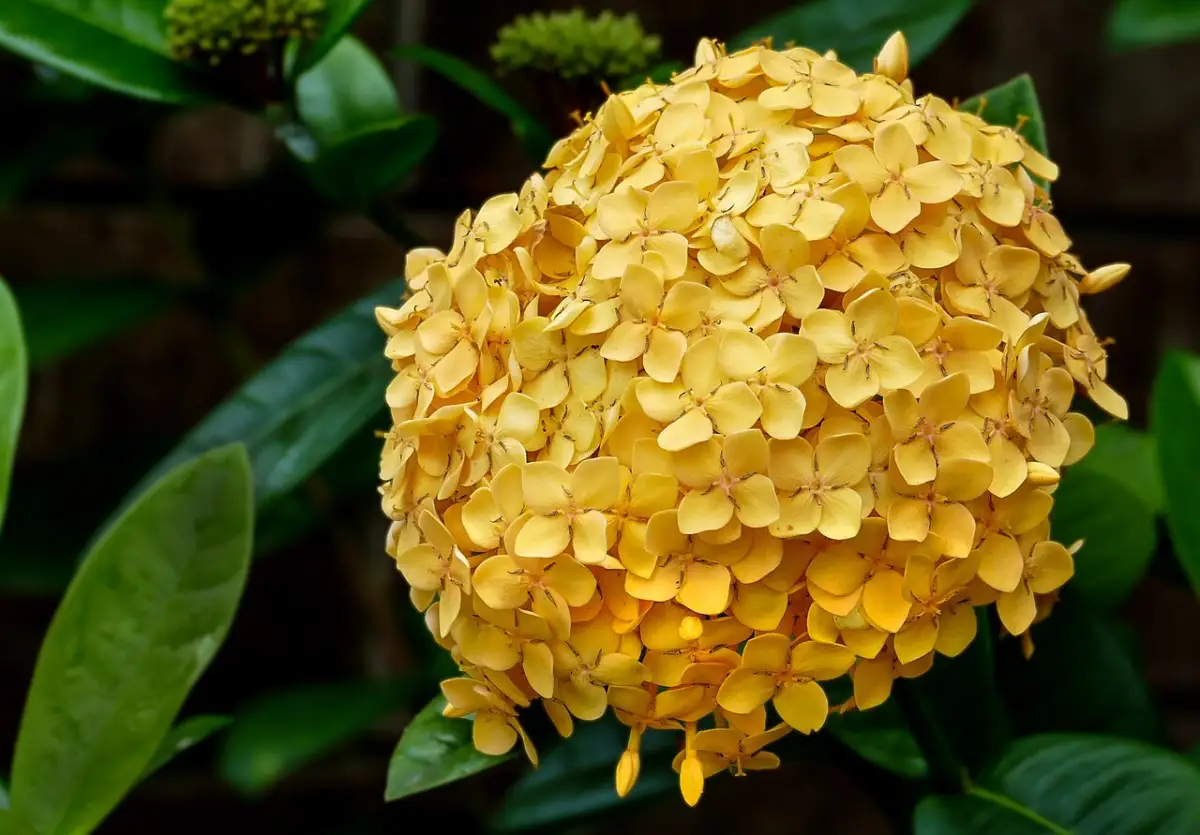
Maui is not a true dwarf. The South Florida Plant Guide describes Maui as a moderate grower kept at about 2.5 to 3 feet, with larger leaves than the slow, boxwood-like dwarf ixora that stays under 2 feet. Unpruned, some nurseries say it can top 3 feet.
How to Identify Maui Ixora
You can recognize Maui ixora by features you can check with your own eyes:
- Leaves: simple, glossy, leathery, oval to oblong, with smooth edges, set opposite each other on the stem. New growth can be bronze.
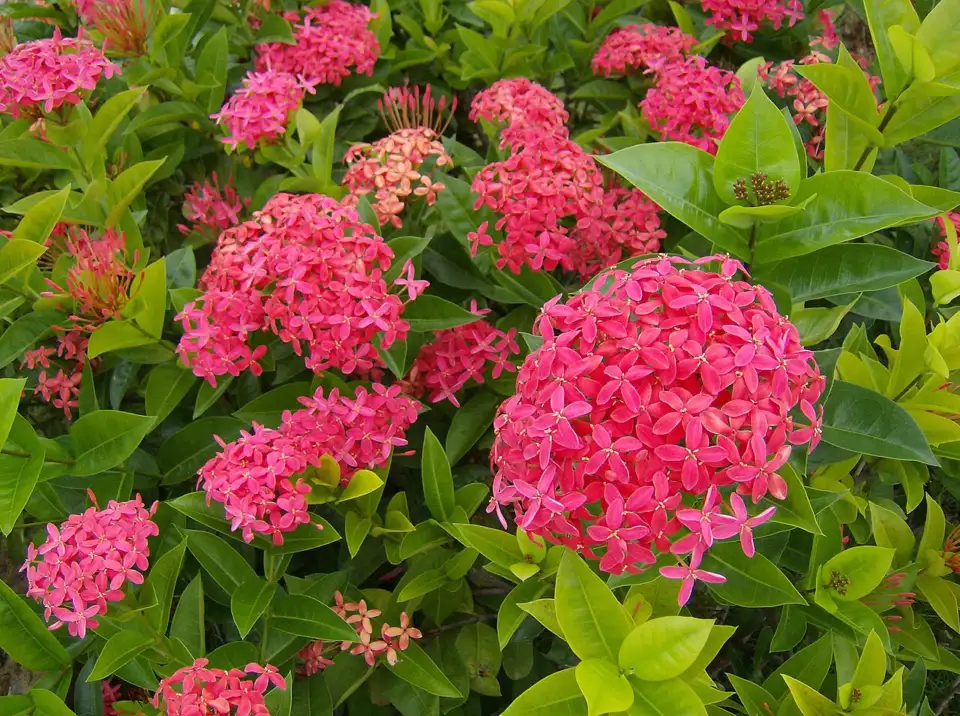
- Flowers: slender tubes ending in 4 small petals, packed into rounded clusters at the branch tips.
- Colors: red-orange (Maui Red), golden yellow with an orange tint (Maui Yellow), or butter yellow to peach (Maui Sunset).
- Habit: rounded, multi-stemmed, evergreen shrub about 2 to 3 feet tall.
- Fruit: small round berries that turn dark purple to black, often few on garden plants.
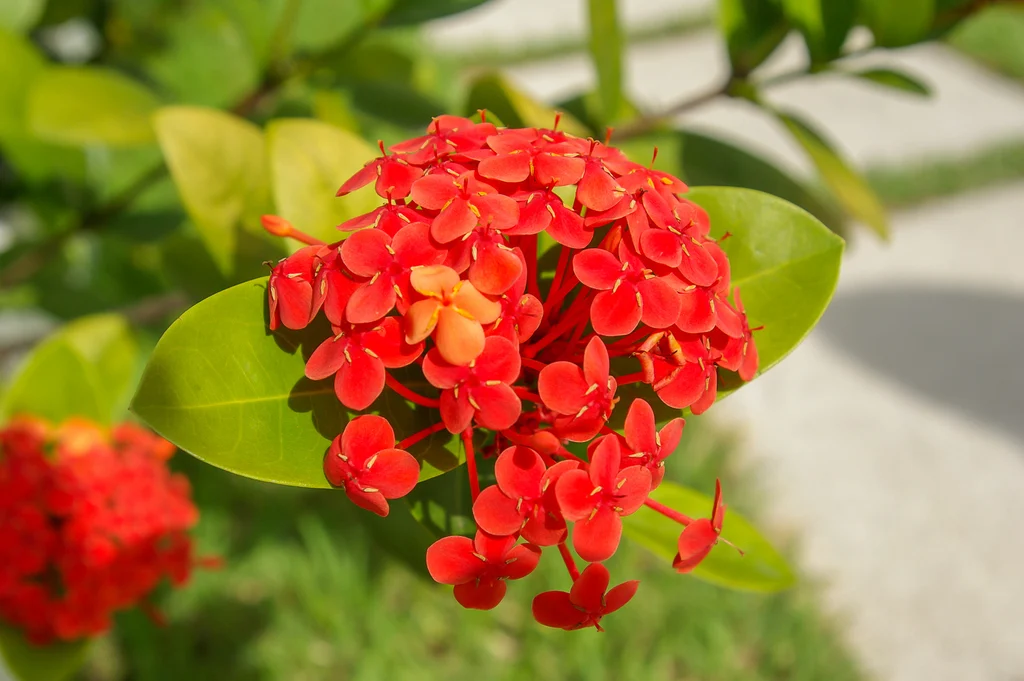
Several ixoras look alike in a garden center. The table below shows how to tell them apart.
| Plant | Scientific name | Height kept | Leaves | Petals | Typical colors |
|---|---|---|---|---|---|
| Maui ixora | Ixora ‘Maui’ (hybrid) | 2 to 3 ft | Medium, glossy, oval | 4, tips fairly rounded | Red-orange, yellow, peach |
| Dwarf ixora (Taiwanese) | Ixora chinensis dwarf forms | Under 2 ft | Small, boxwood-like | 4, rounded | Red, orange, pink, yellow, white |
| Jungle geranium | Ixora coccinea | 4 to 6 ft (more if unpruned) | 1.5 to 3 in, often stalkless | 4, pointed | Scarlet, red |
| Nora Grant ixora | Ixora ‘Nora Grant’ | 3 to 4 ft | Larger, dark green | 4 | Hot pink |
Petal shape is the most useful single clue: Top Tropicals notes that Ixora chinensis has rounded petals while Ixora coccinea has pointed ones. If your plant came without a tag, take a clear daylight photo of one flower cluster and the leaves and try our flower identifier or leaf identifier.
Maui Ixora Care at a Glance
| Need | What to give it | Why it matters |
|---|---|---|
| Light | 6+ hours direct sun | More sun means more flower clusters |
| Soil pH | About 5.0 to 6.0 | Higher pH locks up iron and manganese |
| Water | When top 2 to 3 in are dry | Steady moisture without root rot |
| Fertilizer | Acid-forming slow release, late spring and early fall | Supports blooms and green leaves |
| Micronutrients | Chelated iron or manganese as needed | Fixes yellow new growth |
| Pruning | One main cut in early spring | Flowers form on new tips |
| Temperature | Best above 50°F; frost damages it | Tropical plant |
| Pets | Listed non-toxic by ASPCA (I. coccinea) | Safer choice for yards with pets |
How Much Sun Does Maui Ixora Need?
Maui ixora flowers best in full sun, meaning at least 6 hours of direct light a day. UF/IFAS Gardening Solutions says full sun gives maximum flowering and that partial shade is tolerated.
In practice, shade costs you flowers and leaf color, not the plant. The Backyard Gardening YouTube channel compares two ixoras side by side: one in full sun with dark, glossy leaves and one under a bougainvillea with 3 to 4 hours of sun and paler leaves, though it still bloomed. In very hot climates, a little afternoon shade is fine. The same balance applies to other sun-loving shrubs such as tropical hibiscus.
Soil and pH: The Key to Green Leaves
Maui ixora needs acidic soil, and most care problems start when the pH is too high. UF/IFAS Extension Charlotte County recommends a pH of about 5, and NC State lists a pH below 6.0. Above that range, the roots cannot take up iron and manganese even when they are in the soil.
- Test first. Use a soil test from your local extension office or a reliable kit to know your starting pH.
- Add organic matter. UF/IFAS Charlotte suggests mixing about one-third compost or peat moss into the bed.
- Lower pH with elemental sulfur, following the label rate for your soil type.
- Mulch with pine bark or pine straw, kept a few inches from the stems.
- Retest once or twice a year, because alkaline soils tend to drift back up.
Why Concrete and Rock Mulch Cause Yellow Leaves
Concrete foundations, sidewalks and buried construction debris release lime that raises the pH of nearby soil. UF/IFAS warns that ixora does poorly in alkaline spots near sidewalks and foundations, and that rock mulch can raise pH too. Planting Maui ixora at least 2 feet from the house, and screening out concrete chunks, prevents a lot of yellowing. For yellow leaves on other plants, see our guide to why plant leaves turn yellow.
How Often to Water Maui Ixora
Water Maui ixora when the top 2 to 3 inches of soil are dry, so the soil stays evenly moist but never soggy. Growers Outlet suggests waiting until the top 3 inches are dry, while new plants need more regular water for their first few months.
I have learned that checking the soil before watering helps prevent overwatering and keeps plants healthy, and it works well for ixora. Push a finger into the soil near the root ball instead of watering on a fixed calendar. Pots in summer heat may need water every day or two, while in-ground plants in cooler months need far less.
- Water the soil, not the leaves, to reduce leaf spot.
- Make sure the pot or bed drains freely; standing water leads to root rot.
- Expect slower growth and lower water use when nights drop below about 60°F.
Fertilizer Schedule for Maui Ixora
Feed established Maui ixora with a slow-release granular fertilizer made for acid-loving plants, such as an azalea or gardenia formula. UF/IFAS Charlotte recommends applying it about once in May and once in October, following the label, and adding a liquid micronutrient foliar spray in summer.
More fertilizer does not fix yellow leaves caused by high pH. If new leaves are yellow with green veins, use a chelated iron or manganese product, which the UF/IFAS ixora fact sheet (FP291) notes can correct and help prevent chlorosis. Keep granules and sprays off concrete and pavers, because they can stain.
Pruning Maui Ixora for More Flowers
Prune Maui ixora once a year in early spring, as new growth begins, because flowers form at the tips of new shoots. UF/IFAS notes that frequent shearing reduces flowering, so a tightly clipped hedge will bloom less.
- Wait until the risk of frost has passed (late winter to early spring).
- Cut back leggy or frost-damaged stems to just above a pair of leaves.
- Remove dead, crossing or weak branches from the center.
- Through the season, pinch stem tips lightly and snip off faded clusters to encourage new ones.
Each flower cluster can stay attractive for weeks. The Backyard Gardening channel reports that ixora clusters often last 4 to 5 weeks or more on the plant.
Growing Maui Ixora in Containers
Maui ixora grows well in pots, which is the best option where winters bring frost. Use a container with drainage holes and an acidic potting mix, such as one sold for azaleas, or regular mix blended with peat or pine bark fines.
- Choose a pot 2 to 4 inches wider than the root ball; Growers Outlet notes the plant tolerates being slightly root-bound.
- Check moisture daily in hot weather, since pots dry faster than beds.
- Feed lightly and more often in pots, following the label, because nutrients wash out with watering.
- In cold regions, you can sink the whole pot into a garden bed for summer and lift it in fall.
For general container tips, read how to grow flower plants in pots.
Cold Tolerance and Winter Care
Maui ixora is a tropical shrub that is damaged by frost. UF/IFAS lists Central and South Florida as ixora country, with zone 9B as the northern limit, and suggests that ‘Maui’ may be somewhat more cold tolerant than other ixoras. NC State notes that Ixora coccinea dislikes temperatures below 50°F and can die back in freezes, often regrowing from the roots.
Real-world reports match this. On the PalmTalk forum, a gardener in zone 9a Mississippi reports that Maui Red and Maui Sunset usually die back to the ground at the first hard freeze without heavy protection.
| Your climate | What to do |
|---|---|
| Frost-free (zones 10 to 11, Hawaii, South Florida, tropical Asia) | Grow in the ground year-round |
| Occasional light frost (zone 9b) | Plant near a south wall, mulch, cover with frost cloth on cold nights |
| Regular freezes (zone 9a and colder) | Grow in a pot and move indoors, or treat as a summer annual |
To overwinter a potted plant indoors:
- Bring it in before night temperatures fall below about 50°F.
- Check the leaves and stems for aphids, scale and mealybugs first.
- Place it in your brightest window, ideally facing south.
- Water less often, only when the top few inches are dry, and stop fertilizing.
- Move it back outside gradually once nights stay above 50°F.
Some leaf drop indoors is normal. I believe observing plants regularly and adjusting their care to what they show you is essential, and an overwintering ixora is a good example: water and light needs change week to week.
Year-Round Maui Ixora Care Calendar
| Season (Northern Hemisphere) | Tasks |
|---|---|
| Late winter to early spring | Main pruning after frost risk; test soil pH; refresh mulch |
| Late spring (May) | Apply acid-forming slow-release fertilizer; move pots outside |
| Summer | Water regularly; micronutrient foliar spray; pinch tips; check for pests |
| Early fall (October) | Second fertilizer application; watch for purple leaf spots |
| Winter | Protect from frost or bring indoors; reduce watering |
In the Southern Hemisphere, shift these tasks by six months. In tropical climates with a monsoon season, the busiest growth and flowering usually follow the warm, wet months.
Troubleshooting Maui Ixora by Symptom
Most Maui ixora problems can be traced to soil pH, cold, light or pruning. Use this table to match what you see with the likely cause.
| What you see | Likely cause | What to do |
|---|---|---|
| Yellow new leaves with green veins | Iron or manganese deficiency from high pH (UF/IFAS) | Test pH, add sulfur and organic matter, apply chelated iron or manganese |
| Purple-red spots on older leaves | Phosphorus and potassium deficiency, often in cool winters (UF/IFAS) | Use a complete acid fertilizer on schedule |
| Few or no flowers | Too little sun, frequent shearing, or cool season | Move to full sun, prune once a year, wait for warm weather |
| Leaves dropping in winter | Cold stress | Protect from frost; prune damage in spring |
| Black, sooty coating on leaves | Sooty mold growing on honeydew from aphids or scale | Treat the insects; wash leaves with soapy water |
| Wilting with wet soil | Root rot from poor drainage | Improve drainage, water less |
| Leggy, sparse stems | Shade or no pinching | More sun, pinch tips, early spring cut back |
Common Pests and Diseases
The main pests of ixora are aphids, scale insects, mealybugs and thrips, and the main diseases are sooty mold and root rot. NC State also lists bagworms, nematodes and mushroom root rot for Ixora coccinea.
- Aphids: small soft insects on new tips. Spray them off with water or use insecticidal soap. See how to get rid of aphids.
- Scale and mealybugs: bumps or white cottony spots on stems. Wipe with rubbing alcohol on a cotton swab, then use horticultural oil or insecticidal soap.
- Sooty mold: a sign of sap-sucking insects. UF/IFAS notes that beneficial insects often control them, but soap sprays may be needed.
- Nematodes: stunted plants in sandy soil. Add organic matter and keep plants well watered and fed.
- Root rot: caused by soggy soil. Prevent it with good drainage.
Is Maui Ixora Safe for Pets and Kids?
The ASPCA lists Ixora coccinea (flame of the woods) as non-toxic to dogs, cats and horses, and NC State tags it as non-toxic to pets. The ASPCA does not list the Maui hybrid separately, so treat this as a good sign rather than a guarantee for every cultivar.
Non-toxic does not mean edible. Pets can still get an upset stomach from chewing plants, and children should not eat any garden plant. If a person or pet eats a plant and shows symptoms, contact your poison control center or your vet right away.
Checking Your Plant with a Photo
If you are not sure your shrub is a Maui ixora, a photo can help narrow it down. Take a sharp daylight photo of a full flower cluster, then a second photo of the leaves and stem, and upload them to our flower identifier.
Photo identification, including our tool, can be wrong, especially between closely related cultivars like Maui and other hybrid ixoras. When safety matters, such as a child or pet eating a plant, confirm with your local extension office, a nursery expert or poison control.
Video: Ixora Care Tips for More Flowers
This video from Backyard Gardening shows how sun exposure changes ixora leaf color and walks through propagation from stem cuttings.
Final Thoughts
Maui ixora rewards a simple routine: full sun, acidic soil, steady moisture, two feedings a year and one spring pruning. Get the pH right first, because it solves the yellow leaves that frustrate most growers, and plan ahead for winter if you live where frost is possible.
Frequently Asked Questions
Is Maui ixora a dwarf ixora?
No. Maui ixora is a moderate grower usually kept at 2 to 3 feet tall, with larger leaves than true dwarf ixora (Ixora chinensis forms), which stays under 2 feet and has small, boxwood-like leaves.
Why are my Maui ixora leaves turning yellow?
Yellow new leaves with green veins usually mean iron or manganese deficiency caused by soil pH above about 6. Test the soil, lower pH with sulfur and organic matter, and apply chelated iron or manganese.
How often should I fertilize Maui ixora?
Feed established plants with a slow-release fertilizer for acid-loving plants about twice a year, in late spring and early fall, following the label. A summer micronutrient spray helps keep leaves green.
Can Maui ixora survive winter?
Only in frost-free or nearly frost-free areas (about USDA zones 10 to 11, or 9b with protection). Frost damages it, so in colder areas grow it in a pot and bring it indoors before nights drop below about 50°F.
Is Maui ixora toxic to dogs and cats?
The ASPCA lists Ixora coccinea as non-toxic to dogs, cats and horses. The Maui hybrid is not listed separately, so call your vet if a pet eats it and shows symptoms.
When should I prune Maui ixora?
Do the main pruning once in early spring after frost risk passes. Frequent shearing removes the new tips where flowers form, so pinch lightly during the season instead.