Dipladenia Care Guide: Keep It Blooming From Summer Through Winter
Dipladenia is the bushy, glossy-leaved tropical plant sold in hanging baskets and patio pots, covered in red, pink or white trumpet flowers. It is easy to keep blooming all summer once you get three things right: plenty of sun, careful watering and warmth. This guide gives you clear numbers for each, a symptom table for when things go wrong, and a winter plan for every climate.
Quick Answer: How to Care for Dipladenia
Give dipladenia at least 6 hours of sun a day (with afternoon shade in very hot climates), water only when the top 1 to 2 inches of potting mix feel dry, and feed it every 2 to 4 weeks from spring to late summer. Keep it above 50°F (10°C). It is hardy outdoors only in USDA zones 10 to 11; everywhere colder, bring it indoors or treat it as a summer annual.
| Care need | What dipladenia wants |
|---|---|
| Light | 6+ hours of sun outdoors; the brightest window indoors |
| Water | When the top 1 to 2 inches are dry; less in winter |
| Soil | Fast-draining potting mix, pH about 6.0 to 8.0 |
| Temperature | Best at 65 to 70°F (18 to 21°C) nights; protect below 50°F (10°C) |
| Hardiness | USDA zones 10 to 11; frost kills the top growth |
| Feeding | Liquid bloom fertilizer every 2 to 4 weeks in the growing season |
| Pruning | Pinch young tips; cut back in late winter or early spring |
| Safety | Milky sap can irritate skin; keep away from pets and children |
What Is Dipladenia and How Do You Recognize It?
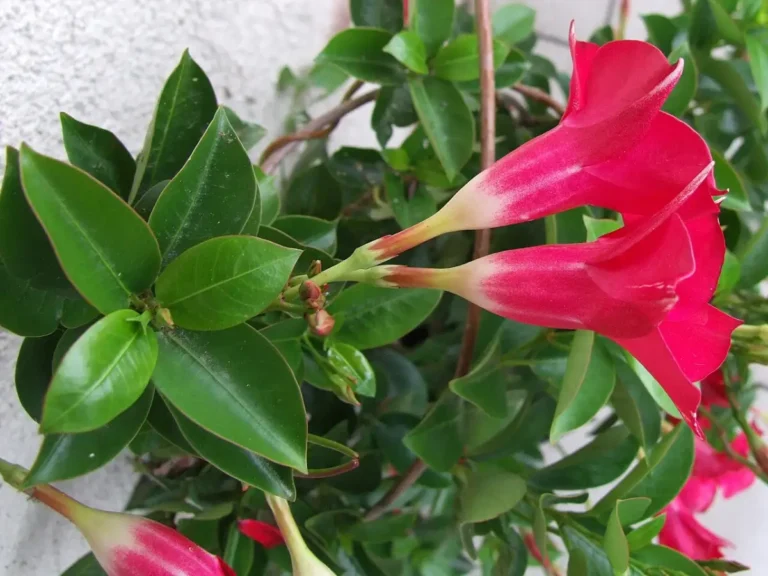
Dipladenia is the trade name for compact, bushy forms of mandevilla, mainly Mandevilla sanderi, also called Brazilian jasmine. It belongs to the dogbane family, Apocynaceae, and is native to the state of Rio de Janeiro in Brazil, according to its botanical record. The old genus name Dipladenia is no longer used by botanists; NC State Extension lists it as a former name of Mandevilla.
Features you can check with your own eyes
- Leaves: opposite (in pairs), oval with a short pointed tip, smooth edges, thick, leathery and very glossy dark green. On M. sanderi they are small, around 2 to 2.5 inches (about 6 cm) long.
- Flowers: funnel-shaped with five spreading, slightly overlapping lobes, usually 1.5 to 3 inches (4 to 7 cm) across, often with a yellow throat. Colors include red, pink, white and bicolors.
- Sap: a white, milky latex oozes from cut or broken stems.
- Habit: bushy and mounding at first, later sending out twining shoots that trail or climb a little.

Not sure what is in your pot? Take a clear daylight photo of a flower and a leaf pair and try our flower identifier or leaf identifier. Photo identification, including our tool, can be wrong, so check the features above before you rely on the result.
Dipladenia vs climbing mandevilla vs “yellow mandevilla”
The quickest way to tell them apart is growth habit and leaf size. University of Florida IFAS explains that the compact “dipladenia” types grow upright with little twining and take slightly more shade, while large-flowered mandevillas are vigorous climbers. Plants sold as yellow mandevilla are a different plant altogether.
| Feature | Dipladenia (Mandevilla sanderi and hybrids) | Climbing mandevilla (e.g. Mandevilla x amabilis ‘Alice du Pont’) | Yellow mandevilla (Pentalinon luteum) |
|---|---|---|---|
| Family | Apocynaceae | Apocynaceae | Apocynaceae |
| Habit | Bushy, mounding, trailing | Strong twining vine | Twining vine |
| Leaves | Small, glossy, smooth | Larger, broader, often textured | Glossy, oval, larger |
| Flowers | Smaller, many colors | Larger, mostly pink, red or white | Bright yellow |
| Support needed | Usually none; fine in baskets | Trellis or obelisk | Trellis |

The care in this guide applies to dipladenia and climbing mandevilla alike. The main difference is that climbers need a trellis and more pruning to keep their size in check.
Light: How Much Sun Does Dipladenia Need?
Dipladenia flowers best with at least 6 hours of sun a day. UF IFAS notes it needs full sun to flower well, and NC State adds that it appreciates afternoon shade in hot, humid climates. In places with intense summer heat (inland Australia, the American Southwest, Pakistan and northern India), morning sun with light afternoon shade keeps leaves from scorching.

Indoors, put it in the brightest window you have, ideally south or west facing in the Northern Hemisphere (north facing in the Southern Hemisphere). Low light is the most common reason an indoor dipladenia drops leaves and stops flowering. If your winter days are short and grey, a full-spectrum grow light for 12 to 14 hours a day helps; see our guide on which light color is best for plant growth.
In my experience with indoor plants, a spot with the right light makes a visible difference in growth, and I always adjust placement after watching how a plant responds for a week or two.
Watering: The Finger Test Rule
Water dipladenia only when the top 1 to 2 inches of potting mix feel dry, then water until it runs out of the drainage holes. This is the rule an Ask Extension horticulturist gave for yellowing, store-bought dipladenia, and it removes the confusion between “keep it moist” and “let it dry”.
The reason is in the roots. Mandevilla sanderi forms thick, starchy, tuberous roots that store water, so an established plant tolerates short dry spells far better than soggy soil. The UK grower behind the GROW UP MAN! channel makes the same point in the video below: if in doubt, err on the dry side.
Summer watering
- Small pots and hanging baskets in full sun can need water every 1 to 3 days in hot weather.
- Larger pots and in-ground plants may go 4 to 7 days.
- Always check first. A light, dry pot needs water; a heavy, cool one does not.
Winter watering
- Indoors in a bright room, water when the top 2 inches are dry, often every 1 to 3 weeks.
- In cool, semi-dormant storage, give just enough to stop the roots drying out completely.
- Never leave the pot standing in a saucer of water.
I have learned that checking the soil before watering is the simplest way to prevent overwatering and keep plants healthy, and that habit matters more with dipladenia than with most houseplants.
Soil, Pot Size and Repotting
Use a fast-draining potting mix, not garden soil. A good blend is two parts quality potting mix to one part perlite or fine bark. NC State lists a soil pH range of 6.0 to 8.0, so most bagged mixes are fine.
- Drainage holes are essential. Dipladenia does not tolerate standing water.
- Pot size: move up only 1 to 2 inches in diameter at a time; an oversized pot stays wet and invites root rot.
- When to repot: in spring, when roots circle the pot or poke through the holes, usually every 1 to 2 years.
For more on choosing containers, see how to grow flower plants in pots.
Temperature, Humidity and Hardiness Zones
Dipladenia grows and flowers fastest with daytime temperatures above 70°F (21°C) and nights around 65 to 70°F (18 to 21°C). Growth slows in the 50s°F, and below 50°F (10°C) leaves start to yellow and drop. Any frost kills the top growth.
- Hardy outdoors year-round: USDA zones 10 to 11 (South Florida, coastal Southern California, Hawaii, frost-free parts of Australia, South and Southeast Asia).
- Grown as a summer plant: zones 9 and colder, the UK and most of Europe, Canada.
- Humidity: it likes moderate to high humidity. Indoors, group plants or use a pebble tray. Avoid wetting the leaves in the evening, which encourages leaf spot.
Fertilizer and How to Get More Flowers
Dipladenia blooms on new growth, so anything that keeps it growing steadily keeps it flowering. Feed every 2 to 4 weeks from spring to late summer with a water-soluble flowering-plant fertilizer that has a higher middle number (phosphorus), such as 10-20-10, at the label rate. Slow-release granules applied in spring also work.
Stop feeding about two weeks before your first expected cold weather and do not feed during winter rest. If your plant has lots of leaves but few buds, the usual causes are too little sun, a high-nitrogen fertilizer, or no new shoots because it needs a trim. The same logic applies to other tropical bloomers; our guide to tropical hibiscus not blooming walks through it in more detail.
Pruning and Pinching
Pinch off the soft tips of young shoots in spring and early summer to make the plant bushier and give it more flowering points. Do a harder cut back, removing up to a third of the growth, in late winter or early spring just before new growth starts.
- Remove faded flowers if you like a tidy plant; dipladenia also drops them on its own.
- Trim long, bare runners back to a leaf pair to keep a basket compact.
- Wear gloves and use clean pruners. The milky sap can irritate skin, as UF IFAS warns.
Overwintering Dipladenia in Cold Climates
Bring dipladenia indoors before night temperatures fall below 50°F (10°C). In much of the US and Europe that means late September to mid October. Before it comes inside, check leaf undersides, stems and leaf joints for pests, rinse the plant with a hose, and keep it apart from other houseplants for a few weeks. Garden writer Melinda Myers recommends exactly this quarantine and describes three ways to overwinter mandevilla and dipladenia.
Option 1: Grow it as a houseplant
- Trim it back by a third so it fits indoors.
- Place it in your sunniest window, away from heater vents and cold drafts.
- Water when the top inch or two dries out; skip fertilizer until spring.
- Expect some yellow leaves in the first 2 to 3 weeks while it adjusts to lower light. This is normal, and a gardening expert answering a reader on Gardening Know How gave the same explanation.
Option 2: Cool, semi-dormant storage
- Cut stems back to about 8 to 12 inches.
- Keep the pot in a cool, frost-free place such as a basement or unheated room, ideally 50 to 60°F (10 to 15°C).
- Water lightly about once a month, only enough to keep the tuberous roots from drying out.
- Move it to bright light in late winter to wake it up.
Option 3: Take cuttings
- Cut 4 to 6 inch stem tips just below a leaf pair.
- Remove the lower leaves, dip the cut end in rooting hormone and insert it in moist perlite or seed-starting mix.
- Keep warm and bright; roots usually form in about 3 to 6 weeks.
Moving it back outside in spring
Wait until nights stay above 50°F (10°C), then harden it off over 7 to 10 days, starting in shade and adding an hour or two of sun each day. Moving it straight into full sun can scorch leaves that grew in weaker indoor light.
Dipladenia Care Calendar by Climate
| Season | Frost-free (zones 10 to 11, tropics) | Cold winters (zone 9 and colder, UK, Europe) | Very hot summers (over 100°F / 38°C) |
|---|---|---|---|
| Spring | Prune, start feeding | Prune indoors, harden off, move out after last frost | Prune, feed, move to morning sun spot |
| Summer | Water by finger test, feed every 2 to 4 weeks | Full sun, frequent watering in pots | Afternoon shade, check pots daily |
| Autumn | Reduce feeding | Pest check, bring in below 50°F (10°C) | Return to fuller sun as heat drops |
| Winter | Light watering, little feeding | Houseplant, cool storage or cuttings | Protect on rare cold nights |
Common Dipladenia Problems and Fixes
Most dipladenia problems come from overwatering, low light, cold or sap-sucking pests. Use the table to match what you see to the likely cause, then apply the fix.
Symptom checker
| What you see | Likely cause | What to do this week |
|---|---|---|
| Lower, older leaves yellow and soft; soil stays wet | Overwatering or poor drainage | Let the mix dry to 2 inches deep; check roots; repot into fresh, fast-draining mix if roots are brown and mushy |
| Young leaves and shoot tips yellow, plant wilts, pot feels light | Underwatering | Soak thoroughly; check more often in heat |
| Yellowing and leaf drop right after moving indoors | Lower light and temperature change | Brightest window or a grow light; water less |
| Leaves drop quickly after a cold night | Cold stress below 50°F (10°C) | Move to warmth; trim damaged growth in spring |
| Yellow stippling, fine webbing under leaves | Spider mites | Rinse undersides; raise humidity; insecticidal soap |
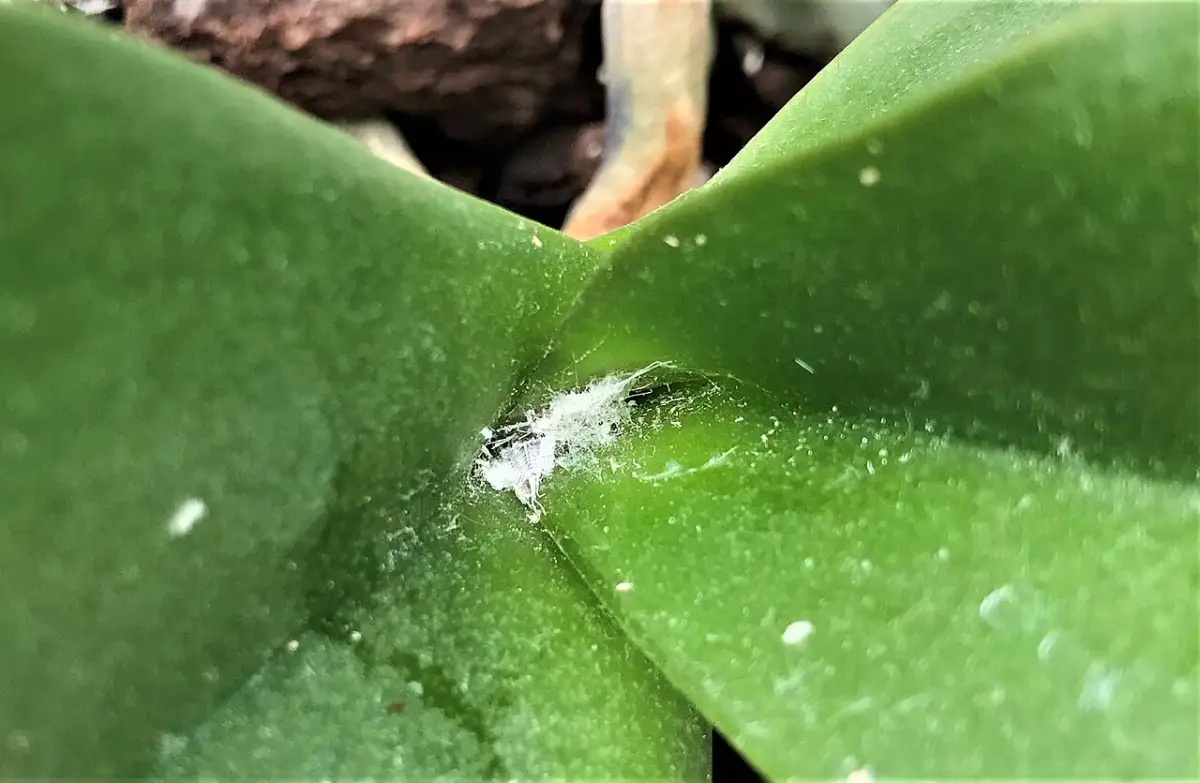
| White cottony clusters in leaf joints, sticky leaves | Mealybugs | Dab with rubbing alcohol on a cotton swab, then insecticidal soap |
| Brown spots with yellow halos | Fungal leaf spot such as anthracnose | Remove spotted leaves; water at the soil, not the leaves |
| Healthy leaves but no flowers | Too little sun, high-nitrogen feed or no new growth | More sun, bloom fertilizer, pinch tips |
For a wider look at leaf color problems, read why plant leaves turn yellow.
Pests
Mealybugs, spider mites, aphids, scale and whiteflies are the pests most often reported on dipladenia, according to NC State and UF IFAS. They usually arrive with a new plant or build up indoors in winter, when dry air favors mites.
- Blast aphids, mites and whiteflies off with a strong spray of water.
- Wipe mealybugs and scale with a cotton swab dipped in rubbing alcohol, then rinse.
- If pests return, spray insecticidal soap or horticultural oil, following the label, every 7 days for 3 weeks.
Our step-by-step guide on getting rid of aphids on indoor plants covers the same methods in more detail.
Diseases
Root rot from waterlogged soil is the most serious disease and the main reason store-bought plants die. Fungal leaf spots such as anthracnose and powdery mildew show up in damp, crowded conditions. Prevention is simple: drain well, water the soil rather than the leaves, and give the plant air movement.
Is Dipladenia Toxic? Sap, Pets and Children
Treat dipladenia as a plant to keep away from pets and children. UF IFAS warns that its milky sap can irritate skin and may be toxic if ingested, and the sap is described as toxic in botanical references. Reliable data on how severe poisoning is for cats, dogs or people is limited, so caution is the sensible choice.
- Adults: wear gloves when pruning; wash skin if sap touches it.
- Children: keep baskets and pots out of reach.
- Cats and dogs: place it where pets cannot chew leaves or stems.
If a person or pet has eaten part of the plant and shows symptoms such as vomiting or drooling, contact poison control or your vet right away.
Video: Why a Dipladenia Struggles
This video from the GROW UP MAN! channel shows a mature Mandevilla sanderi grown in a UK greenhouse and explains overwatering, cold and the confusing naming.
The Takeaway
Good dipladenia care comes down to bright sun, the finger-test watering rule and warmth above 50°F (10°C). Feed it through summer, pinch it for more flowers, and decide on a winter plan before the first cold night. Watch your plant regularly and adjust to what it shows you; small changes in light and water usually bring it back into bloom.
Frequently Asked Questions
Is dipladenia the same as mandevilla?
Yes. Dipladenia is an older genus name for plants now classified as Mandevilla, mainly Mandevilla sanderi. In shops, “dipladenia” usually means the compact, bushy types, while “mandevilla” often means larger climbing vines.
How often should I water dipladenia?
Water when the top 1 to 2 inches of potting mix are dry. In summer heat a small pot may need water every 1 to 3 days; indoors in winter it may be every 1 to 3 weeks.
Does dipladenia need full sun?
It flowers best with at least 6 hours of sun a day. In very hot climates, give it morning sun and light afternoon shade to prevent leaf scorch.
Can dipladenia stay outside in winter?
Only in frost-free areas, roughly USDA zones 10 to 11. Elsewhere, bring it indoors before nights drop below 50°F (10°C), store it cool and dry, or take cuttings.
Why are my dipladenia leaves turning yellow?
The most common causes are overwatering, low light after moving indoors, cold below 50°F (10°C), and pests such as mealybugs or spider mites. Check the soil moisture and leaf undersides first.
Is dipladenia safe for cats and dogs?
It is best kept away from pets. University of Florida IFAS warns the milky sap can irritate skin and may be toxic if eaten. Contact your vet if a pet chews it and shows symptoms.
Featured image: Photo: Photo by David J. Stang / Wikimedia Commons, CC BY-SA 4.0