Ruellia (Mexican Petunia) Care: Sun, Water, Pruning and How to Keep It Contained
Mexican petunia (Ruellia simplex) is one of the easiest flowering perennials for hot gardens, and one of the easiest to lose control of. It handles heat, humidity, drought and soggy soil, then rewards you with a new flush of purple trumpets almost every morning from late spring to fall.
This guide covers everything you need for healthy, well-behaved plants: sun, water, soil, pruning, winter care by climate, pots, cultivar choice, pet safety and fixes for the most common problems.
Quick Answer
Ruellia (Mexican petunia) care comes down to six rules. Give it full sun for the most flowers, water deeply until it is established and then only in dry spells, and plant it in almost any soil that is not bone dry for long periods. Cut it back hard in late winter, remove seed pods during the season, and grow a sterile cultivar such as ‘Purple Showers’ or a UF Mayan or Aztec selection if you live where it spreads.
- Light: 6 or more hours of direct sun; it tolerates part shade but blooms less.
- Water: keep new plants evenly moist for the first few weeks, then water when the top few inches of soil are dry.
- Soil: sand, loam or clay, wet or dry; fertile, moist soil gives the fastest growth.
- Hardiness: perennial in USDA zones 8 to 11; grown as an annual or potted plant in colder areas.
- Pruning: cut stems near the ground in late winter or after frost; snip off seed pods in summer.
- Spread: it self-seeds and runs by rhizomes, and it is a Category I invasive plant in Florida.
How to Recognize Mexican Petunia
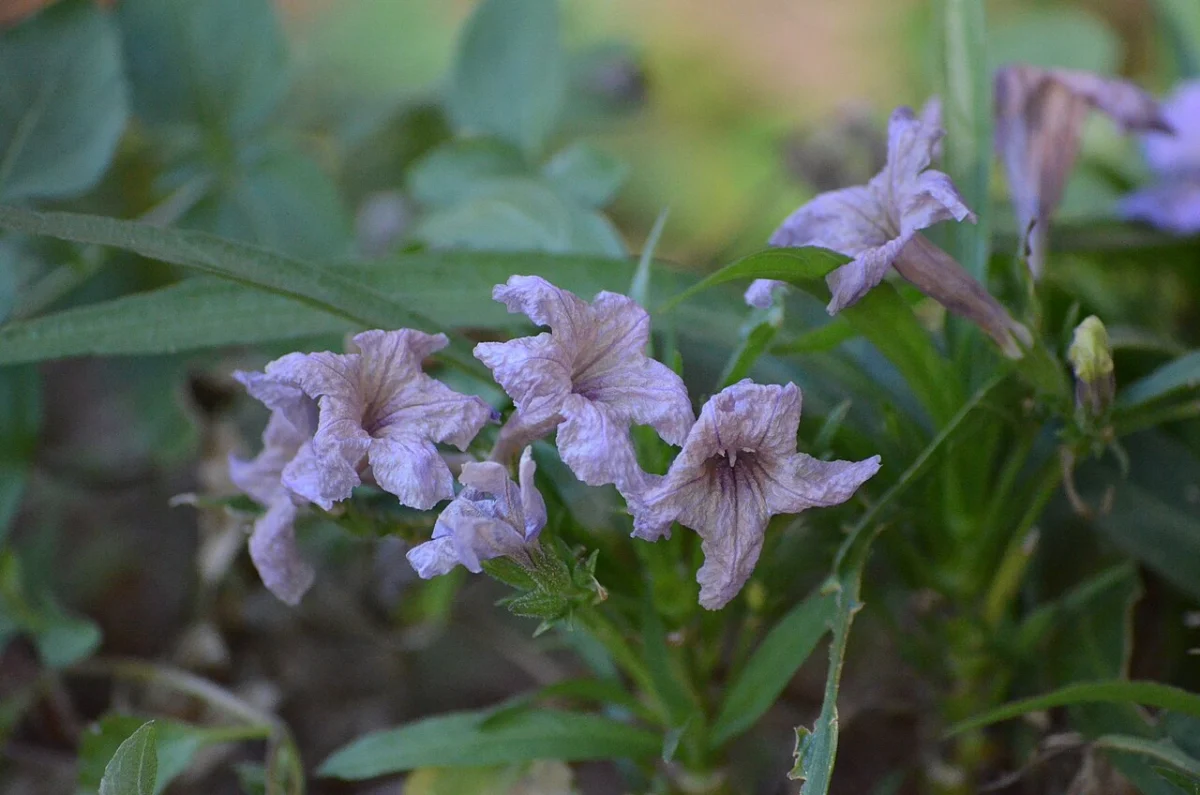
Mexican petunia is an upright, clump-forming herbaceous perennial in the acanthus family (Acanthaceae), not a true petunia (Petunia, Solanaceae). The quickest check is the leaves: long, narrow and willow-like, set in opposite pairs along stems that turn purple in strong sun.
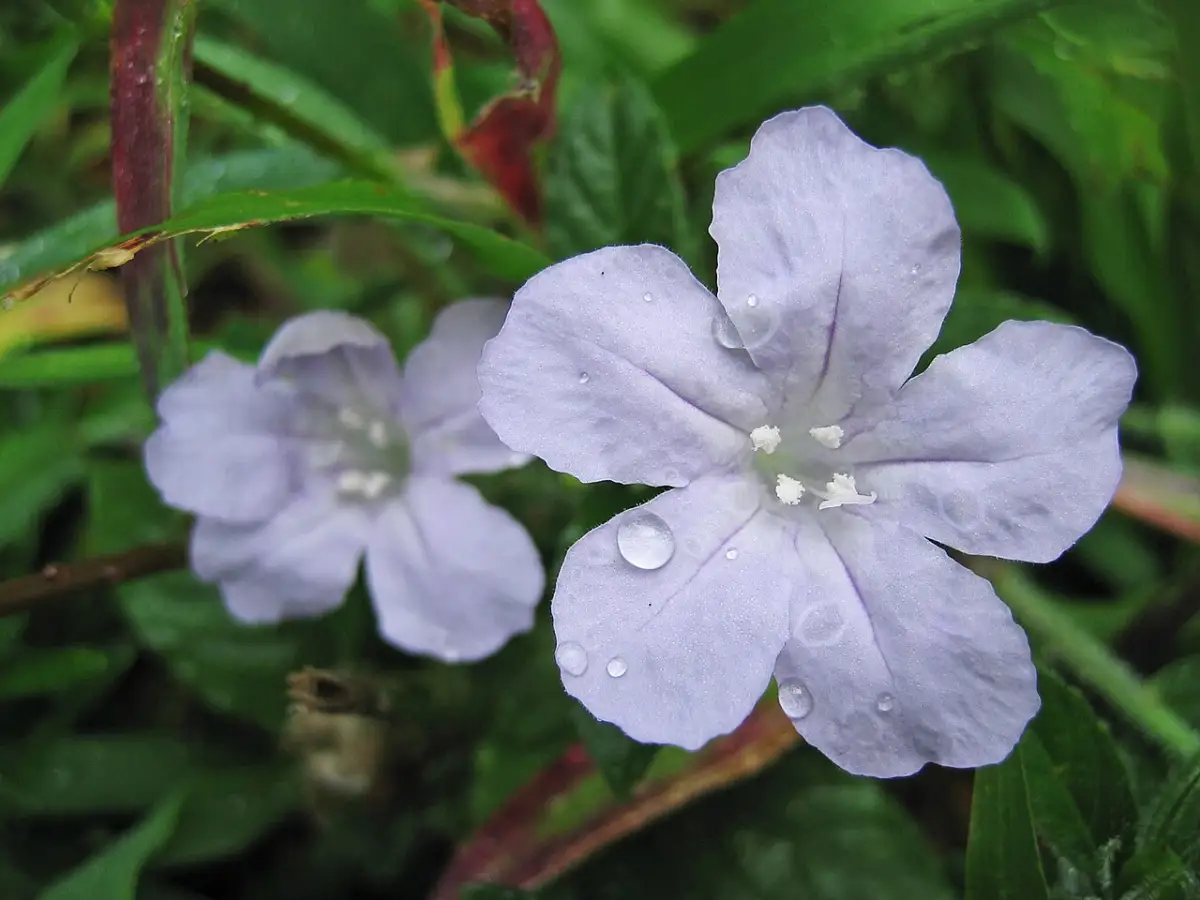
According to the NC State Extension Plant Toolbox, the leaves are about 6 to 12 inches long and under 1 inch wide, and plants reach 2 to 3 feet in gardens and up to 4 feet in the wild. Each flower has five flared lobes, is lavender to violet (pink and white in some cultivars), and lasts a single day.
After flowering, the plant forms a slim capsule up to about 1 inch long. UF/IFAS Extension reports that ripe capsules burst and throw seeds 8 to 10 feet, and the seeds form a sticky gel when wet that glues them to soil.
One plant, many names
Ruellia simplex, Ruellia brittoniana, Ruellia tweediana, Ruellia coerulea and Ruellia malacosperma all refer to the same plant. UF/IFAS explains that R. simplex has priority because it was the first name published, from a Cuban specimen in 1870. Common names include Mexican bluebell, Britton’s wild petunia, Texas petunia and purple showers.
Mexican petunia vs Carolina wild petunia
Gardeners in the eastern United States often meet the native Carolina wild petunia (Ruellia caroliniensis, Acanthaceae) and wonder if it is the same plant. It is not, and the leaves and habit tell them apart within seconds.
| Feature | Mexican petunia (Ruellia simplex) | Carolina wild petunia (Ruellia caroliniensis) |
|---|---|---|
| Leaves | Long, narrow, willow-like, 6 to 12 in | Oval, rich green, crowded on the stem |
| Stems | Smooth, green to purple, woody at base | Hairy, mostly unbranched |
| Flowers | On stalks in loose clusters, lavender to violet | Unstalked, in leaf axils, light purple, one or two open per day |
| Width of clump | 2 to 3 ft and spreading by rhizomes | 6 to 12 in |
| Habit in the wild | Dense stands along wet ditches and lake edges | Scattered single plants in woods and lawns |
| Status | Native to Mexico, the Caribbean and South America; invasive in Florida | Native to central and eastern US; host plant for buckeye butterfly caterpillars |
Sources: NC State Extension (R. caroliniensis) and UF/IFAS EP415. If you are unsure which one you have, upload a clear leaf and flower photo to our flower identifier.
Mexican Petunia Care at a Glance
| Need | What works |
|---|---|
| Light | Full sun (6+ hours) for most flowers; part shade accepted |
| Water | Regular while establishing; drought tolerant once rooted; tolerates wet soil |
| Soil | Clay, loam or sand; acidic to alkaline; fertile and moist is best |
| Hardiness | USDA zones 8 to 11 (UF/IFAS); NC State lists 8a to 10b |
| Size | 2 to 3 ft tall in gardens; dwarf types 6 to 12 in |
| Bloom | Late spring to fall; each flower lasts one day |
| Feeding | Light, balanced fertilizer in spring if soil is poor |
| Wildlife | Butterflies, hummingbirds and bees; seldom browsed by deer |
| Main risk | Self-seeding and rhizome spread |
How Much Sun Does Mexican Petunia Need?
Mexican petunia blooms best with at least 6 hours of direct sun a day. It survives in part shade, but the plant stays greener and opens noticeably fewer flowers.
UF/IFAS notes that plants in more direct sunlight have been observed producing more flowers. Sun also changes the stems: in bright light they turn deep purple, while in shade they stay mostly green.
In very hot, dry climates such as desert regions, afternoon shade can reduce scorched leaves without cutting bloom much. In humid tropical and subtropical areas, full sun all day is usually fine.
How Often to Water Mexican Petunia
Water by checking the soil, not by the calendar. I have learned that checking the soil before watering is the simplest way to prevent overwatering, and it suits this plant well because its needs change so much between planting time and maturity.
- Push a finger 2 to 3 inches into the soil next to the clump.
- If it feels dry at that depth, water slowly until the root zone is soaked.
- If it still feels moist, wait a day or two and check again.
New plants
Newly planted Mexican petunias need deep, regular watering for the first few weeks so roots can grow out of the nursery soil. Keep the soil evenly moist, not waterlogged, until you see steady new growth.
Established plants in the ground
Once rooted, Mexican petunia tolerates both drought and soggy soil. Gardeners in central Texas report growing it through summer with little or no extra water, yet it also grows along pond edges.
There is a trade-off. UF/IFAS research found that plants in wet conditions produced three times more seed pods and longer stems than plants in dry conditions. If you want a tidier, less weedy clump, water only during long dry spells rather than keeping the bed constantly wet.
Plants in pots
Potted plants dry out much faster than garden plants, especially in summer heat. Check them every one to two days in hot weather and use a container with drainage holes, because roots sitting in standing water can rot.
Soil and Fertilizer
Mexican petunia grows in sand, loam or clay and in soil pH from acidic to alkaline, according to NC State Extension. Fertile, moist, well-drained soil gives the fastest growth and the fullest flowering.
- Mix compost into poor or sandy soil at planting time.
- Apply a light, balanced fertilizer (for example 10-10-10) once in spring if growth is weak.
- Skip heavy nitrogen feeding: it pushes leafy growth and does not improve flowering.
- Mulch 2 to 3 inches deep to hold moisture and limit seedlings around the clump.
Pruning and Deadheading
Mexican petunia needs one hard cut-back a year plus light trimming in summer. Pruning keeps the clump dense, removes frost damage and, most important, stops seed production.
Spent flowers drop on their own, so classic deadheading is optional. What matters is removing the capsules that form behind the flowers, because those are what throw seed across the garden.
Late winter cut-back
- Wait until late winter or very early spring, or until frost has browned the stems.
- Use clean, sharp hand pruners.
- Cut every stem to about 2 to 6 inches above the ground.
- Rake up and bag the cut stems and any capsules so seeds do not land in the bed.
- New shoots appear as soon as the soil warms.
Removing seed pods
During summer, look along the stem tips for green to brown pods about 1 inch long. Snip the top few inches of flowered stems every two to three weeks, or pick off pods by hand. Bag them rather than composting them, since the seeds have no dormancy and can sprout almost immediately, according to UF/IFAS.
Winter Care by Climate
Mexican petunia is evergreen in frost-free areas and dies back to the ground after a freeze in cooler ones. Gardening Know How reports tip damage below 32 °F and dieback to the ground in the 20s °F, with regrowth from the roots in spring.
| Climate | What happens | What to do |
|---|---|---|
| Tropical and subtropical (USDA 10 to 11 and similar frost-free regions worldwide) | Stays evergreen; may flower most of the year | Trim lightly in the cooler season; keep removing seed pods |
| Zone 9 | Occasional frost burns the tops | Leave damaged stems until late winter, then cut back |
| Zone 8 | Dies to the ground in most winters; roots survive | Cut to 2 to 6 inches after frost and mulch the crown |
| Zone 7 | Marginal; may survive with protection | Plant against a warm wall, mulch heavily, or overwinter a potted plant indoors |
| Zone 6 and colder | Killed by winter cold | Grow as a summer annual or keep it in a pot and bring it inside |
Hardiness ratings differ between sources. UF/IFAS lists zones 8 to 11, NC State lists 8a to 10b, and the Plant Sleuth channel (University of Tennessee instructor Andy Pulte) says he has seen it survive in zone 7. Treat zone 7 as a gamble rather than a guarantee.
Growing Mexican Petunia in Pots and Indoors
A container is the easiest way to enjoy Mexican petunia where it is not hardy or where you want to limit rhizome spread. Use a pot at least 12 inches wide with drainage holes and a fertile, free-draining potting mix.
Place the pot where it gets full sun outdoors. Before the first frost, cut stems back by about half and move the pot to the brightest window you have, or under a grow light; our guide to the best light color for plant growth explains what to look for. Water sparingly indoors, only when the top of the mix is dry, and move it back outside after your last frost.
For general container tips, see how to grow flower plants in pots. Pots still allow seeds to escape, so keep removing capsules.
Propagation, and When You Should Not Spread It
Mexican petunia is easy to multiply from stem cuttings, division or seed. UF/IFAS notes that cuttings root readily even without rooting hormone.
- Cuttings: in spring or summer, cut a 4 to 6 inch stem tip just below a leaf pair, strip the lower leaves and set it in moist potting mix in bright, indirect light.
- Division: in early spring, dig up a clump, slice the crown and rhizomes into sections with a spade and replant each one at the same depth.
- Seed: possible, but not recommended, because seed-grown plants are fertile and add to the spread problem.
If you live in Florida or another region where the plant escapes into natural areas, do not share seed or divisions of fertile types, and never dump trimmings near ditches, ponds or streams.
Is Mexican Petunia Invasive? Pick a Sterile Cultivar
Yes, the wild type and seed-producing cultivars are invasive in parts of the world. The Florida Exotic Pest Plant Council has listed Mexican petunia as a Category I invasive since 2001, and UF/IFAS reports naturalized populations in 35 Florida counties plus 8 US states from South Carolina to Texas, Hawaii, Puerto Rico and the US Virgin Islands.
The safest choice is a cultivar with little or no seed. Note that even sterile plants still spread slowly by rhizomes, so edging or a pot is still useful.
| Cultivar | Height and flower | Seed production |
|---|---|---|
| ‘Purple Showers’ | 3 to 4 ft, purple | Set no seed in UF trials |
| Mayan Purple, Mayan White | Up to 3 ft, purple or white | Highly reduced or not detectable; approved by UF/IFAS for use with caution |
| Mayan Compact Purple | 1 to 2 ft | Highly reduced or not detectable |
| Mayan Pink | 1 to 2 ft, pink | Low, but some fruits may form |
| Aztec Pink, Aztec Purple, Aztec Pink/White | Bicolor flowers | Highly reduced or not detectable |
| ‘Katie’ (purple, pink, white) | 6 to 12 in dwarf | Produces seed; not recommended by UF/IFAS researchers in Florida |
| ‘Chi Chi’, ‘Morado Chi’ | 3 to 4 ft, pink or purple | As much or more seed than the wild type |
Source: UF/IFAS EP415, Natural Area Weeds: Mexican Petunia. Outside the United States, check your country’s or state’s invasive species list before planting fertile types, especially near wetlands.
How to Remove Mexican Petunia You No Longer Want
Hand removal works for small patches if you get every piece of rhizome. UF/IFAS warns that rhizome fragments left in the soil regrow, so plan on repeat visits.
- Water the bed the day before so the soil loosens.
- Cut off and bag any stems carrying seed pods first.
- Dig around each clump with a garden fork and lift it out whole.
- Sift the soil by hand and remove every white or tan horizontal root you find.
- Bag all material for the trash, not the compost.
- Check the area every few weeks for a season and pull new sprouts while small.
For large stands, UF/IFAS tested ready-to-use glyphosate products and found a follow-up treatment was often needed 3 to 6 months later. If you choose herbicide, follow the label exactly and never spray near water unless the product is labeled for it.

Troubleshooting Common Mexican Petunia Problems
Mexican petunia has few serious pests or diseases, so most problems trace back to light, water or cold. NC State Extension lists southern blight as a disease to watch, and spider mites and whiteflies can appear in hot, dry weather.
| Symptom | Likely cause | Fix |
|---|---|---|
| Healthy leaves but few flowers | Too much shade or too much nitrogen | Move to 6+ hours of sun; stop high-nitrogen feeding |
| Yellow, dropping lower leaves | Waterlogged soil or long drought | Check soil 2 to 3 in deep; improve drainage or water deeply |
| Tall, floppy stems | Shade, rich wet soil, or no annual cut-back | Cut back in late winter; give more sun |
| Brown, crisp stems after cold | Frost or freeze damage | Cut to 2 to 6 in in late winter; wait for spring regrowth |
| Fine speckling and webbing under leaves | Spider mites | Hose off leaves; use insecticidal soap if needed |
| Tiny white insects flying up when touched | Whiteflies | Insecticidal soap on leaf undersides; remove heavily infested stems |
| Wilting at the base with white threads on soil | Southern blight (fungal) | Remove affected plants and the soil around the base; improve air flow |
| Seedlings appearing several feet away | Exploding seed capsules | Remove pods; switch to a sterile cultivar |
For a wider look at leaf color problems, read why plant leaves turn yellow. Sap-sucking pests on potted plants brought indoors can be handled the same way as in our guide to getting rid of aphids on indoor plants.
Is Mexican Petunia Toxic to Dogs, Cats or Children?
There is no confirmed record of Mexican petunia being toxic, but there is also no authoritative source declaring it safe. The Lady Bird Johnson Wildflower Center checked five toxic plant databases, including the ASPCA toxic and non-toxic plant list, and found no species of Ruellia listed, while noting that absence from a list is not a guarantee.
Some nursery pages call the plant toxic to dogs and children, but they do not cite a source. The practical approach is to discourage pets and children from chewing it, as with any garden plant, since eating plant material can upset the stomach.
If a pet eats the plant and shows symptoms such as vomiting, drooling or diarrhea, call your veterinarian or the ASPCA Animal Poison Control Center at (888) 426-4435. If a person eats it and feels unwell, contact your local poison control center (1-800-222-1222 in the United States).
Watch: How to Identify Mexican Petunia
This short video from the Plant Sleuth channel shows the plant’s upright habit, leaves and flowers in a real landscape and explains why it needs containment near wet areas.
Not Sure It Is Mexican Petunia? Identify It From a Photo
Several purple, trumpet-flowered plants look similar at a glance, including the native wild petunias and true garden petunias. A photo of the leaves and one open flower is usually enough to narrow it down.
- Photograph the plant in daylight, not in deep shade or at night.
- Take one close photo of a leaf pair showing how leaves sit on the stem.
- Take one photo of an open flower from the front.
- Upload the photos to our flower identifier or, for a plant not in bloom, the leaf identifier.
- Compare the result with the ID table above before deciding what to do with the plant.
Photo identification, including our tool, can be wrong. When safety matters, such as a pet or child eating a plant, confirm with a local extension office, a vet or poison control.
12-Month Mexican Petunia Care Calendar
Observing plants regularly and adjusting care to what you see works better than any fixed schedule, so use this calendar as a starting point. Months are for the Northern Hemisphere; in the Southern Hemisphere shift them by six months.
| Time of year | Main tasks |
|---|---|
| Late winter (Feb to early Mar) | Cut all stems to 2 to 6 in; bag debris; plan sterile replacements |
| Spring (Mar to May) | Light feed if soil is poor; plant or divide; water new plants regularly |
| Early summer (Jun) | Bloom starts in earnest; begin pod removal every 2 to 3 weeks |
| Mid to late summer (Jul to Aug) | Water during dry spells; check for spider mites; keep removing pods |
| Fall (Sep to Nov) | Bloom continues until frost; bring potted plants indoors in cold zones |
| Winter (Dec to Jan) | Leave frost-damaged stems in place in zones 8 to 9; water indoor pots sparingly |
Related Care Guides
Mexican petunia shares its family with the shrimp plant, which has similar heat tolerance; see our shrimp plant care guide. For another bold, sun-loving perennial that handles wet soil, read our canna lily care guide.
The Bottom Line
Mexican petunia is close to effortless when you give it full sun, deep watering while it settles in, and one hard cut-back each winter. The real work is keeping it where you planted it: choose a sterile cultivar, remove seed pods in summer, and keep it away from ponds and ditches if you live where it spreads.
Mexican Petunia Care FAQs
Do Mexican petunias come back every year?
Yes, in USDA zones 8 to 11 the roots survive winter and new shoots appear in spring, even if frost kills the tops. In zone 7 survival is uncertain, and in colder areas it is grown as an annual or overwintered indoors in a pot.
Should I cut back Mexican petunia in winter?
Yes. Cut all stems to about 2 to 6 inches above the ground in late winter or after frost browns them. This clears dead growth and gives a denser clump in spring.
Why is my Mexican petunia not blooming?
The most common cause is too little sun. Move it to a spot with at least 6 hours of direct sun and avoid high-nitrogen fertilizer, which produces leaves instead of flowers.
Which Mexican petunia does not spread by seed?
UF/IFAS lists ‘Purple Showers’ and the Mayan and Aztec series (except Mayan Pink, which may set some fruit) as producing little or no seed. All of them can still spread slowly by rhizomes.
Can Mexican petunia grow indoors?
It can live indoors over winter in a very bright window or under a grow light, but it flowers best outdoors in full sun. Water sparingly indoors and move it back outside after the last frost.
Is Mexican petunia the same as a regular petunia?
No. Mexican petunia (Ruellia simplex) belongs to the acanthus family, while garden petunias belong to the nightshade family. The flowers look similar, but the plants differ in leaves, growth habit and care.
Featured image: Photo: Prenn / Wikimedia Commons, CC BY-SA 3.0