

Croton Mammy Care: Light, Water, Leaf Drop Fixes and Safety
Croton Mammy (Codiaeum variegatum ‘Mammy’, family Euphorbiaceae) is a compact croton with narrow, twisted leaves splashed with red, yellow, green, purple and burgundy. It is one of the most common crotons sold as a houseplant, and it has a reputation for dropping leaves soon after it comes home.
This guide gives you a clear care routine, a way to confirm you really have a Mammy, a table for diagnosing leaf drop, and sourced safety facts for homes with pets and children.
Quick Answer: Croton Mammy Care in One Routine
Croton Mammy needs bright light with a little gentle direct sun, soil that dries in the top 2.5 cm (1 inch) before you water, and temperatures that stay above 16°C (60°F). Keep humidity around 40 to 60 percent, feed lightly from spring to early autumn, and keep it away from cold drafts and heater vents. Most leaf drop comes from moving the plant, cold air, low light or watering by the calendar instead of by the soil.
| Care factor | What Croton Mammy needs |
|---|---|
| Light | Bright light, a few hours of soft morning or late afternoon sun; avoid harsh midday sun through glass |
| Water | When the top 2.5 cm (1 inch) of soil is dry; less in winter |
| Temperature | 16 to 29°C (60 to 85°F); damage below 10°C (50°F) |
| Humidity | 40 to 60 percent indoors |
| Soil | Free-draining, humus-rich potting mix; pot with drainage holes |
| Feeding | Balanced liquid fertilizer in the growing season; none in winter |
| Size indoors | About 90 cm to 1.2 m (3 to 4 feet) |
| Hardiness | Outdoors year round only in USDA zones 11 to 12 or similar frost-free climates |
| Toxicity | Mildly toxic if eaten; sap can irritate skin |
How to Identify a Croton Mammy
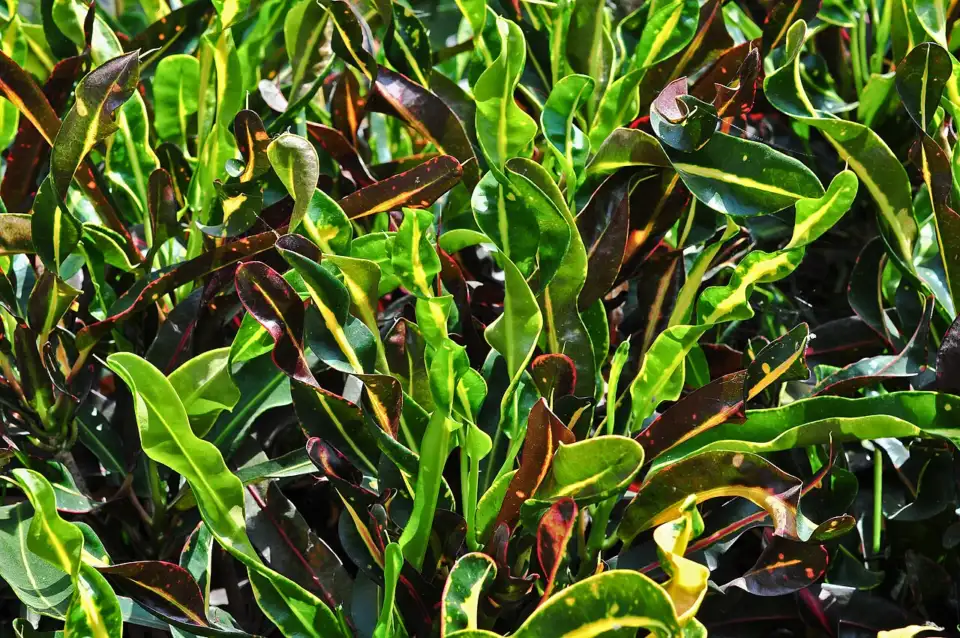
A Croton Mammy is identified by its narrow, glossy leaves that twist or curl along their length, in mixed red, yellow, green and dark purple tones. Most crotons sold in shops have flat, broad leaves, so the twist is the quickest clue.
- Leaves: simple, alternate on the stem, leathery and glossy. NC State Extension describes croton leaves as linear to ovate and often “crinkled or twisted” (NC State Extension Plant Toolbox). Mammy leaves are narrow and corkscrew-like rather than broad.
- Color: the RHS describes ‘Mammy’ foliage as “vividly and irregularly coloured green, yellow, red and burgundy” with gentle ruffles (RHS Plants). New leaves often start greener and develop color in good light.
- Stem and sap: woody stems; broken leaves or stems leak a milky or clear sap.
- Flowers: small, star-shaped, white or yellowish flowers on thin spikes. They are easy to miss and are not the reason people grow the plant.
- Other names: Croton Mami, Mamey croton, curly croton and Joseph’s coat.
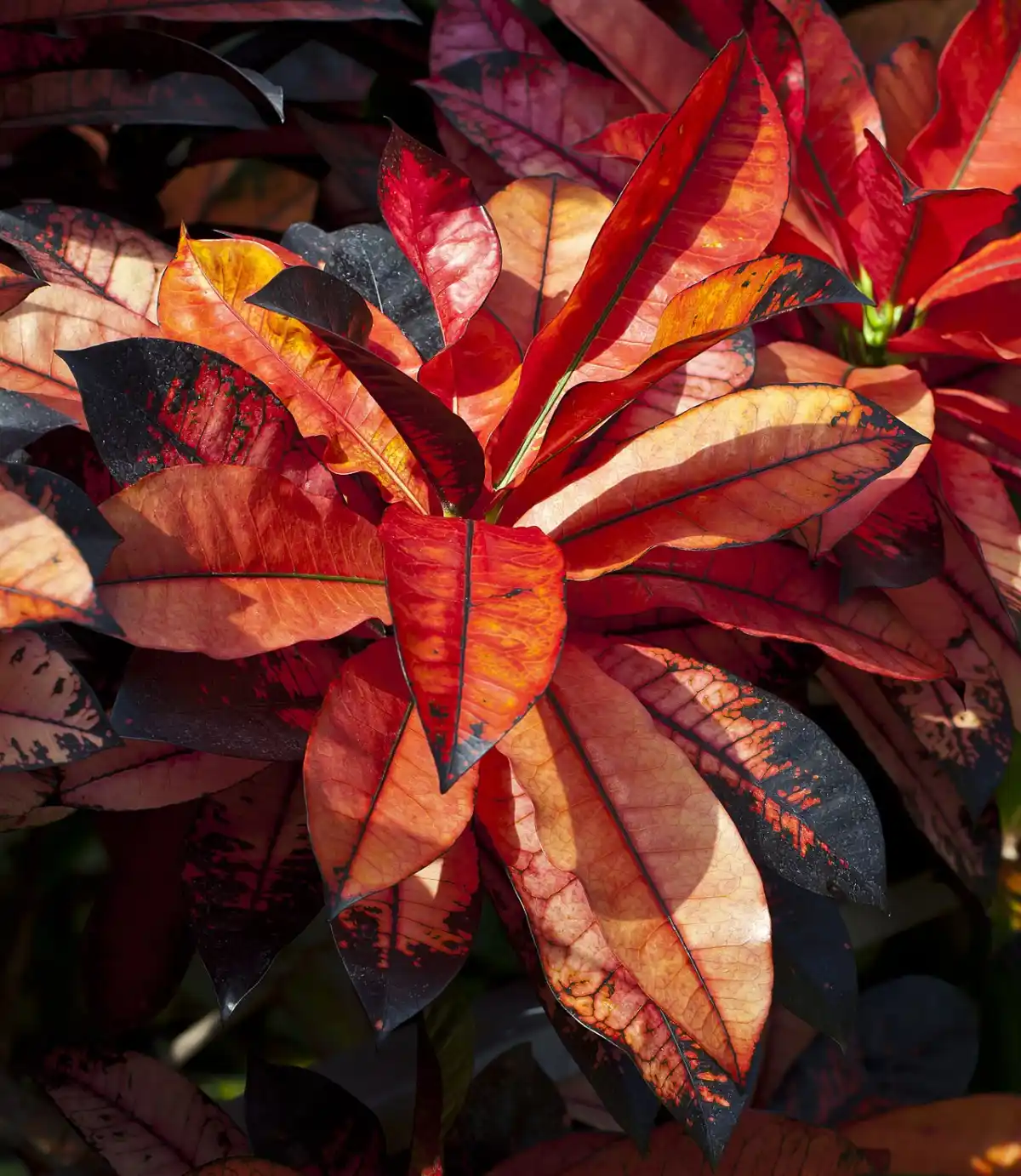
If your plant came without a label, a clear daylight photo of one leaf can help. You can try our leaf identifier or the general plant identifier, but keep in mind that photo identification, including our tool, can be wrong. Croton cultivars look very similar, so treat any result as a starting point.
Croton Mammy vs Petra and Other Crotons
The leaf shape separates Mammy from its look-alikes faster than color does. All of these are cultivars of the same species, Codiaeum variegatum, so their care is the same.
| Cultivar | Leaf shape | Colors | Typical size | Quick clue |
|---|---|---|---|---|
| Mammy | Narrow, twisted, curly | Red, yellow, green, dark purple, burgundy | About 1 m (3 to 4 ft) indoors | Corkscrew leaves, compact bush |
| Petra | Broad, flat, oval | Dark green with yellow, pink and orange-red along the veins | Larger; can reach about 2.4 m (8 ft) outdoors | Colored veins on flat leaves |
| Spirale | Long and strongly spiraled | Red and green | Medium | Tighter, longer spirals than Mammy |
| Gold Dust | Rounded oval, flat | Bright green with gold speckles | Small to medium | Speckles, not stripes |
| Eleanor Roosevelt | Very narrow, flat | Green with gold spots aging to red | Medium | Thin, straight, spotted leaves |
Cultivar descriptions for Petra, Spirale, Gold Dust and Eleanor Roosevelt follow the NC State Extension cultivar list.
Light: How Much Sun Croton Mammy Needs
Croton Mammy needs bright light to keep its colors. NC State Extension notes that crotons need bright light, with some direct sun, for the best leaf color, and may lose lower leaves in too much shade. The RHS warns that harsh direct sun can scorch the leaves, so the goal is bright light without hot midday rays.
| Window (Northern Hemisphere) | Placement for Croton Mammy |
|---|---|
| East | Right at the window; soft morning sun is ideal |
| West | Close to the window, with a sheer curtain in hot summers |
| South | About 1 m (3 ft) back from the glass, or behind a sheer curtain |
| North | Usually too dim; add a grow light |
In the Southern Hemisphere, swap north and south in this table. If your home is dark, a full-spectrum grow light for 10 to 12 hours a day works well; our guide to what color light is best for plant growth explains which bulbs to choose.
Signs of Too Little or Too Much Light
- Too little: new leaves stay mostly green, stems stretch, and lower leaves drop.
- Too much: pale, bleached or gray-looking patches and crispy brown spots on the side facing the window.
From what I have learned growing indoor plants, placing a plant in a suitable spot with the right light can make a visible difference in its growth. With Mammy, the difference shows in the color of each new leaf, so judge a new position by the leaves that open there over the next month.
How Often to Water Croton Mammy
Water Croton Mammy when the top 2.5 cm (1 inch) of soil feels dry, then water until it runs out of the drainage holes. Empty the saucer so the roots never sit in water.
A fixed weekly schedule is the most common mistake. How fast the pot dries depends on light, heat, pot size and season, so a plant in a sunny summer window may need water twice as often as the same plant in winter. NC State Extension advises watering liberally from spring to autumn and sparingly in winter, and the RHS recommends compost that is evenly moist but never waterlogged.
- Push a finger into the soil up to the first knuckle.
- If it feels dry, water slowly until water drains out of the bottom.
- If it still feels damp, check again in two or three days.
- Use room-temperature water; cold water can shock tropical roots.
I have found that checking the soil before watering helps prevent overwatering and keeps plants healthier. It is the single most useful habit for this plant, because both soggy and bone-dry soil cause the same symptom: falling leaves.
Temperature and Humidity
Croton Mammy grows best between 16 and 29°C (60 and 85°F) with humidity around 40 to 60 percent. The RHS advises a spot where temperatures never drop below 16°C (60°F), and NC State Extension recommends bringing outdoor crotons inside when temperatures reach 10°C (50°F).
- Keep the plant away from air conditioner vents, heaters and drafty doors. Sudden temperature swings are a classic cause of leaf drop.
- Raise humidity with a tray of damp pebbles under the pot, a room humidifier, or by grouping plants together.
- Misting gives only a short boost; a pebble tray or humidifier works for longer.
Care by Climate and Region
- Tropical and frost-free areas (USDA zones 11 to 12, much of South and Southeast Asia, northern Australia, the Caribbean): Mammy can live outdoors all year in bright shade or morning sun.
- Hot, dry summers (for example, the plains of Pakistan and India or the US Southwest): give afternoon shade and check soil more often, as pots can dry within a day or two.
- Cold winters (most of Europe, Canada and the northern US): grow it as a houseplant and keep it in the warmest bright room. Expect slower growth and less water use from late autumn to late winter.
Majesty palms have similar humidity needs; see our majesty palm care guide for more ways to raise humidity indoors.
Soil, Pot and Fertilizer
Croton Mammy needs a free-draining potting mix rich in organic matter, in a pot with drainage holes. NC State Extension describes the ideal soil as well-drained, humus-rich and occasionally dry. A simple mix is two parts quality houseplant potting mix to one part perlite or fine bark.
Feed from spring to early autumn with a balanced liquid fertilizer. The RHS suggests feeding every two weeks in that period; if you are unsure, half-strength once a month is a safe start, since overfeeding can burn roots and dull leaf color. Stop feeding in winter, when growth slows.
Repotting and Pruning
Repot Croton Mammy only when roots circle the pot or poke out of the drainage holes, usually every two to three years. Move up just one pot size (about 2.5 to 5 cm, or 1 to 2 inches, wider) and keep the soil line at the same height.
Prune in spring to remove leggy stems or dead leaves. Cut just above a leaf node, and remove no more than about a third of the plant at once.
Wear gloves when you prune. NC State Extension warns that the sap can irritate skin and soft tissue, and that it permanently stains fabric, so cover clothes and furniture.
How to Propagate Croton Mammy
Croton Mammy propagates from stem cuttings, and spring or early summer gives the fastest rooting.
- Wearing gloves, cut a 10 to 15 cm (4 to 6 inch) stem tip with a few leaves.
- Rinse or dab away the sap, then remove the lowest leaves.
- Dip the cut end in rooting hormone (optional, but it helps).
- Plant it in moist perlite and peat or coir mix, or stand it in water.
- Cover loosely with a clear bag and keep it warm, around 21 to 27°C (70 to 80°F), in bright indirect light.
- Expect roots in about four to six weeks; pot it up once roots are 2 to 3 cm long.
Your First 30 Days With a New Croton Mammy
Some leaf drop in the first weeks is normal, because the plant is adjusting from a bright, humid greenhouse to your home. This checklist reduces the shock.
- Choose its final spot on day one, and avoid moving it again for at least a month.
- Do not repot straight away unless the pot has no drainage holes.
- Check the soil every two to three days, and water only when the top inch is dry.
- Keep it away from vents, radiators and doors.
- Inspect the undersides of leaves for webbing or white fluff, and keep it apart from other plants for two weeks.
- Hold off on fertilizer until you see new growth.
I believe that observing plants regularly and adjusting their care to what they show you is essential. A quick look at the leaves every few days tells you more than any fixed schedule.
Why Is My Croton Mammy Dropping Leaves?
Croton Mammy drops leaves mainly because of stress: a change of location, cold air, too little light, or watering that is too heavy or too light. Match the symptom to the likely cause below.
| What you see | Likely cause | Fix |
|---|---|---|
| Healthy-looking leaves fall soon after buying or moving | Relocation shock | Keep it in one bright spot; it usually settles within a few weeks |
| Leaves drop in winter near a door or window | Cold drafts below 16°C (60°F) | Move to a warmer bright spot away from drafts |
| Lower leaves yellow and drop; soil stays wet | Overwatering or poor drainage | Let soil dry, check drainage holes, repot if roots are mushy |
| Leaves droop, then turn crispy and fall | Underwatering | Water thoroughly and check soil more often |
| New leaves green, lower leaves drop | Too little light | Move closer to a bright window or add a grow light |
| Brown, crispy leaf tips and edges | Low humidity or fertilizer salt buildup | Add a pebble tray, flush soil with water |
| Speckled, dull leaves with fine webbing | Spider mites | See the pest section below |
Leaf twisting on its own is not a problem. Mammy leaves are naturally curly, so only worry about twisting if it comes with spots, sticky residue or wilting. For yellowing patterns on other houseplants, see why plant leaves turn yellow.
Pests and Diseases
Spider mites are the main pest of Croton Mammy indoors. NC State Extension notes that spider mite susceptibility can limit croton use in indoor settings, and lists twospotted spider mites and banded greenhouse thrips as linked problems.
- Spider mites: tiny dots, pale speckling and fine webbing under leaves. Rinse leaves in the shower, raise humidity, and treat with insecticidal soap or neem oil every 5 to 7 days for three rounds.
- Mealybugs: white cottony clusters in leaf joints. Wipe them off with a cotton swab dipped in rubbing alcohol.
- Scale: brown bumps on stems and leaf veins. Scrape off and treat with horticultural oil.
- Thrips: silvery streaks and black specks. Rinse and treat with insecticidal soap.
- Root rot: caused by soggy soil; prevent it with a free-draining mix and drainage holes.
The same gentle sprays work on many soft-bodied pests; our guide on getting rid of aphids on indoor plants covers safe home treatments in more detail. Test any spray on one leaf first and wait a day, because stressed crotons can react badly to harsh products.

Is Croton Mammy Toxic to Pets and People?
Yes, Croton Mammy is mildly toxic if eaten, and its sap can irritate skin. It affects people, dogs and cats, and the risk is mostly mouth and stomach upset rather than serious poisoning.
- People and children: NC State Extension rates croton as low severity, toxic mainly if large amounts are eaten. Eating it can cause nausea, vomiting and diarrhea, and repeated contact with the sap can cause allergic skin rash. The toxic compounds are diterpene esters, found in all parts of the plant (NC State Extension).
- Dogs and cats: the Pet Poison Helpline says eating croton may cause mild mouth and stomach irritation with drooling, vomiting or diarrhea, and that sap from leaves, stems and roots can cause minor skin irritation (Pet Poison Helpline).
Keep the plant out of reach of pets that chew leaves and of small children, and wash hands after pruning. If a person or pet has eaten part of the plant and shows symptoms, contact your local poison control center or a vet right away. For another common houseplant safety question, see are snake plants toxic to cats.
How to Check Your Plant’s Identity and Health Yourself
If you are unsure whether your plant is a Mammy, or what is wrong with it, a short check gives you clearer answers.
- Take a photo of a single leaf in daylight, flat against a plain background, showing both color and shape.
- Take a second photo of the whole plant to show its height and leaf arrangement.
- Look under three or four leaves with a phone flashlight for webbing, specks or white fluff.
- Note how long the soil stays damp after watering; more than a week in summer suggests poor drainage or low light.
- Upload the leaf photo to our leaf identifier and compare the result with the cultivar table above.
Remember that photo identification is not a substitute for an expert when safety matters. If a plant may have been eaten, call poison control or a vet rather than relying on an app result.
Final Thoughts
Croton Mammy rewards steady conditions: bright light, soil checked before every watering, warmth above 16°C (60°F) and decent humidity. Growing indoor plants has taught me how small changes in care can support healthier growth, and with this plant those small changes show up in every new, colorful leaf. Pick one good spot, watch the leaves, and adjust slowly.
Frequently Asked Questions
How often should I water a Croton Mammy?
Water when the top 2.5 cm (1 inch) of soil feels dry, then water until it drains. In summer that may be every few days; in winter it is much less often. Check the soil rather than following a fixed schedule.
Does Croton Mammy like sun or shade?
It needs bright light with a little gentle direct sun to keep its colors. An east window is ideal. Harsh midday sun through glass can scorch the leaves, and deep shade turns new leaves green and causes leaf drop.
Why is my new Croton Mammy dropping leaves?
Leaf drop after buying is usually relocation shock from moving out of a bright, humid greenhouse. Keep it in one bright, warm spot away from drafts, water only when the top inch is dry, and it usually settles within a few weeks.
How big does a Croton Mammy get?
Indoors it usually stays around 90 cm to 1.2 m (3 to 4 feet) tall. Outdoors in frost-free climates it can grow larger over time.
Is Croton Mammy toxic to cats and dogs?
Yes, mildly. The Pet Poison Helpline says eating croton may cause drooling, vomiting or diarrhea, and the sap can irritate skin. Keep it out of reach and contact a vet if your pet ate some and shows symptoms.
What is the difference between Croton Mammy and Croton Petra?
Mammy has narrow, twisted, curly leaves and stays compact. Petra has broad, flat, oval leaves with yellow, pink and orange-red colored veins and grows larger. Both are cultivars of Codiaeum variegatum and need the same care.
Featured image: Photo: Photo by and (c)2006 Derek Ramsey (Ram-Man). Location credit to the Chanticleer… / Wikimedia Commons, CC BY-SA 3.0



One Comment