Croton Petra Care: Light, Water, Leaf Drop Fixes and Look-Alikes
Croton Petra (Codiaeum variegatum ‘Petra’) is the croton you see most often in garden centers, with broad dark green leaves painted yellow, orange and red along the veins. It is not hard to keep, but it reacts quickly to low light, cold drafts and uneven watering, usually by dropping leaves or losing color. This guide gives you a clear routine, explains why each step matters, and shows how to fix the most common problems.
Quick Answer: How to Care for Croton Petra
Give Croton Petra bright light (a few hours of gentle direct sun is fine), water when the top half inch to one inch of soil is dry, and keep it between 60 and 85°F (16 to 29°C), away from drafts. These ranges come from the University of Wisconsin Horticulture croton guide.
- Light: bright, indirect light indoors, with some soft morning sun. Low light turns new leaves green.
- Water: evenly moist, never soggy. Water less in winter.
- Temperature: 60 to 85°F. Leaf drop is common if it stays below 50°F (10°C).
- Humidity: moderate to high. Dry, heated rooms cause crispy edges.
- Feeding: light feeding during spring and summer only.
- Safety: the sap irritates skin and the plant is mildly poisonous if eaten. Keep it away from pets and children.
| Care factor | What Croton Petra needs | Sign it is wrong |
|---|---|---|
| Light | Bright indirect light, some gentle sun | Green new leaves (too little); gray, dull or scorched leaves (too much harsh sun) |
| Water | When top 0.5 to 1 inch of soil is dry | Yellow, soft leaves (too wet); drooping, crispy leaves (too dry) |
| Temperature | 60 to 85°F (16 to 29°C) | Sudden leaf drop after cold nights or drafts |
| Humidity | Moderate to high | Brown, crispy leaf edges |
| Soil | Rich, well-draining potting mix | Soil that stays wet for days |
| Hardiness | Outdoors year-round in USDA zones 11 to 12 | Damage after frost |
How to Recognize Croton Petra
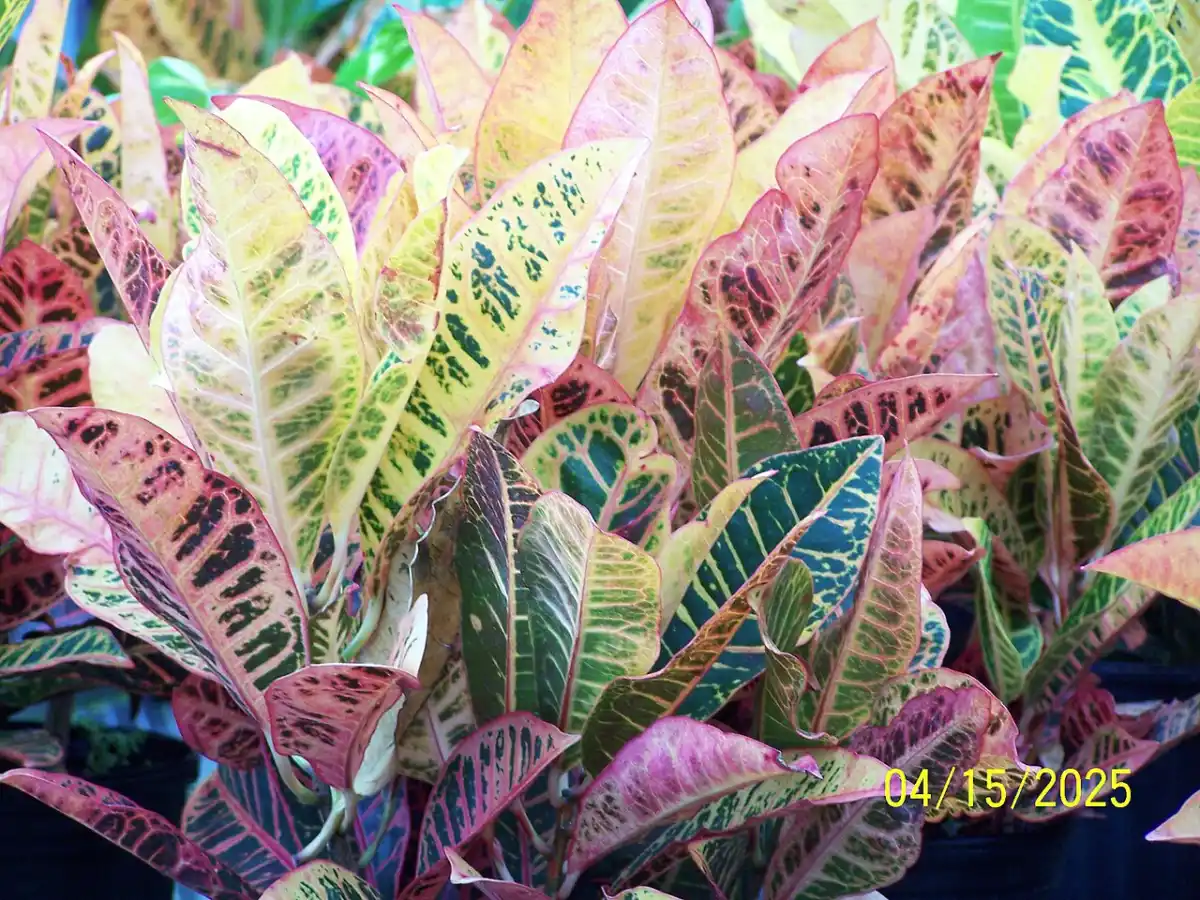
Croton Petra has large, glossy, leathery leaves that are pointed-oval in shape, dark green, and marked with bold yellow, pink and orange to red color along the veins. The Wisconsin Horticulture guide calls it one of the most common croton varieties sold, and NC State Extension describes the same dark green leaves with yellow, pink and orange-red markings along the veins.
- Scientific name: Codiaeum variegatum ‘Petra’ (older name Codiaeum variegatum var. pictum).
- Family: Euphorbiaceae, the spurge family, which also explains its irritating sap.
- Native range of the species: Malaysia, Pacific islands and northern Australia according to NC State; UF/IFAS lists India and Malaysia.
- Leaves: alternate (one leaf per node, staggered up the stem), simple, up to about 18 inches long.
- Size: about 3 feet indoors; 2 to 8 feet tall in tropical landscapes (NC State).
- Flowers: small and easy to miss, on slender spikes (racemes) from the leaf joints. Male flowers are white with five petals and many stamens; female flowers are yellowish with no petals.
- Fruit: a small capsule, about a quarter inch across, holding three seeds.
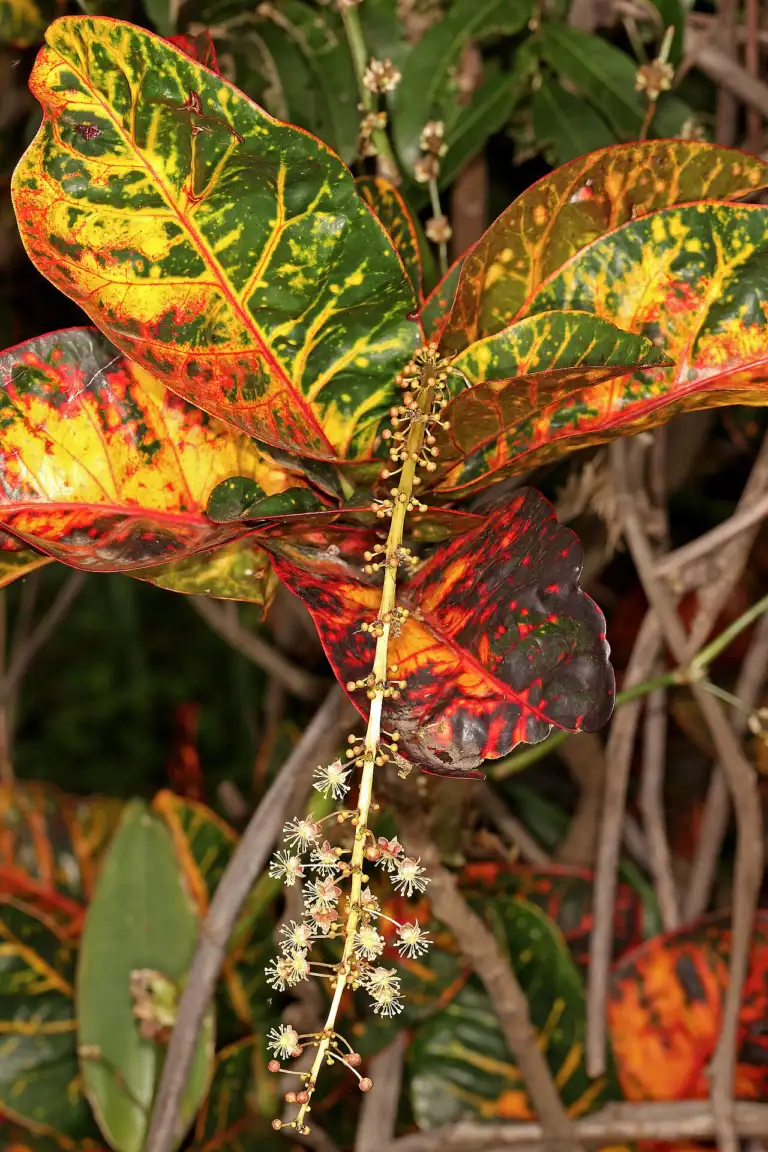
Flowering indoors is not a sign of a problem. Many growers snip the flower spikes off so the plant puts its energy into leaves.
Croton Petra vs Other Croton Cultivars
All of these are the same species, so care is nearly identical, but leaf shape is the quickest way to tell them apart. Look at the outline of one mature leaf first, then at how the color is placed: along the veins, in spots, or in streaks.
| Cultivar | Leaf shape | Color pattern | Quick check |
|---|---|---|---|
| ‘Petra’ | Broad, pointed-oval, flat | Dark green with yellow, orange and red veins | Color follows the veins like a painted outline |
| ‘Mammy’ | Elongated and twisted or curled | Greens and purples with bits of red | Leaves spiral instead of lying flat |
| ‘Gold Dust’ | Smaller, rounded oval | Bright green speckled with gold dots | Spots, not veins |
| ‘Zanzibar’ | Very long, narrow, grass-like | Purple, red, orange and gold | Arching, strap-like leaves |
| ‘Oakleaf’ | Lobed like an oak leaf | Green to bronze with red, orange or yellow veins | Deep indentations along the edge |
| ‘Eleanor Roosevelt’ | Long and slender | Medium green with gold spots, aging to red | Narrow leaves with spots |
Descriptions are based on the Wisconsin Horticulture cultivar list. If your plant has twisted leaves, see our Croton Mammy care guide instead.

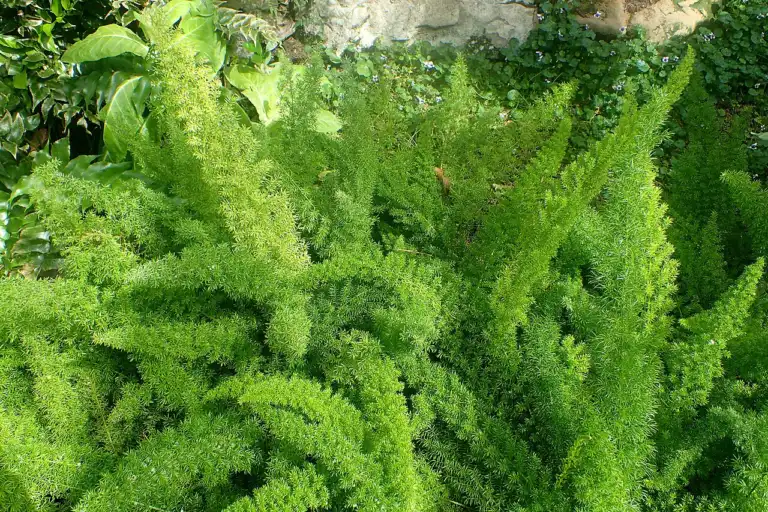
Gold Dust (above) carries its yellow as dots on smaller leaves, while Petra carries it along the veins of much larger leaves.
Croton Petra Light Needs
Light controls Petra’s color more than anything else you do. The yellow, orange and red pigments show best in bright light, and in dim rooms new leaves come in mostly green.
Indoors
Place Petra in the brightest spot you have, close to a window that gets strong daylight for most of the day. UF/IFAS Gardening Solutions recommends Petra for indoor use because it holds its color in indoor light better than many cultivars, but notes that even Petra will lose some color without enough light.
- An east-facing window with morning sun works well in most homes.
- A south- or west-facing window is good if a sheer curtain softens the hottest afternoon sun (south-facing in the Northern Hemisphere; north-facing in the Southern Hemisphere).
- Turn the pot a quarter turn every week or two so all sides get light.
- If natural light is weak in winter, a full-spectrum grow light helps. Our guide to which light color is best for plant growth explains what to look for.
I have found that moving a plant to a brighter spot with indirect sunlight makes a visible difference in its growth, and with Petra that difference shows up as stronger color on the next set of leaves.
Outdoors by Climate
Petra can live outdoors all year only in frost-free climates. NC State lists USDA zones 11 to 12, and UF/IFAS says crotons do best in subtropical South and Central Florida, where frost damages them but they usually recover.
- Tropical and frost-free regions (South Florida, Hawaii, Southeast Asia, much of South Asia’s warm lowlands, northern Australia): grow it in the ground in full sun to light shade. In very hot, dry summers, afternoon shade protects the leaves.
- Warm temperate regions (most of the southern US, the Mediterranean): use it as a summer patio plant and bring it indoors before nights drop to 50°F (10°C), as advised by NC State.
- Cool climates (UK, northern Europe, Canada, northern US): treat it as a houseplant. A sheltered summer spot outside is possible only during steady warm weather.
Move it gradually. Wisconsin Horticulture warns that changing a croton’s environment too quickly can shock it into dropping leaves, so give it a week in shade before full sun outside, and the reverse when bringing it in.
How to Water Croton Petra
Water Croton Petra when the top half inch to one inch of soil feels dry, then soak it until water runs from the drainage hole. Both soggy soil and long dry spells cause leaf drop, so the goal is even moisture.
- Push a finger into the soil up to the first knuckle.
- If it feels damp, wait and check again in a day or two.
- If it feels dry, water slowly with room-temperature water until it drains out the bottom.
- Empty the saucer after 15 minutes so the roots do not sit in water.
- In winter, when growth slows, check less often and expect the soil to stay damp longer.
I have learned that checking the soil before watering, instead of watering on a fixed day, is the simplest way to prevent overwatering. This matters with Petra because a fixed “once a week” schedule can be too much in a cool winter room and too little next to a sunny summer window.
Yellow, soft lower leaves with wet soil usually point to overwatering. Our guide on why plant leaves turn yellow covers the other causes.
Temperature and Humidity
Croton Petra does best between 60 and 85°F (16 to 29°C) and often drops leaves if temperatures stay below 50°F (10°C), according to Wisconsin Horticulture. Stable conditions matter as much as the numbers.
- Keep it away from air conditioning vents, heaters, and doors that open to cold air.
- Do not let leaves touch a cold window pane in winter.
- Humidity should be moderate to high. Grouping plants together, using a humidifier, or setting the pot on a tray of wet pebbles (with the pot above the water line) all help.
- Misting raises humidity only for a short time, so treat it as a bonus, not the main fix.
Soil, Pot and Fertilizer
Use a rich, well-draining potting mix in a pot with a drainage hole. NC State recommends soil high in organic matter with good drainage; adding perlite or fine bark to a standard houseplant mix achieves this.
- Repotting: repot in spring only when roots fill the pot or circle the bottom, moving up one size (about 2 inches wider). Petra dislikes disturbance, so do not repot a newly bought plant that is still settling in.
- Fertilizer: Wisconsin Horticulture suggests feeding once or twice during the growing season, or more often for faster growth. A balanced houseplant fertilizer at half strength in spring and summer is enough. Skip feeding in fall and winter.
- Too much fertilizer can leave salt crust on the soil and brown leaf tips. Flush the pot with plain water if you see this.
Pruning and Propagation
Prune Petra in spring or early summer to shape it or remove leggy stems, cutting just above a leaf joint. Always wear gloves: NC State notes the clear to milky sap can irritate skin and soft tissue, and it permanently stains fabric.
The two reliable ways to make new plants are listed by Wisconsin Horticulture: air layering in spring and softwood stem cuttings in summer.
- Cut a healthy stem tip about 4 to 6 inches long, just below a leaf joint.
- Rinse the cut end to stop the sap flow and remove the lower leaves.
- Dip the end in rooting hormone (optional) and insert it into moist, airy mix such as peat or coir with perlite.
- Cover with a clear bag or keep it in a humid spot with bright, indirect light and warmth.
- Expect roots in several weeks. Cuttings root more slowly in cool rooms.
Growing Petra from seed is not useful at home. Wisconsin Horticulture points out that seedlings do not look like the parent, so the Petra color pattern is only kept through cuttings or layering.
Settling In a New Croton Petra: 7-Day Checklist
New crotons often drop a few leaves in the first weeks because of the change in light, temperature and humidity between the nursery and your home. This is shock, not necessarily a care mistake, and it usually stops once the plant adjusts.
- Day 1: choose its permanent bright spot and leave it there. Repeated moves make leaf drop worse.
- Day 1: check the soil. Water only if the top inch is dry.
- Days 2 to 3: look under the leaves and along stems for webbing, white fluff or small bumps (pests from the store).
- Days 2 to 7: keep it away from vents, heaters and cold drafts.
- Days 3 to 7: do not fertilize or repot yet.
- Day 7: check the soil again and water if needed. A few yellow or dropped lower leaves are normal.
- After week 1: keep observing. New leaves appearing at the tips are the best sign it has settled.
I believe that observing a plant regularly and adjusting its care to what it shows you is the most reliable habit for healthy indoor plants, and Petra rewards that patience.
Croton Petra Problems and Fixes
Most Petra problems trace back to light, temperature changes or watering. Use this table to match the symptom to the likely cause.
| Symptom | Most likely cause | Fix |
|---|---|---|
| Sudden drop of lower leaves | Move, cold draft, temperature below 50°F, or watering swings | Keep it in one warm, bright spot and water evenly |
| New leaves mostly green | Too little light | Move closer to a bright window or add a grow light |
| Gray, dull or bleached patches | Too much harsh direct sun | Filter afternoon sun with a sheer curtain |
| Yellow, soft leaves and wet soil | Overwatering or poor drainage | Let soil dry more between waterings; check the drainage hole |
| Drooping, limp leaves and dry soil | Underwatering | Water thoroughly; new foliage wilts first when thirsty (UF/IFAS) |
| Brown, crispy edges | Dry air or salt buildup | Raise humidity; flush soil with plain water |
| Fine webbing, speckled leaves | Spider mites | See pests below |
Pests
The usual croton pests are mealybugs, spider mites and scale insects (Wisconsin Horticulture), with UF/IFAS also listing thrips. Spider mites are most common in warm, dry indoor air.
- Spider mites: tiny dots and fine webbing under leaves, with speckled, dull leaves. Rinse the plant in the shower and raise humidity; repeat weekly.
- Mealybugs: white, cottony clumps in leaf joints. Wipe off with a cotton swab dipped in rubbing alcohol.
- Scale: small brown bumps on stems and leaf veins. Scrape off gently and treat with insecticidal soap or horticultural oil, following the label.
The same gentle methods in our guide to getting rid of aphids on indoor plants also work for many soft-bodied croton pests.
Is Croton Petra Toxic to Pets and People?
Yes, Croton Petra is mildly poisonous and its sap can irritate skin. NC State Extension rates its poison severity as low, lists diterpene esters as the toxic compounds, and notes that eating it can cause nausea, vomiting and diarrhea, with large amounts needed for serious poisoning.
- People and children: the sap can cause itching and swelling, and repeated contact can lead to allergic skin rash (NC State Extension). Wear gloves when pruning.
- Cats and dogs: UF/IFAS advises keeping children and pets from nibbling croton leaves because of their irritating and poisonous qualities. Place the plant where pets cannot chew it.
If a person or pet has eaten part of a croton and shows symptoms, contact your local poison control center or veterinarian right away.
How to Check Your Plant Yourself
If you are not sure your plant is Petra or another croton, compare one mature leaf with the cultivar table above, then confirm with a photo. Take the photo in daylight, fill the frame with one flat leaf, and include a second shot of the whole plant.
You can upload it to our plant identifier or the leaf identifier for a quick suggestion. Photo identification, including our tool, can be wrong, so it is not a substitute for an expert when safety matters, such as a pet that has chewed a plant.
Final Tips for a Colorful Croton Petra
Croton Petra stays full and colorful when three things stay steady: bright light, even moisture and warmth above 60°F. Fix light first if color fades, and look for drafts or watering swings first if leaves drop. Growing indoor plants has shown me how small, consistent adjustments like these support healthier growth over time.
Frequently Asked Questions
Why is my Croton Petra losing leaves?
The most common causes are a recent move, cold drafts, temperatures below 50°F (10°C), or swinging between soggy and bone-dry soil. Keep it in one bright, warm spot and water when the top inch of soil is dry; new plants usually stop dropping leaves once they adjust.
Why are my Croton Petra leaves turning green?
Green new growth means the plant is not getting enough light. Move it closer to a bright window or add a grow light; the next leaves should show stronger yellow, orange and red veins.
Can Croton Petra take direct sun?
Outdoors in frost-free climates it can grow in full sun to light shade. Indoors, a few hours of gentle morning sun is ideal; harsh afternoon sun through glass can leave gray, dull or bleached patches.
Is Croton Petra toxic to cats and dogs?
Croton is mildly poisonous. NC State Extension lists nausea, vomiting and diarrhea if eaten and skin irritation from the sap, and UF/IFAS advises keeping pets and children from chewing the leaves. Call a vet if a pet eats it and shows symptoms.
How often should I water Croton Petra?
There is no fixed schedule. Water when the top half inch to one inch of soil is dry, which may be every few days in summer and much less often in winter.
What is the lowest temperature Croton Petra can tolerate?
It grows best between 60 and 85°F (16 to 29°C). Below 50°F (10°C) leaf drop is common, and frost damages the plant, so bring outdoor plants inside before nights get that cold.
Featured image: Photo: Karl Thomas Moore / Wikimedia Commons, CC BY-SA 4.0