

Adonidia Palm Care: Light, Water, Feeding and Problem Fixes
Adonidia palm care is simple once you know the palm’s few real limits: it wants strong light, steady moisture with good drainage, a palm fertilizer, and protection from frost. The Adonidia palm (Adonidia merrillii, family Arecaceae), also sold as the Christmas palm or Manila palm, is one of the most planted small palms in warm climates and one of the most bought palms for patios and bright rooms elsewhere.
This guide gives you a care routine you can follow, explains what each frond symptom usually means, and shows how the advice changes depending on where you live.
Quick Answer: How to Care for an Adonidia Palm
Grow an Adonidia palm in full sun to light shade, in soil that drains well. Water when the top 2 inches (5 cm) of soil feel dry, feed three times a year with a palm fertilizer, and keep it above 30°F (about minus 1°C). Never cut fronds that still have green tissue.
| Care factor | What the palm needs |
|---|---|
| Light | Full sun (6 or more hours) outdoors; brightest spot available indoors |
| Water | Twice a week for the first month after planting, then about weekly in warm, dry weather; always check the soil first |
| Soil | Any well-drained soil; sand, loam or clay are tolerated if water does not pool |
| Fertilizer | Palm fertilizer such as 8-2-12+4Mg, three times a year from spring to fall |
| Cold limit | Damage starts near 30°F (-1°C); best outdoors in USDA zones 10 to 11 |
| Pruning | Rarely needed; the palm drops dead fronds on its own |
| Main risk | Lethal yellowing disease in regions where it occurs, such as Florida and the Caribbean |
| Pets | Listed as non-toxic to dogs, cats and horses by the ASPCA |
How to Recognize an Adonidia Palm
An Adonidia palm has a single smooth grey trunk ringed with leaf scars, a smooth light green crownshaft, and arching feather-shaped fronds. The National Parks Board of Singapore describes fronds 1.5 to 2 m long with drooping leaflets about 60 cm long, and a crown that stays compact compared with a royal palm (NParks Flora and Fauna Web).
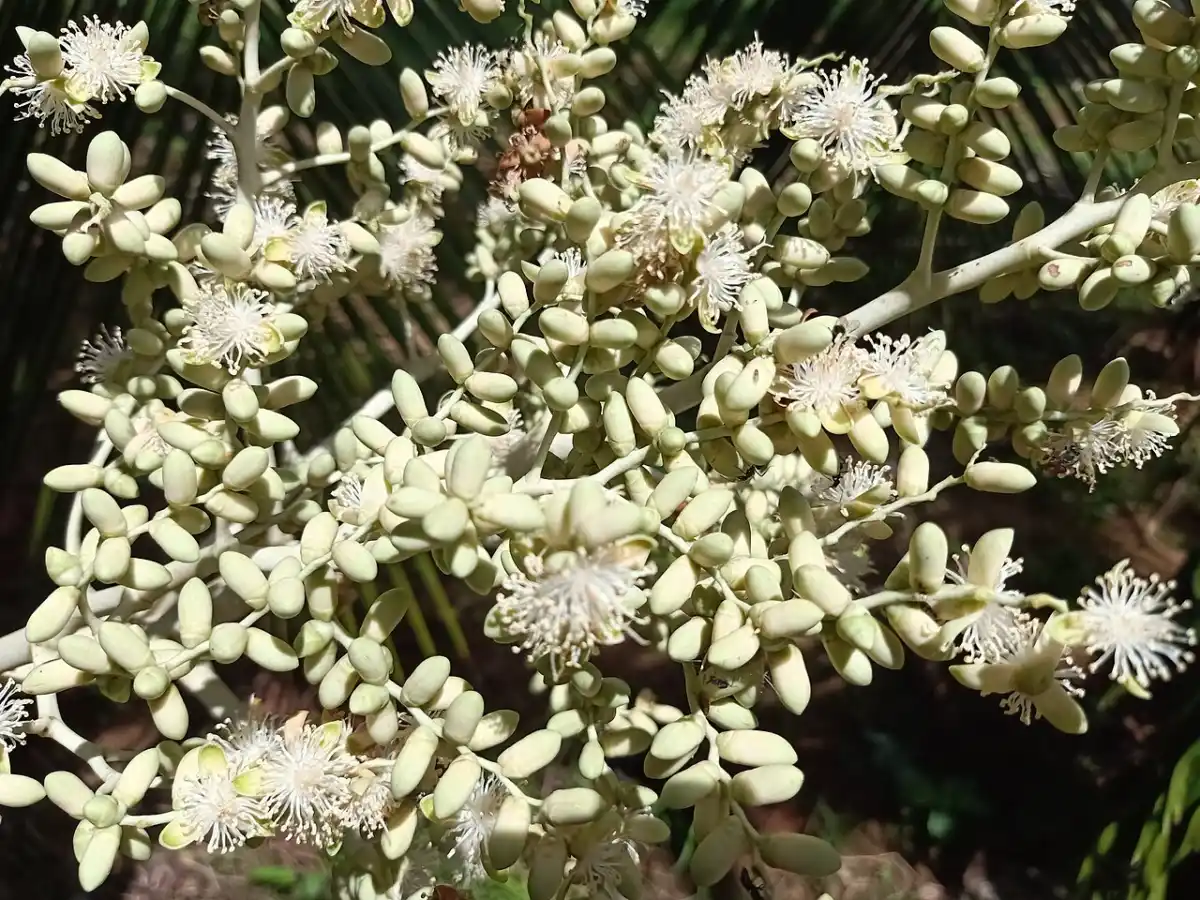
Cream flower clusters form just below the crownshaft in summer. They ripen into glossy red fruits about 3 cm long from late fall into winter, which is where the name Christmas palm comes from. NC State Extension lists a mature height of up to 25 feet (about 7.5 m), with fronds 4 to 5 feet long (NC State Extension Plant Toolbox). Older books and nurseries still use the synonym Veitchia merrillii, and the species is native to the Philippines, especially Palawan.
Adonidia vs Royal Palm vs Foxtail Palm
Young palms are often mislabeled at garden centers, and care differs by species. Use this table to check what you have before you follow any care routine.
| Feature | Adonidia palm (Adonidia merrillii) | Royal palm (Roystonea regia) | Foxtail palm (Wodyetia bifurcata) |
|---|---|---|---|
| Mature height | Up to about 25 ft | Much taller; a large landscape tree | Medium-sized, taller than Adonidia |
| Trunk | Slim, smooth grey, about 6 in wide | Massive, grey, often bulging | Grey, ringed, moderately slim |
| Leaflets | Arranged in a flat plane, arching downward | Arranged in several planes along the leaf | Radiate all around the leaf stem like a bottlebrush |
| Fruit | Bright red, about 3 cm, winter | Small, dark purple to black | Larger, orange-red |
| Native range | Philippines | Cuba and South Florida | Queensland, Australia |
If you are not sure which palm you have, take a clear daylight photo of a whole frond and the crownshaft and try our plant identifier or the leaf identifier. Photo identification, including our tool, can be wrong, so confirm with a local nursery or extension office when it matters.
Light Needs for an Adonidia Palm
Outdoors, an Adonidia palm grows best in full sun and tolerates partial shade. UF/IFAS Gardening Solutions says it grows best in full sun but can tolerate partial shade (UF/IFAS Gardening Solutions). In heavy shade the trunk grows thin and the crown looks sparse.
Indoors, the RHS recommends bright, filtered light for houseplants (RHS). A spot near the brightest window is usually needed, and a grow light helps in dark winters.
Moving a Shade-Grown Palm Into Sun
Many nursery palms are grown under shade cloth, so their fronds burn if they go straight into full sun or behind a hot west-facing window. Growers on the PalmTalk forum report exactly this: a new palm placed in strong afternoon sun developed scorched, papery fronds and recovered once it was moved to gentler light and reintroduced slowly.
- Week 1: give the palm morning sun only, about 2 to 3 hours, with shade in the afternoon.
- Week 2: increase to about half a day of sun.
- Week 3 and later: move it to full sun if it is planted outdoors in a warm climate.
- Scorched fronds will not turn green again. Leave them until they are fully brown, because the palm still draws nutrients from them.
The Palmfather YouTube channel makes the same point for 7-gallon nursery palms: start them on about half a day of sun rather than full exposure.
How to Water an Adonidia Palm
Water an Adonidia palm when the top 2 inches (5 cm) of soil are dry, and water deeply enough that the whole root ball is moistened. For a newly planted palm, water thoroughly about twice a week for the first month, then about once a week once roots establish, adjusting for rain and heat.
UF/IFAS notes the palm is fairly drought tolerant once established, but that is not the same as thriving dry. In one Houzz discussion, a homeowner assumed overwatering caused a trio of palms to yellow, and the answer they received pointed to dry soil instead. The finger test settles this question better than any calendar.
- Check first: push a finger 2 inches into the soil near the root ball. Dry means water; damp means wait.
- Containers: water until it runs from the drainage holes, then empty the saucer.
- Indoors: the RHS advises letting the top inch or so dry between waterings and warns the palm dislikes waterlogging.
- Mulch: a mulch ring helps hold moisture outdoors, but keep it a few inches away from the trunk.
Soil, Planting and Spacing
An Adonidia palm is not fussy about soil type as long as water drains away. NC State Extension lists clay, loam and sand, and acid, neutral or alkaline pH as acceptable, and UF/IFAS notes it adapts well to Florida’s nutrient-poor sandy soils.
- Choose a sunny site away from cold winds and at least a few feet from walls, so the crown can spread 5 to 8 feet.
- Dig a hole about twice as wide as the root ball but no deeper. Palms planted too deep often decline.
- Set the palm at the same depth it grew in the pot, backfill with the native soil, and water to settle it.
- Plant in the warm season so roots establish before any cool weather. Our guide on the best time to plant trees explains why timing matters.
Adonidia palms are often planted in groups of two to four for curving multi-trunk clumps. UF/IFAS warns that competition in these groups can cause one or more palms to fail, so give clumps extra water and fertilizer.
Fertilizer and Nutrient Deficiencies
Feed an Adonidia palm with a palm-specific, slow-release fertilizer three times a year, spring through fall. UF/IFAS recommends products labeled 8-2-12+4Mg or 8-0-12+4Mg for landscape palms, because they supply potassium and magnesium in the right balance and include micronutrients (UF/IFAS Palm Nutrition).
Feeding is what separates a full, thick-trunked palm from a thin one. The Palmfather channel describes underfed Adonidias in Florida as skinny, pencil-thin palms, while fed and watered ones look full. Indoor palms need feeding only in spring and summer, at a lighter rate.
Where a symptom first appears tells you a lot. Older (lower) fronds show mobile nutrient shortages, while the newest fronds show immobile ones. The guidance below follows UF/IFAS Palm Nutrition.
| Nutrient | Where it starts | What you see |
|---|---|---|
| Potassium (K) | Oldest fronds | Yellow or orange spots, brown dead leaflet tips; the most common palm deficiency |
| Magnesium (Mg) | Oldest fronds | Bright yellow band along the leaf edges with a green center |
| Manganese (Mn) | Newest fronds | Pale new leaves with dead streaks, sometimes frizzled; cold soil can trigger it temporarily |
| Boron (B) | Newest fronds | Sharply bent or stunted leaf tips, spears that fail to open, crown growing sideways |
| Iron (Fe) | Newest fronds | Even yellowing of new leaves, often from poor drainage or deep planting |
NC State Extension and UF/IFAS both single out boron deficiency as a known problem for Christmas palm. Do not cut yellowing fronds to tidy the palm: UF/IFAS explains that removing them takes away nutrients the palm is moving to new growth. Recovery is slow, and UF/IFAS notes that correcting a deficiency can take six months to two or three years. For a broader look at yellow foliage on other plants, see why plant leaves turn yellow.
Temperature, Hardiness Zones and Climate
An Adonidia palm is a tropical palm that is hardy only to about 30°F (about minus 1°C), according to UF/IFAS. It grows outdoors year-round in USDA zones 10 to 11 and similar frost-free climates. Some retailers list “zones 3 to 11,” but that only means a container that comes indoors before cold weather.
Cold damage is not always immediate death. The Palmfather channel notes that below about 30°F many Adonidias die, and survivors can show damaged fronds and a narrow, pinched section of trunk where growth stalled. Forum growers in cooler subtropical areas also report leaf spotting after cool, wet winters.
| Climate | Examples | What changes in care |
|---|---|---|
| Humid tropical | Philippines, Southeast Asia, Caribbean, Hawaii, South Florida | Plant in the ground in full sun; focus on fertilizer and, in Florida and the Caribbean, lethal yellowing watch |
| Hot and dry tropical or subtropical | Frost-free desert-edge and monsoon climates | Water deeply and more often in the hot season; young palms appreciate afternoon shade; mulch |
| Mild subtropical with rare frost | Central Florida, coastal Southern California, southeast Queensland | Plant in a sheltered warm spot or keep in a large pot; cover or wrap during cold snaps; expect slower growth |
| Temperate with cold winters | UK, northern Europe, Canada, northern US | Grow as a container or houseplant; move indoors before nights reach about 40°F (4.5°C) |
When a freeze is forecast, move potted palms indoors or into a garage, and cover in-ground palms with frost cloth that reaches the ground. Water the soil a day before, since moist soil holds heat better than dry soil.
Growing Adonidia Indoors or in Containers
An Adonidia palm can grow indoors if it gets very bright light, warmth and moderate humidity. The RHS gives an optimal range of 18 to 28°C with a minimum of 15°C for houseplants, and NParks notes it needs strong light indoors.
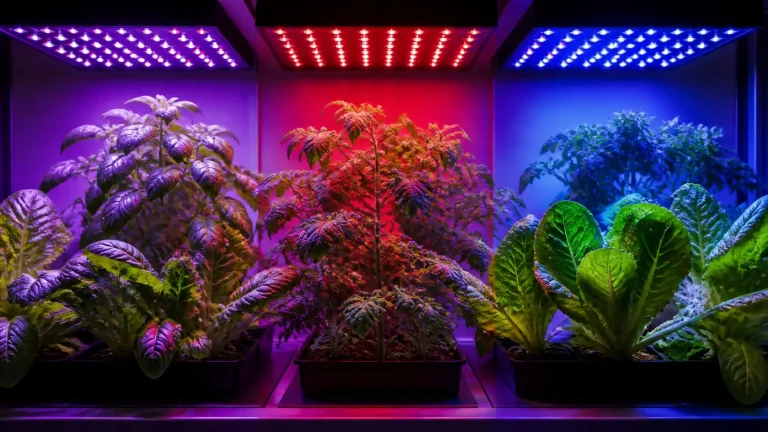
- Light: place it near the brightest window, and add a full-spectrum grow light in winter. Our article on which light color is best for plant growth explains what to look for in a grow light.
- Pot: use a pot with drainage holes and a free-draining mix with added grit or perlite.
- Crowded 3-packs: palms are often sold three to a pot. Each is a single-trunk palm, so move them up to a larger container (PalmTalk growers suggest around 7 gallons) or separate them carefully when young.
- Humidity: very dry indoor air can brown leaflet tips. Grouping plants or using a humidifier helps more than occasional misting.
- Summer outdoors: in cold climates, a summer outside in a bright, sheltered spot can boost growth. Bring it in well before the first cold nights.
Pruning: Let the Palm Clean Itself
An Adonidia palm is self-cleaning, which means old fronds drop off on their own once they die. UF/IFAS describes it as a palm that drops dead leaves cleanly, which keeps pruning to a minimum.
- Remove only fronds that are completely brown, or ones that hang dangerously.
- Never cut fronds that still show green or yellow; they feed new growth.
- Never cut into the crownshaft or the central spear.
- Use clean, sharp tools, and wipe them between palms to avoid spreading disease.
- Flower and fruit stalks can be removed if fallen fruit is a nuisance on patios.
Common Adonidia Palm Problems and How to Fix Them
Most Adonidia problems come from light shock, cold, water extremes or poor nutrition, and only a few come from disease. Start with where the damage appears and when it started.
Read the Fronds: Symptom Table
| Symptom | Where it starts | Most likely cause | What to do |
|---|---|---|---|
| Bleached or crispy brown patches | Fronds facing the sun | Sunburn after a move from shade | Shade it and reintroduce sun gradually |
| Yellow-orange spotting, brown tips | Oldest fronds | Potassium deficiency | Feed with 8-2-12+4Mg; do not cut those fronds |
| Yellow edges, green center | Oldest fronds | Magnesium deficiency | Use a palm fertilizer with magnesium |
| Bent tips, unopened spears, leaning crown | Newest fronds | Boron deficiency | Apply boron only at label rates; excess is toxic |
| Dark spots spreading after cool, wet weather | Any fronds | Cold stress with fungal leaf spot | Improve air flow, avoid wetting foliage, protect from cold |
| Many fronds yellowing and dropping | Throughout | Drought or root problems | Check soil moisture and drainage |
| Fronds turning reddish-brown to grey, oldest first, fruit dropping | Older to younger fronds | Possible lethal yellowing | Contact a certified arborist or extension office quickly |
Lethal Yellowing on Adonidia
Lethal yellowing is an incurable disease caused by a phytoplasma (Candidatus Phytoplasma palmae) and spread by a planthopper, Haplaxius crudus. UF/IFAS EDIS lists Adonidia merrillii as a susceptible species (UF/IFAS EDIS, Lethal Yellowing of Palm).
On Adonidia the disease does not look like simple yellowing. EDIS describes leaves turning shades of reddish-brown to dark brown or grey, progressing from older to younger fronds, with the spear leaf usually staying unaffected until the other leaves have died. Fruit often drops early. Infected palms usually die within 3 to 5 months of the first symptoms.
- Prevention: in affected regions, trunk injections of the antibiotic oxytetracycline every four months can protect healthy palms. This must be done by a professional.
- Removal: EDIS advises removing palms with more than 25% of the canopy discolored, since treatment no longer helps.
- Where it matters: the disease is a concern in Florida, the Caribbean, parts of Central America and other regions where it has been found. Many tropical regions have no reported cases, so check with your local extension or agriculture office.
Pests to Watch For
Adonidia palms are not pest-free, despite what some sales pages say. NC State Extension lists banded greenhouse thrips, root mealybugs and scale insects, and the RHS adds aphids and spider mites for indoor plants.
- Check the undersides of leaflets and the crownshaft for white fluff (mealybugs), bumps (scale) or fine webbing (spider mites).
- Wipe light infestations off with a damp cloth, or spray with insecticidal soap, following the label.
- Indoor pests spread fast between plants; our guide to getting rid of aphids on indoor plants covers safe treatments that also work on other soft-bodied pests.
Growing Adonidia From Seed
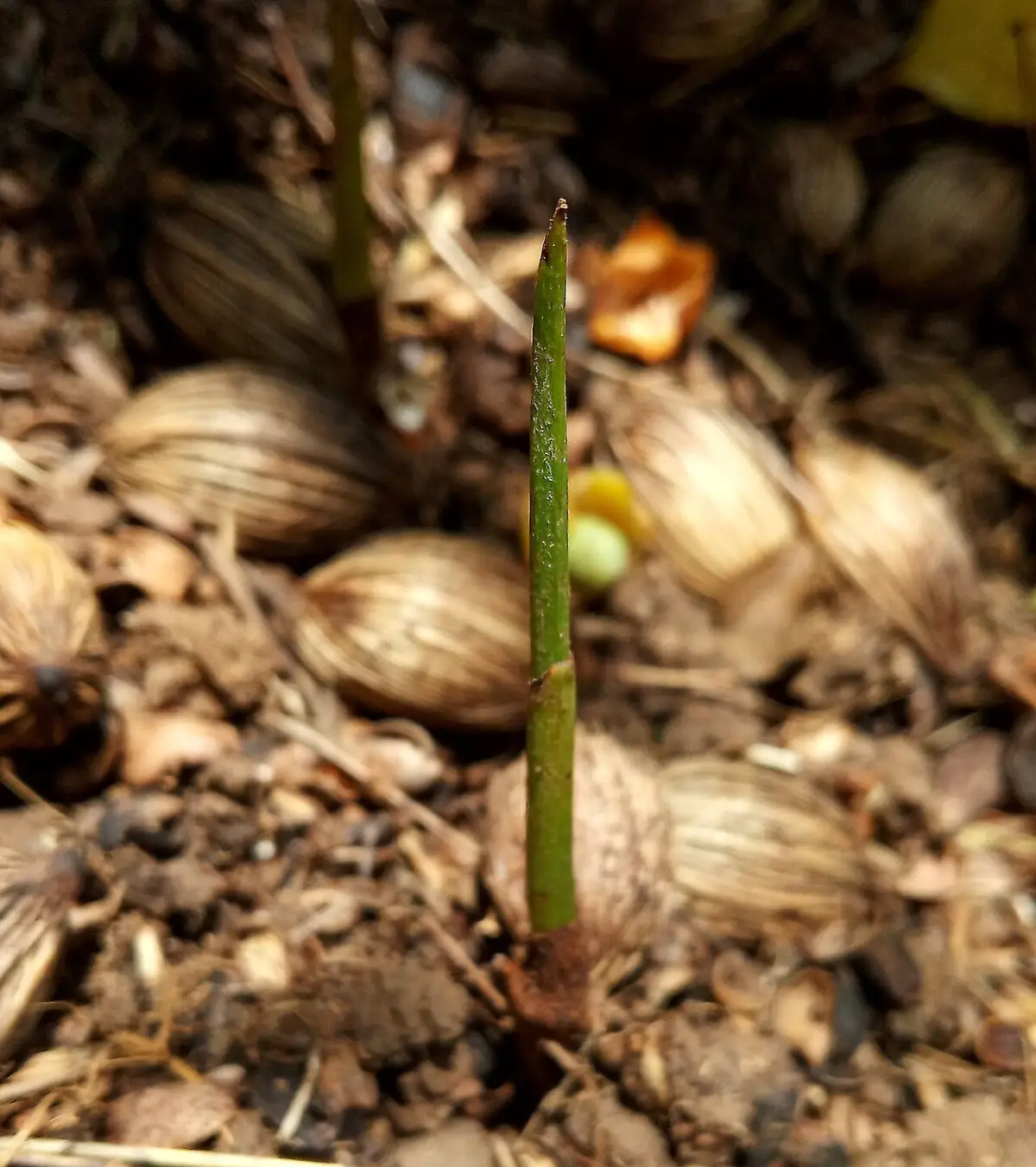
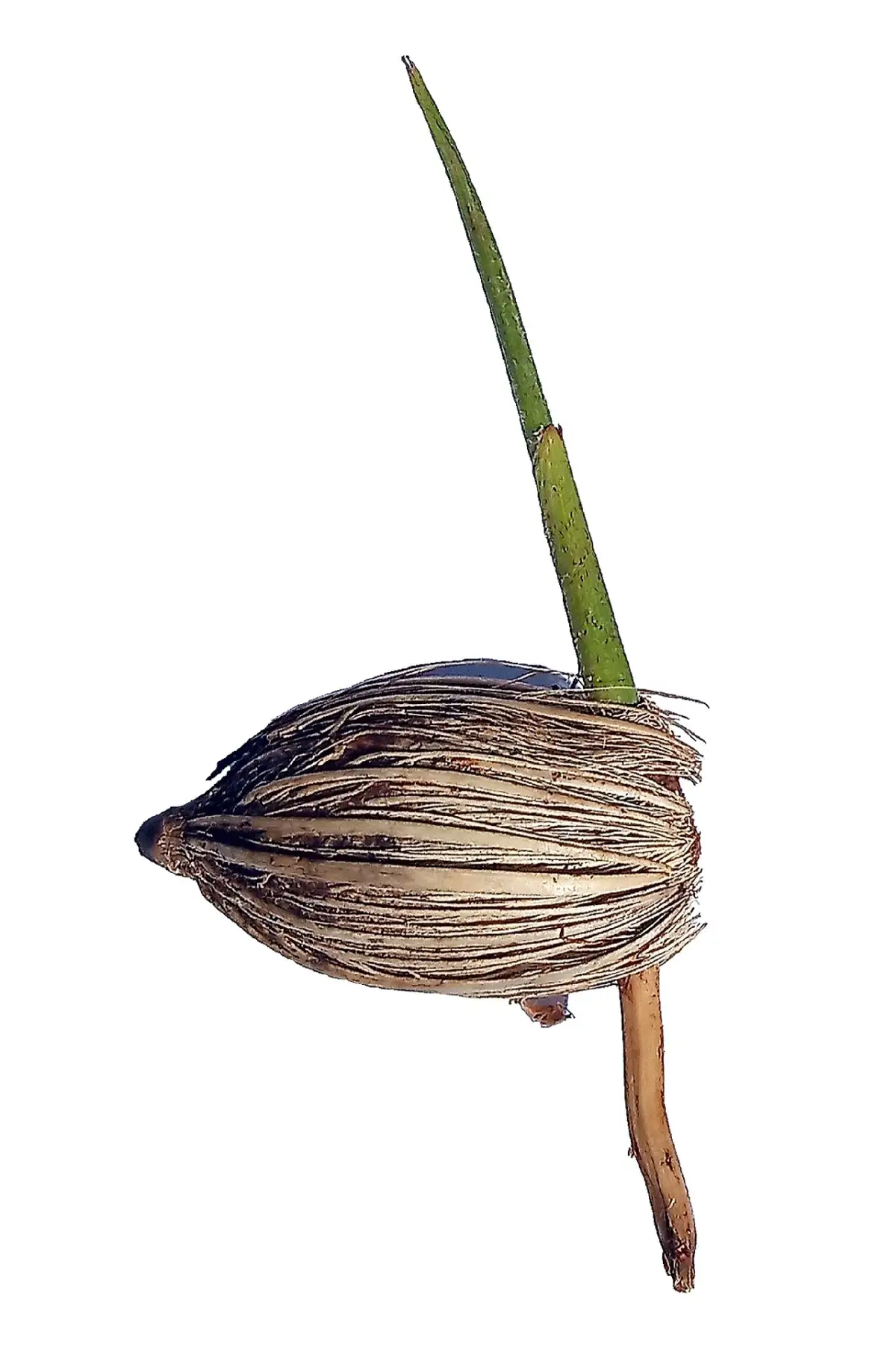
Adonidia palms grow only from seed, and fresh seed germinates in about 1 to 3 months, according to NParks and the National Tropical Botanical Garden.
- Collect fruits once they are fully red.
- Wear gloves and remove the fleshy pulp. NParks notes the pulp contains oxalate that can irritate sensitive skin.
- Soak cleaned seeds in water for a day, as the RHS suggests.
- Sow them just below the surface in a moist, free-draining mix and keep them warm, ideally above 75°F (24°C).
- Pot each seedling once its first leaf opens.
Is the Adonidia Palm Toxic to Pets or People?
The ASPCA lists the Christmas palm (Adonidia merrillii) as non-toxic to dogs, cats and horses (ASPCA). That does not make the fruit a snack. The pulp can irritate skin, and large seeds can be a choking risk for small pets and children.
If a person or pet eats any plant and shows symptoms, contact poison control or your vet right away. For a comparison with a common houseplant that is toxic to cats, see are snake plants toxic to cats.
A Practical Care Routine That Works
I have learned that checking the soil before watering prevents overwatering and keeps plants healthy, and that habit matters with an Adonidia palm more than any fixed schedule. I have also found that placing plants in a suitable spot with the right light makes a clear difference in growth, which is exactly why sun acclimation matters so much for this palm.
Above all, I believe that observing plants regularly and adjusting care to what they show is essential. With an Adonidia, that means looking at which fronds change first, old or new, before reaching for fertilizer or a spray bottle.
Watch: Adonidia Palm Overview
This short video from The Palmfather shows mature and nursery Christmas palms in South Florida and explains feeding, cold limits and sun for young potted palms.
Key Takeaways
A healthy Adonidia palm needs bright sun introduced gradually, deep watering when the top soil dries, palm fertilizer three times a year, and protection below 30°F. Leave yellowing fronds in place, read where symptoms start, and in lethal yellowing regions, act fast on reddish-brown fronds. If you are unsure which palm you are growing, check it with our plant identifier before changing its care.
Frequently Asked Questions
How often should I water an Adonidia palm?
Water when the top 2 inches of soil are dry. New plantings usually need deep watering twice a week for the first month, then about once a week in warm, dry weather. Water less in cool or rainy periods and indoors in winter.
What is the best fertilizer for an Adonidia palm?
A slow-release palm fertilizer labeled 8-2-12+4Mg or 8-0-12+4Mg, applied three times a year from spring to fall, is the UF/IFAS recommendation for landscape palms. Indoor palms need lighter feeding in spring and summer only.
How cold can an Adonidia palm tolerate?
UF/IFAS lists the Christmas palm as cold hardy only to about 30°F (about -1°C). It grows outdoors year-round in USDA zones 10 to 11; in colder areas keep it in a pot and bring it indoors before nights reach about 40°F.
Why are my Adonidia palm fronds turning brown?
Brown patches on sun-facing fronds usually mean sunburn after a move from shade. Spotted older fronds point to potassium deficiency, and dark spots after cool, wet weather suggest cold stress. Reddish-brown to grey fronds progressing from old to new can signal lethal yellowing and need an expert check.
Is the Adonidia palm toxic to cats and dogs?
The ASPCA lists the Christmas palm (Adonidia merrillii) as non-toxic to dogs, cats and horses. The fruit pulp can irritate skin, so call your vet if a pet eats the fruit and shows symptoms.
Can an Adonidia palm grow indoors?
Yes, if it gets very bright light, temperatures of about 18 to 28°C with a minimum near 15°C, and a free-draining pot. A grow light helps in dark winters.
Featured image: Photo: Forest & Kim Starr / Wikimedia Commons, CC BY 3.0



2 Comments