

Musa Basjoo Banana Care: Sun, Water, Feeding and Winter Protection by Climate
Musa basjoo, the Japanese banana, is the banana people in cold-winter places can actually keep. Frost kills its leaves every year in most gardens, yet the plant comes back from the ground in spring. Good care is mostly about two things: feeding a very hungry plant in summer, and keeping its underground rhizome dry and insulated in winter.
This guide covers both, with a climate table so you can pick the winter method that suits where you live, whether that is a UK city garden, a US zone 6 backyard or a hot subtropical courtyard.
Quick Answer
To care for Musa basjoo, plant it in full sun or light shade, shelter it from wind, and give it rich, moist soil that never stays waterlogged. Water deeply whenever the top few centimetres of soil feel dry, and feed it every two weeks in spring and summer because it is a heavy feeder. After the first frost blackens the leaves, protect the pseudostem and rhizome with wrapping and a thick mulch, or move potted plants into a cool, frost-free place.
- Light: 6 or more hours of sun is ideal; part shade works with slower growth.
- Water: consistently moist in the growing season, much drier in winter.
- Feeding: regular feeding from spring to late summer.
- Hardiness: leaves are damaged around 0°C (32°F); the rhizome survives about -23°C (-10°F) when well mulched, according to NC State Extension.
- Winter: wrap or cut and mulch in the ground; store pots cool and nearly dry.
How to Recognise Musa basjoo
Musa basjoo (Japanese banana, hardy banana or Japanese fibre banana) belongs to the banana family, Musaceae. It was once listed as Musa japonica, and despite the common name it is native to Sichuan in China, as NC State Extension explains.
The “trunk” is not wood. It is a pseudostem made of tightly rolled leaf sheaths, and the real growing point sits in an underground rhizome. Knowing this is the key to winter care: you are protecting the rhizome first and the pseudostem second.
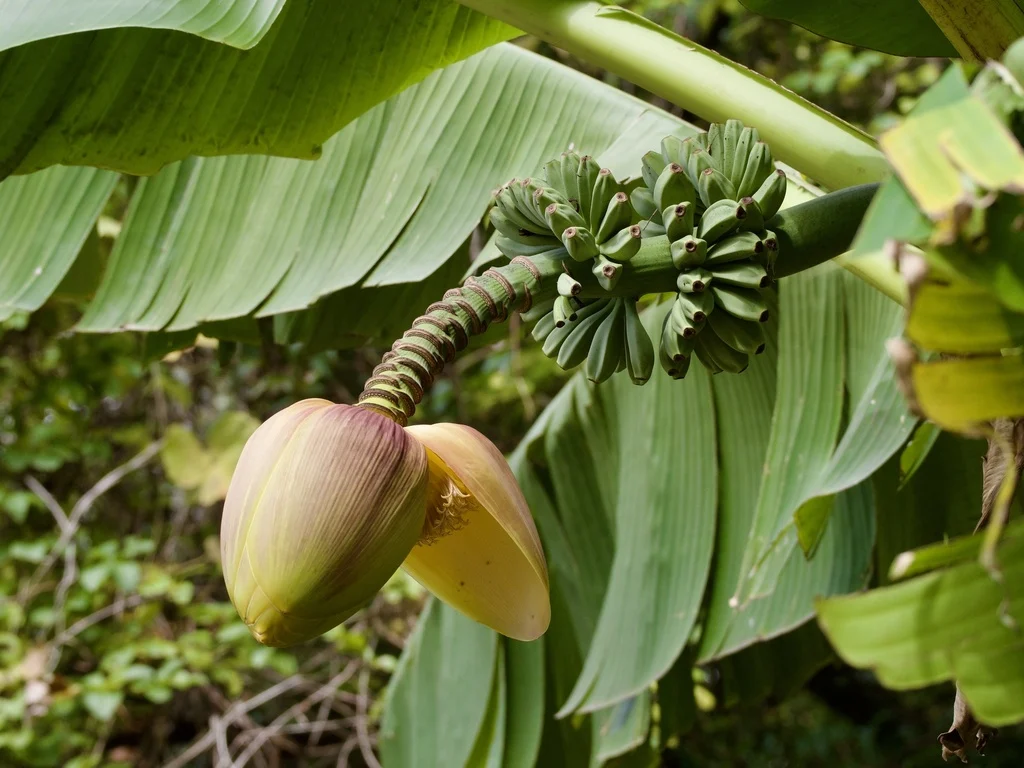
Features you can check with your own eyes:
- Leaves: bright green, paddle-shaped, smooth, up to about 1.8 m (6 ft) long and 60 cm (2 ft) wide on a stalk up to 30 cm (12 in).
- Stem: a soft green pseudostem; new leaves unroll from the top like a cigar.
- Height: commonly 1.8 to 4.3 m (6 to 14 ft) in one season once established.
- Flowers: a hanging stalk with cream to yellow tubular flowers under reddish-brown bracts, in summer.
- Fruit: small, green to yellow, packed with black seeds.
- Habit: forms a clump of several stems from suckers (pups).
Not sure if your plant is a basjoo or another banana? Upload a clear daylight photo of a whole leaf and the stem to our free plant identifier, or use the leaf identifier for a close leaf shot. Photo identification, including our tool, can be wrong, so treat the result as a starting point and confirm it against the features above.
Musa basjoo vs Look-Alikes
Several big-leaved plants get sold or mislabelled as “hardy banana”. The table shows how to tell them apart, which also matters for care because their winter needs are very different.
| Plant | Leaves | Stem | Flower | Cold tolerance |
|---|---|---|---|---|
| Japanese banana (Musa basjoo), Musaceae | Plain bright green, thin, tears easily in wind | Green pseudostem, suckers freely | Hanging stalk, cream flowers, brownish bracts | Rhizome hardy with mulch; the hardiest common banana |
| Red Abyssinian banana (Ensete ventricosum ‘Maurelii’), Musaceae | Red-tinted with red midrib | Thick, single stem, no suckers | Rare outdoors in cool climates | Tender; must come indoors (RHS) |
| Dwarf Cavendish (Musa acuminata ‘Dwarf Cavendish’), Musaceae | Thicker, often with maroon blotches when young | Shorter, stocky | Can produce edible fruit in warm conditions | Frost tender |
| Bird of paradise (Strelitzia reginae), Strelitziaceae | Stiff, grey-green, leathery, on long stalks | No pseudostem; leaves rise from the base | Orange and blue “bird head” flower | Frost tender |
NC State Extension specifically notes that Musa basjoo is often confused with Strelitzia reginae. The quickest check is the leaf texture: basjoo leaves are thin and shred in wind, while bird of paradise leaves feel stiff and leathery.

Where to Plant: Sun, Shelter and Soil
Plant Musa basjoo in a warm, sunny spot that is sheltered from wind, in fertile soil that holds moisture but drains freely. Each of those three conditions solves a specific problem.
- Sun: full sun (6 or more hours) gives the fastest growth and largest leaves. Part shade is acceptable, but deep shade weakens the plant.
- Shelter: the huge leaves split along their veins in wind. The RHS notes this shredding is a natural adaptation and does not harm the plant, but a spot near a wall, fence or other plants keeps leaves looking whole.
- Soil: dig in plenty of compost. The most important point is drainage: cold, wet soil in winter is what kills the rhizome most often.
- Timing: plant outdoors in late spring after your last frost, and harden off pot-grown plants first.
After planting, mulch with compost but keep it about 7.5 cm (3 in) away from the stem to prevent rot, as the RHS advises.
Watering and Feeding Through the Season
Musa basjoo needs a lot of water and a lot of food while it is growing, and very little of either when it is dormant. Matching water and feed to the season is the simplest way to get a big plant without root rot.
Watering
Water deeply whenever the top 3 to 5 cm (1 to 2 in) of soil is dry. Large leaves lose water fast, so in hot weather a plant in full sun may need water every one to two days, especially in a pot. Never let it sit in a waterlogged saucer.
From my own experience with indoor plants, I have learned that checking the soil before watering helps prevent overwatering and keeps plants healthier. That habit matters even more with a banana, because the same plant that wants daily water in July can rot if you water it the same way in November.
Feeding
Musa basjoo is a heavy feeder. In the ground, scatter a general granular fertiliser or a layer of well-rotted manure in spring. Through late spring and summer, add a liquid feed every two weeks; BBC Gardeners’ World recommends a high-potassium liquid feed fortnightly. Higher-nitrogen feeds push leaf growth, while potassium supports overall vigour.
Stop feeding by late summer. Soft new growth made in autumn is the first to be damaged by frost.
Seasonal Care Calendar
Use this calendar as a guide for temperate gardens in the Northern Hemisphere (for example the UK, northern Europe and US zones 5 to 8). Shift it by about six months in the Southern Hemisphere, and in frost-free climates follow the summer tasks all year.
| Time of year | Main tasks |
|---|---|
| Early spring | Check for new shoots; wake stored pots by moving them to a bright, warm room and watering lightly. |
| Mid to late spring | Unwrap gradually once hard frosts are over; feed with granular fertiliser; plant new plants after the last frost; divide pups. |
| Summer | Water deeply and often; liquid feed every two weeks; remove torn or yellow lower leaves. |
| Late summer | Stop feeding; prepare wrapping materials and mulch. |
| Autumn | After the first light frost, remove leaves and protect the plant; move pots under cover before hard frost. |
| Winter | Keep protection dry; water pots only enough to stop the roots drying out completely. |
How Cold Can Musa basjoo Survive?
Musa basjoo has two different cold limits: one for the leaves and one for the rhizome. Leaves brown at about 0°C (32°F), while the underground rhizome is hardy to about -23°C (-10°F) when it is pruned and mulched, according to NC State Extension, which lists USDA zones 5 to 10.
Other sources set the line differently. MasterClass gives roughly -6°C (22°F) as the soil temperature at which the rhizome dies, and the University of Tennessee’s Plant Sleuth channel suggests zone 6 and warmer is a more realistic range than zone 5. The honest reading is that zone 5 is marginal and needs deep mulch, while zones 7 to 9 are much easier.
What happens at each level:
- Light frost: leaves blacken; the pseudostem usually survives.
- Hard frost: the pseudostem collapses; the rhizome survives if the soil does not freeze deeply.
- Deep soil freeze or cold, waterlogged soil: the rhizome can die.
Overwintering Musa basjoo by Climate
The right winter method depends on how cold your winters get and whether you want to keep last year’s height. If the pseudostem survives, the plant starts spring tall; if only the rhizome survives, it regrows from ground level, often to a similar size by late summer.
| Your winter minimum | Example places | Recommended method | Cut height | Mulch |
|---|---|---|---|---|
| Rarely below -1°C (30°F), USDA 9 to 11 | Subtropical and frost-free gardens | No protection needed; plant stays evergreen | None; remove only damaged leaves | Normal compost mulch |
| Down to about -7°C (20°F), USDA 8 | Mild UK cities and coasts, Pacific Northwest | Remove leaves, wrap pseudostem in fleece and hessian | Leaves only | 10 cm (4 in) or more |
| Down to about -18°C (0°F), USDA 6 to 7 | Inland UK, much of the US Midwest and Northeast | Wrap plus wire cage filled with straw and a waterproof top, or cut back and mulch deeply | Leaves only if caging; about 30 to 60 cm (1 to 2 ft) if mulching | 30 to 45 cm (12 to 18 in) over the crown |
| Down to about -29°C (-20°F), USDA 5 | Colder US states, central Europe | Cut back and bury the crown in deep mulch; expect regrowth from the rhizome | 30 to 45 cm (12 to 18 in) | 30 to 45 cm (12 to 18 in), kept dry |
| Colder than USDA 5 | Canada zone 4, northern regions | Grow in a pot and store dormant indoors | 10 to 20 cm (4 to 8 in) | Not needed |
Pot-grown plants are more exposed to cold than plants in the ground in every zone, so treat a pot as one zone colder or bring it under cover.
Wrap the Pseudostem in Place
Wrapping keeps the existing pseudostem alive so you start spring with height. The RHS Wisley method works like this:
- After the first light frosts, cut off all leaves just above the top of the stem with a sloping cut so water runs off instead of into the stem.
- Wrap the whole pseudostem in horticultural fleece with no gaps, tied with garden twine firmly but not tightly.
- Add a layer of hessian (burlap) over the fleece and tie it in place.
- In colder areas, build a cylinder of chicken wire around the plant, about 15 cm (6 in) from the stem, held by two stakes.
- Pack the cage tightly with straw or dry bracken.
- Fix a waterproof cover over the top so rain and snow cannot soak the straw.
The RHS team at Harlow Carr found that clumps left unwrapped, with their old leaves on, also survived. Their simpler approach now is to let the foliage drop and tie it neatly around the stems, which is a useful option for very large clumps.
This short video from the Walking Talking Gardeners channel shows a UK gardener removing the leaves and covering the pseudostems for winter.
The presenter makes a practical point worth repeating: an unprotected basjoo usually regrows from its roots, but keeping the pseudostems intact preserves height and gives the plant a better chance to flower.
Cut Back and Mulch
In colder gardens, cutting back and burying the crown in mulch is simpler and more reliable than trying to save a tall pseudostem. After a frost kills the leaves, cut the pseudostem down and pile dry mulch such as straw, shredded leaves or wood chips over the base.
Published cut heights range from about 15 cm (6 in) to 60 cm (2 ft): MasterClass suggests 15 cm, Greenwood Nursery 30 to 45 cm, and NC State 60 cm. They differ because the goals differ. A shorter stump is easier to cover completely with mulch in zone 5, while a taller stump keeps more stored energy where winters are milder. Whichever height you choose, the mulch must stay dry, so cover it with a sheet or tarp if your winters are wet.
Pots: Bring Indoors or Store Dormant
Potted Musa basjoo has two winter options:
- Keep it growing: move it to a bright, cool room or conservatory before frost, water only when the compost is dry, and stop feeding. Expect a few leaves to yellow from low light and dry air.
- Store it dormant: after a light frost, cut the pseudostem to 10 to 20 cm (4 to 8 in) and keep the pot in a dark, frost-free place around 7 to 10°C (45 to 50°F), such as a garage, with little or no water. Laidback Gardener recommends waking the plant in early spring in a warm, bright room.
If a pot must stay outside in a mild area, the RHS suggests wrapping the pot in insulation, keeping it out of heavy rain and raising it on bricks so the drainage holes stay clear.
When to Unwrap in Spring
Remove wrapping gradually once hard frosts are over, which in much of the UK is around late April and later in colder US zones. Take off the waterproof cover and straw first, then the hessian and fleece over a week or two.
New leaves that grew in darkness under wrapping can look pale or yellow at first. This is common and they usually green up within a couple of weeks in light. Pull back any mulch from the crown so the soil can warm up.
Growing Musa basjoo in a Pot
Musa basjoo grows well in a large container, which is often the easiest choice in very cold areas. Use a loam-based compost such as John Innes No. 3 mixed with about 30 percent grit by volume for drainage, as the RHS recommends.
- Pot size: start with a pot only slightly larger than the rootball. Greenwood Nursery suggests 75 litres (about 20 gallons) or more for a mature plant.
- Repotting: repot young plants every spring into a pot 5 to 7.5 cm (2 to 3 in) wider, then every two to three years once the pot is over 30 cm (12 in).
- Height control: if the plant gets too tall, cut the pseudostem back during the growing season, leaving at least 60 cm (2 ft); new leaves will grow from the cut top.
- Water and feed: pots dry out much faster than garden soil, so check daily in summer and feed more regularly.
For general container tips, see our guide on how to grow flower plants in pots.
Care in Hot Climates
In frost-free or near frost-free places (USDA zones 9 to 11 and similar climates), Musa basjoo stays evergreen and needs no winter protection. The challenges there are heat, dry air and wind rather than cold.
- Water more often in hot, dry spells, since large leaves lose water quickly.
- In very hot, dry summers, a spot with some afternoon shade and wind shelter reduces leaf scorch; sources list partial shade as acceptable for this species.
- Mulch heavily to keep the soil cool and moist.
- Divide crowded clumps every few years so stems are not competing for water.
If you grow other tropical-looking plants in a similar climate, our lemongrass plant care guide covers watering and winter care across climates in the same way.
Leaf Problems, Pests and Diseases
Most Musa basjoo problems come from water, wind or cold rather than disease. Match the symptom to the likely cause before changing anything.
| Symptom | Likely cause | What to do |
|---|---|---|
| Leaves split into strips | Wind | Normal and harmless; move or shelter the plant for neater leaves |
| Brown, crispy leaf edges | Too little water or low humidity | Water more deeply; group pots with other plants |
| Limp leaves | Under- or overwatering | Check soil moisture a few centimetres down before watering |
| Lower leaves yellow one at a time | Normal ageing as new leaves form, or hunger | Remove old leaves; feed if growth is slow |
| Pale new leaves in spring | Grew under wrapping without light | Usually greens up in a couple of weeks |
| Centre of the stem soft or dead in spring | Cold damage or rot from wet winter conditions | Cut back to healthy tissue; improve drainage; wait for new shoots |
| Fine webbing, speckled leaves indoors | Spider mites | Raise humidity; rinse leaves; use insecticidal soap |
| White cottony clusters | Mealybugs | Wipe off; treat with insecticidal soap |
According to NC State Extension, indoor plants can get aphids, spider mites, mealybugs and scale, outdoor plants can be attacked by grasshoppers, borers and root nematodes, and the species is susceptible to anthracnose, wilt and banana mosaic virus. For more help, read why plant leaves turn yellow and how to get rid of aphids on indoor plants.
Flowers, Fruit and Pups
Musa basjoo flowers only after 12 to 24 months of continuous growth, so it rarely blooms where frost kills it to the ground each year. When it does flower, a heavy stalk hangs from the top of the pseudostem in summer.
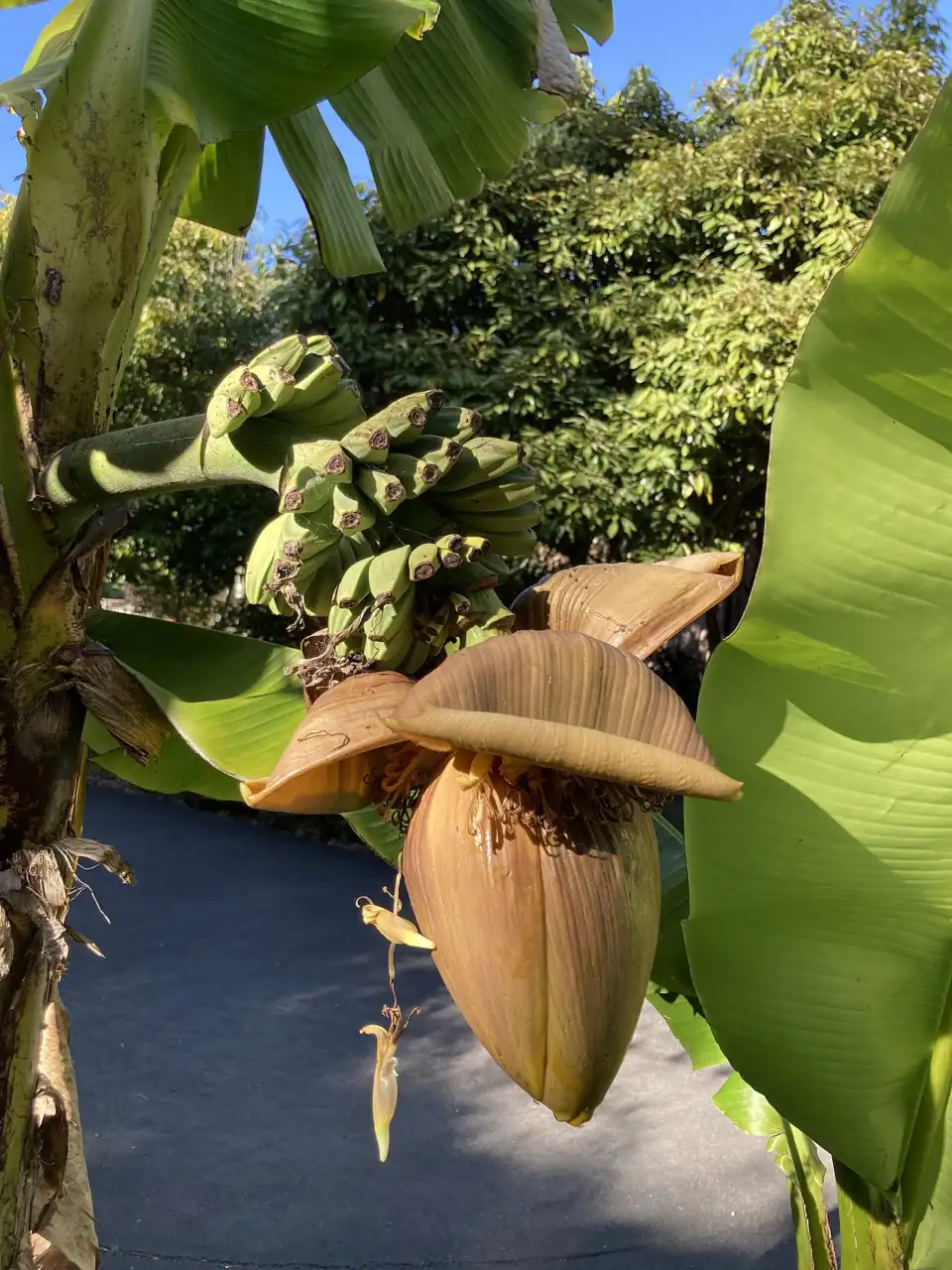
After flowering and fruiting, that individual pseudostem dies. This is normal: the rhizome sends up new pups to replace it, so the clump carries on.
Is the Fruit Edible?
No, the fruit is not considered edible. NC State Extension describes it as small fruit with sparse white pulp and many black seeds. Grow Musa basjoo for its leaves, not for bananas.
How to Divide Pups
Divide pups in spring, once the plant is growing again:
- Choose a pup with several leaves of its own.
- Dig down beside it to find where it joins the main rhizome.
- Cut it free with a sharp spade, keeping as many roots as possible.
- Remove some lower leaves to reduce water loss.
- Pot it into a container just large enough for the roots, or plant it directly, and keep it moist until new growth appears.
Established clumps can be divided about every five years to keep them in bounds.
Is Musa basjoo Safe for Pets?
Banana plants are generally considered non-toxic to pets, but there is no specific entry for Musa basjoo. The ASPCA lists the edible banana, Musa acuminata, as non-toxic to dogs, cats and horses. Musa basjoo is a different species in the same genus, so treat it as low risk rather than proven safe.
The leaves are tough and fibrous, so a pet that chews them may still vomit or have an upset stomach. If a pet or a child eats part of the plant and shows symptoms, contact your vet or a poison control centre straight away.
How to Check Your Plant Yourself
I have not grown Musa basjoo myself, so instead of a personal story, here is a simple weekly check you can do in a few minutes. It follows a principle I rely on with all my plants: observe regularly and adjust care to what the plant shows you.
- Soil: push a finger 3 to 5 cm into the soil. Water if it is dry; wait if it is damp.
- Newest leaf: a healthy plant unrolls a new leaf frequently in summer. A long pause usually means it needs food, water or warmth.
- Leaf colour: even pale yellow across new leaves in summer suggests hunger; brown edges suggest dryness.
- Underside of leaves: look for webbing, cottony spots or tiny insects.
- Forecast: from late summer, watch for the first frost so you can protect the plant in time.
With the right spot, steady water and food in summer, and dry protection in winter, Musa basjoo can return larger year after year in climates far colder than a banana should tolerate. Start with the climate table above, choose one method, and adjust it after your first winter.
Musa Basjoo Care FAQs
Should I cut back Musa basjoo in winter?
It depends on your climate. In mild areas, remove only the leaves and wrap the pseudostem to keep its height. In colder areas (USDA 5 to 6), cut the pseudostem to about 30 to 60 cm after frost and cover the crown with 30 to 45 cm of dry mulch.
Will Musa basjoo come back after frost?
Usually yes. Frost kills the leaves and often the pseudostem, but the underground rhizome is hardy to about -23°C (-10°F) when mulched, so new shoots appear once the soil warms in late spring. Cold, waterlogged soil is the main thing that kills it.
How often should I water Musa basjoo?
In the growing season, water deeply whenever the top 3 to 5 cm of soil is dry, which can mean every one to two days for pots in hot weather. In winter, keep the soil only slightly moist and never wet.
Can Musa basjoo grow in a pot?
Yes. Use a large pot with loam-based compost and extra grit for drainage, repot as it grows, and move it into a cool, frost-free place or store it dormant over winter in cold climates.
Are Musa basjoo bananas edible?
No. The small fruit has little pulp and many hard black seeds, and it is not considered edible. The plant is grown as an ornamental for its large leaves.
Why are my Musa basjoo leaves turning brown?
Brown, crispy edges usually mean too little water or dry air. Leaves split into strips are caused by wind and are harmless. Brown, soft centres in spring usually mean cold damage or rot from wet winter conditions.
Featured image: Photo: Crusier / Wikimedia Commons, CC BY 4.0


One Comment