Variegated Alocasia Macrorrhiza Care Guide: Light, Water, Reversion and Safety
Variegated Alocasia macrorrhiza is one of the most striking elephant ears you can grow, and one of the easiest to damage by accident. Its white and cream leaf sectors burn faster than green tissue, its corm rots in soggy soil, and much of the care advice online contradicts itself. This guide gives one consistent routine and explains why each step matters.
If you already grow the hybrid Alocasia California, much of the routine will feel familiar, but the variegated form needs extra protection from strong sun.
Quick Answer: How to Care for Variegated Alocasia Macrorrhiza
Give variegated Alocasia macrorrhiza bright, indirect light with no afternoon sun, and water only when the top 5 cm (about 2 inches) of soil is dry. Keep it at 18 to 27°C (65 to 80°F) with 60 to 80% humidity, in a chunky, fast-draining aroid mix.
Feed at half strength in spring and summer only, and cut back water in winter when growth slows. Remove fully green shoots if you want to keep the variegation, and keep the plant away from pets and children because every part contains irritating calcium oxalate crystals.
What Is Variegated Alocasia Macrorrhiza?
Variegated Alocasia macrorrhiza is a cultivated form of giant taro, Alocasia macrorrhizos ‘Variegata’, in the arum family (Araceae). “Macrorrhiza” is an older spelling still used by sellers. Common names include variegated giant taro, variegated elephant ear and variegated upright elephant ear.
The wild green species is native to the wet tropics from Central Malesia to Queensland, including Borneo, the Philippines, New Guinea and the Solomon Islands, according to Kew’s Plants of the World Online. The variegated form is known only in cultivation; Singapore’s NParks Flora and Fauna Web lists it as a horticultural plant with white, grey or cream leaf patches.
The white sectors are the key to its care. White tissue has little or no chlorophyll, so it cannot make food and has no green pigment to buffer strong light. That is why a variegated plant grows more slowly than the green species and scorches more easily.
How to Identify It and Tell It Apart From Look-Alikes
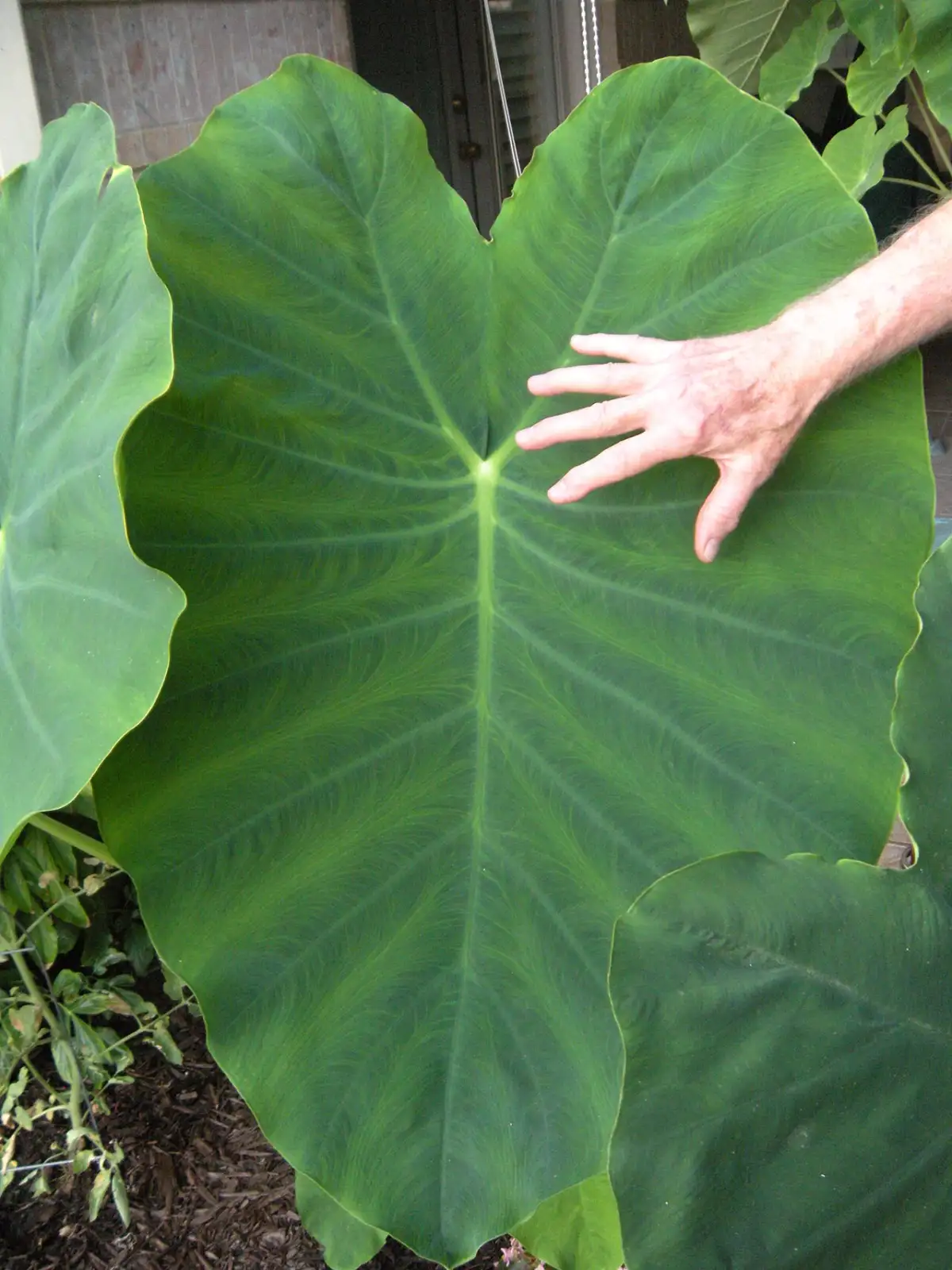
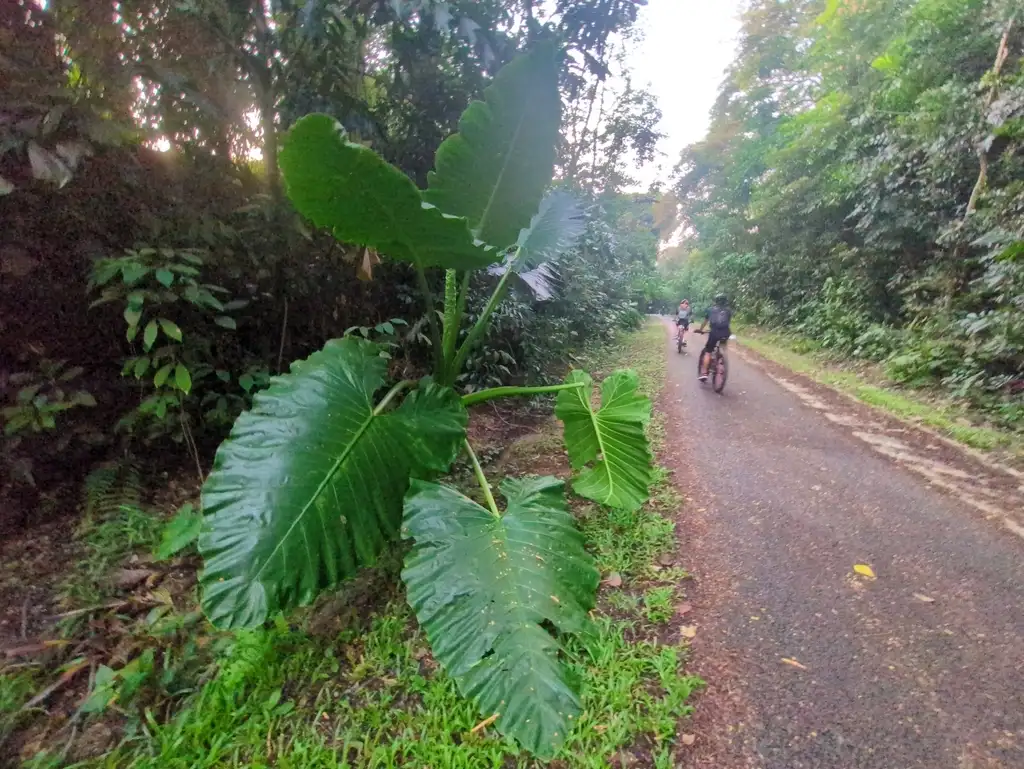
Look at three things: which way the leaf tips point, where the leaf stalk (petiole) joins the blade, and the leaf color pattern. True Alocasia leaves are held upright or level with the tips pointing up, and the petiole joins at the notch of the leaf, as horticulturist Walter Reeves explains.
| Plant | Leaf tip direction | Petiole attachment | Leaf color | Mature height |
|---|---|---|---|---|
| Variegated giant taro (Alocasia macrorrhizos ‘Variegata’) | Up or level | At the leaf notch | Green with white, cream or grey sectors | 1 to 3 m (NParks) |
| Giant taro (Alocasia macrorrhizos) | Up or level | At the leaf notch | Solid glossy green | Up to about 4.5 m outdoors in the tropics |
| Taro (Colocasia esculenta) | Hangs down | On the back of the blade, away from the notch (peltate) | Matte green, sometimes a purple dot where the stalk joins | About 1 to 2 m |
| Arrowleaf elephant ear (Xanthosoma sagittifolium) | Hangs down | In the notch of the arrow-shaped leaf | Green, with a vein running just inside the leaf edge | Up to about 2.7 m |
The iNaturalist Colocasia vs Xanthosoma vs Alocasia guide uses the same keys: Alocasia leaves point upward even when mature, while Colocasia and Xanthosoma leaves droop at the tip. Some colorful Alocasia hybrids hold their leaves lower, so check the petiole too.
If you are not sure which elephant ear you have, upload a clear daylight photo of a whole leaf and its stalk to our Leaf Identifier. Photo identification, including our tool, can be wrong, so treat the result as a starting point and confirm with the features above or an expert when safety matters.
Variegated Alocasia Care at a Glance
| Need | Target | Why it matters |
|---|---|---|
| Light | Bright, indirect (roughly 10,000 to 20,000 lux); no afternoon sun | White sectors scorch first |
| Water | When the top 5 cm (2 in) is dry | Soggy soil rots the corm |
| Soil | Chunky aroid mix, pH about 5.5 to 6.5 | Roots need air as well as moisture |
| Humidity | 60 to 80% | Dry air browns leaf edges |
| Temperature | 18 to 27°C (65 to 80°F); keep above 10°C (50°F) | Cold stops growth and invites rot |
| Fertilizer | Balanced liquid feed at half strength, every 2 to 4 weeks in spring and summer | Slow variegated growth needs less food |
| Size indoors | Usually 1.2 to 1.8 m (4 to 6 ft) | Plan floor space before it grows |
| Toxicity | Toxic to dogs, cats, horses and people if chewed | Calcium oxalate crystals |
Light: Bright, but Protect the White Sectors
Place the plant where it gets several hours of bright light but direct sun never sits on the leaves in the afternoon. An east window, a bright north window, or a spot 1 to 2 m back from a south or west window behind a sheer curtain works well in most homes.
NParks notes that the variegated parts of the leaves can burn and turn brown in afternoon sun, so shade from midday onward is the single most important rule. A little gentle morning sun is usually fine.
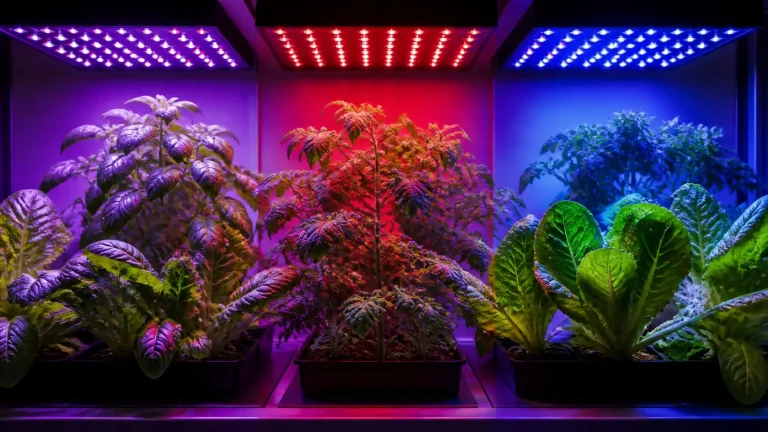
Too little light causes the opposite problem. New leaves come in smaller, petioles stretch and lean toward the window, and the plant has less energy to support white tissue. If your room is dim, a full-spectrum LED grow light for 10 to 12 hours a day helps; our guide to what color light is best for plant growth explains which bulbs to choose.

Watering Without Rotting the Corm
Water deeply when the top 5 cm (about 2 inches) of soil is dry, then let all excess water drain away. In warm, bright months this is often every 5 to 8 days indoors, and in winter it can stretch to every 2 to 3 weeks.
A fixed calendar is the most common mistake. Pot size, mix, light and temperature change how fast the soil dries, which is why guides that say “water weekly” often lead to rot. In my experience, checking the soil before watering is the habit that prevents overwatering more than any schedule.
- Push a finger or a wooden skewer 5 cm into the soil.
- If it comes out damp or with soil stuck to it, wait and check again in two days.
- If it comes out dry, water slowly until water runs from the drainage holes.
- Empty the saucer after 15 minutes so the pot never sits in water.
The bulb-like stem base, called a corm or rhizome, stores water. In wet, poorly drained soil it is prone to rot (NParks), and yellow leaves with a soft, dark base are a warning sign.
Soil, Pot and Repotting
Use a loose, fast-draining mix that holds some moisture but plenty of air. A simple recipe is equal parts peat-free or peat-based potting mix, orchid bark and perlite, with a handful of worm castings. UC Master Gardeners in Solano County recommend a loose, peat-based mix with a pH of 5.5 to 6.5 for this species (UC ANR).
- Choose a pot with drainage holes; plastic or glazed pots dry slower than terracotta.
- Repot in spring every 12 to 24 months, or when roots circle the pot.
- Go up only 5 to 10 cm (2 to 4 inches) in diameter; oversized pots stay wet and raise rot risk.
- Expect one or two older leaves to yellow after repotting; this is normal transplant stress.
Humidity and Temperature
Aim for 60 to 80% relative humidity and 18 to 27°C (65 to 80°F). Below 10°C (50°F), growth stalls and the corm becomes vulnerable to rot, and frost kills the leaves.
A humidifier is the most reliable way to raise humidity indoors. Pebble trays and grouping plants help a little, but misting the leaves raises humidity only for minutes and can encourage leaf spot. Keep the plant away from heaters, air-conditioning vents and cold drafts, which cause crispy edges; the same dry-air causes are explained in our majesty palm brown tip guide.
Feeding Your Variegated Alocasia
Feed with a balanced liquid fertilizer such as 20-20-20 diluted to half strength every 2 to 4 weeks from spring through late summer. Stop feeding in autumn and winter, when the plant is not producing new leaves.
Variegated plants make less food than green ones, so they also use less fertilizer. Too much feed shows up as brown, burnt leaf tips and a white crust on the soil; if you see that, flush the pot with plain water and skip the next feeding.
Reversion: What to Do About Green Leaves
Some variation from leaf to leaf is normal: one leaf may be heavily marbled and the next mostly green. True reversion is when a whole shoot or offset comes up solid green and keeps producing only green leaves.
The variegation is a chimera, a mix of green and non-green cell layers, and the nursery TopTropicals notes that green shoots can take over. Green shoots grow faster because they make more food, so if you want to keep the variegation, cut solid green offsets off at the base with a clean knife once they appear.
The opposite extreme also causes trouble. A leaf or offset that is almost entirely white cannot feed itself, so it usually collapses soon after unfurling. Leave an all-white offset attached to the mother plant rather than dividing it, and do not move the plant into brighter sun to “force” more white, because that only burns the leaves.
Winter Slowdown or Dying? A Quick Test
In cool, dark months many Alocasia slow down, drop one or two older leaves, and stop pushing new growth. That is a rest period, not death, and overwatering during it is the most common way owners lose the plant.
- Press the base of the stem just above the soil. A firm base means the plant is resting; a soft, mushy or foul-smelling base means rot.
- Check the soil 5 cm down. If it is still wet days after watering, cut back watering.
- If the base is soft, unpot the plant, cut away brown, mushy roots and corm tissue with a clean blade, let it dry for a day, and replant in fresh, dry mix.
- Keep a resting plant at or above 15°C (59°F), water lightly only when the top half of the pot is dry, and wait for spring.
Leaf Symptom Decoder
Use this table to match what you see with the most likely cause and the fix to make this week.
| Symptom | Most likely cause | Fix |
|---|---|---|
| White sectors turn brown and papery | Direct afternoon sun | Move back from the window or add a sheer curtain |
| Crispy brown edges on all leaves | Low humidity or underwatering | Run a humidifier; check soil more often |
| Yellow older leaves, soft dark stem base | Overwatering and corm rot | Let soil dry; follow the rot steps above |
| One old leaf yellows as a new one opens | Normal leaf turnover | Remove the old leaf once fully yellow |
| Leaning, long petioles, small leaves | Too little light | Brighter indirect spot or a grow light |
| Fine webbing, speckled leaves | Spider mites | Shower leaves; treat with insecticidal soap |
| Water drops at leaf tips in the morning | Guttation from wet soil | Harmless, but water a little less |
For a wider look at yellowing on houseplants, see why plant leaves turn yellow.
Pests to Watch
Spider mites are the main pest of indoor Alocasia, especially in dry air, followed by mealybugs, thrips, scale and aphids (UK Houseplants and UC ANR). Check leaf undersides weekly, wipe leaves with a damp cloth, and treat with insecticidal soap or neem oil, repeating every 7 days for 3 weeks. Our guide to getting rid of aphids on indoor plants covers safe sprays step by step.
Propagation by Division and Offsets
The reliable way to propagate variegated Alocasia macrorrhiza is division of offsets (pups) or of the clump in spring. NParks lists division and the storage organ (corm) as propagation methods; seed will not reproduce the variegation.
- Water the day before so the roots are hydrated.
- Unpot the plant and find offsets that have their own roots and at least two or three leaves with green in them.
- Wear gloves, then cut the offset free with a clean, sharp knife.
- Pot it in a small container of moist aroid mix and keep it warm (above 20°C) in bright, indirect light.
- Expect new roots in 2 to 8 weeks; do not feed until a new leaf appears.
Indoors or Outdoors? Care by Climate
Where you live decides how you grow this plant. Outdoors it is reliable only in frost-free or nearly frost-free climates, roughly USDA zones 9b to 11, while in cooler regions it is a houseplant or a summer patio plant.
- Tropical and humid subtropical regions (for example Southeast Asia, northern Australia, Florida, Hawaii): grow it outdoors year-round in bright shade, sheltered from wind and afternoon sun.
- Hot, dry climates (for example parts of South Asia, the Middle East and the southwestern United States): keep it in deep afternoon shade, water more often in heat, and raise humidity; it often does better indoors in peak summer.
- Temperate regions (for example the UK, most of Europe, northern US and Canada): grow indoors, or move it outside only when nights stay above about 15°C (59°F), and bring it in well before nights drop toward 10°C (50°F).
Size depends on setting. UC Master Gardeners report the species reaching around 15 feet outdoors but usually 4 to 6 feet indoors, while NParks gives 1 to 3 m for the variegated form; slower variegated growth usually keeps it at the lower end.
Is Variegated Alocasia Toxic to Pets and People?
Yes. The ASPCA lists Alocasia as toxic to dogs, cats and horses because of insoluble calcium oxalates. Signs include mouth pain and swelling, heavy drooling, vomiting (not in horses) and difficulty swallowing.
People are affected too. NParks describes the sap as an irritant that is toxic if eaten, and the IVIS veterinary guide notes that sap in the eye can cause severe conjunctivitis. Some seller pages label this plant edible; do not eat any part of it.
- Keep the plant out of reach of children, cats and dogs.
- Wear gloves when dividing, pruning or repotting, and wash your hands afterward.
- If a person or pet chewed the plant and shows symptoms, contact your local poison control center or a vet right away (in the US, ASPCA Animal Poison Control is (888) 426-4435).
How to Check Your Plant Each Week
I believe observing plants regularly and adjusting care to what they show is essential, and a variegated Alocasia rewards that more than most houseplants. Small changes in placement or watering often make the difference between a clean new leaf and a burnt one.
- Soil: test the top 5 cm before you reach for the watering can.
- Light: look for any direct sun patch on the leaves in the afternoon and move the plant if needed.
- Leaves: check white sectors for new browning and undersides for webbing or white cottony spots.
- Base: press the stem base once a month; it should feel firm.
- Shoots: note any solid green offsets and remove them if you want to keep the variegation.
Final Takeaway
Variegated Alocasia macrorrhiza is not hard to keep once you protect two weak points: the white leaf tissue from strong sun and the corm from wet soil. Give it bright, indirect light, water by soil check rather than by calendar, keep it warm and humid, and it will keep producing those marbled leaves. Keep it out of reach of pets and children, and identify any look-alike elephant ear carefully before assuming its care or safety is the same.
Frequently Asked Questions
Why are the white parts of my variegated Alocasia turning brown?
White sectors have little or no chlorophyll and scorch first in direct afternoon sun or very dry air. Move the plant to bright, indirect light and raise humidity to 60 to 80%. Browned areas will not recover, but new leaves should open clean.
How often should I water variegated Alocasia macrorrhiza?
Water when the top 5 cm (about 2 inches) of soil is dry, not on a fixed schedule. Indoors that is often every 5 to 8 days in warm months and every 2 to 3 weeks in winter.
Will variegated Alocasia macrorrhiza revert to green?
It can. The variegation is a chimera, and solid green shoots grow faster and can take over. Cut fully green offsets off at the base if you want to keep the variegation.
How big does variegated Alocasia macrorrhiza get?
NParks gives 1 to 3 m for the variegated form. Indoors it usually stays around 1.2 to 1.8 m (4 to 6 ft), and slower variegated growth keeps it smaller than the green species.
Is variegated Alocasia toxic to cats and dogs?
Yes. The ASPCA lists Alocasia as toxic to dogs, cats and horses because of insoluble calcium oxalates, causing mouth pain, drooling, vomiting and trouble swallowing. Contact a vet or poison control if your pet chewed it and shows symptoms.
Can I grow variegated Alocasia outdoors?
Outdoors year-round only in frost-free climates, roughly USDA zones 9b to 11, in bright shade away from afternoon sun. Elsewhere, grow it indoors and move it outside only when nights stay above about 15°C (59°F).
Featured image: Photo: Photo by David J. Stang / Wikimedia Commons, CC BY-SA 4.0