Lemongrass Plant Care: Sun, Water, Winter and Fixes for Every Climate
Lemongrass (Cymbopogon citratus) is a tropical clumping grass in the grass family, Poaceae, grown for its lemon-scented stalks and leaves. It is easy to keep healthy once you match three things: strong sun, steady warmth and even moisture. This guide covers each care factor, adapts the advice to your climate, and helps you fix brown leaves, winter losses and thin stalks.
Quick Answer: How to Care for Lemongrass
Give lemongrass at least 6 hours of direct sun, rich free-draining soil, and water whenever the top 2 to 3 cm (about 1 inch) of soil is dry. Feed it with a nitrogen-rich liquid fertilizer every 2 to 3 weeks from spring to late summer. It grows well only above about 13°C (55°F), so bring potted plants indoors before night temperatures drop below 7°C (45°F), as the Royal Horticultural Society advises.
- Light: full sun, 6 to 8 hours a day.
- Water: evenly moist in summer, much less in winter.
- Soil: rich, loose and well drained, never waterlogged.
- Feeding: nitrogen-rich feed in the growing season, none in winter.
- Temperature: warm days, no frost; indoors in cold winters.
- Pets: the ASPCA lists lemongrass as toxic to dogs, cats and horses.
Lemongrass Care at a Glance
This table sums up the care needs in one place. Where trusted sources disagree, the range is shown and explained later in the article.
| Care factor | What lemongrass needs |
|---|---|
| Common names | Lemongrass, lemon grass, West Indian lemongrass |
| Scientific name and family | Cymbopogon citratus, Poaceae (grass family) |
| Light | Full sun, 6 to 8 hours of direct light |
| Water | Keep evenly moist in growth; water sparingly in winter |
| Soil | Fertile, loamy, well drained; pH about 6.0 to 7.0 is a safe target |
| Pot size | At least 30 cm (12 in) wide; larger for mature clumps |
| Feeding | Nitrogen-rich liquid feed every 2 to 3 weeks, spring to late summer |
| Best growing temperature | Above 13°C (55°F) |
| Bring indoors | Before nights fall below 7°C (45°F) |
| Hardiness | Grows year-round outdoors in roughly USDA zones 9 to 11 |
| Size | About 1 to 1.5 m (3 to 5 ft) tall in good conditions |
| Pet safety | Toxic to dogs, cats and horses (ASPCA) |
Make Sure Your Plant Is Lemongrass
Before you change your care routine, confirm you have culinary lemongrass and not a close relative. Several Cymbopogon species are sold under similar names, and citronella grass is the one most often mixed up with it.

West Indian lemongrass forms a dense clump of arching, strap-like leaves about 1 to 2.5 cm (0.5 to 1 in) wide. The leaf bases swell into pale, scallion-like stalks, and crushing a leaf releases a clean lemon scent. It rarely flowers in gardens.
| Feature | West Indian lemongrass | East Indian lemongrass | Citronella grass |
|---|---|---|---|
| Scientific name | Cymbopogon citratus | Cymbopogon flexuosus | Cymbopogon nardus and C. winterianus |
| Stems | Pale green to white, swollen bases | Often purple or red tinted | Often reddish at the base |
| Scent when crushed | Clean, sweet lemon | Lemon with a sharper note | Grassier, musky, insect-repellent smell |
| Main use | Cooking and tea | Cooking and essential oil | Repellent oils, ornamental |
| Flowers | Rarely | More often | Yes, in warm climates |
Care for all three is very similar, but only C. citratus and C. flexuosus are the usual kitchen lemongrasses. If you are unsure, take a clear daylight photo of the leaves and stalk base and check it with our plant identifier or the leaf identifier. Photo identification, including our tool, can be wrong, so treat the result as a starting point, not a final answer.
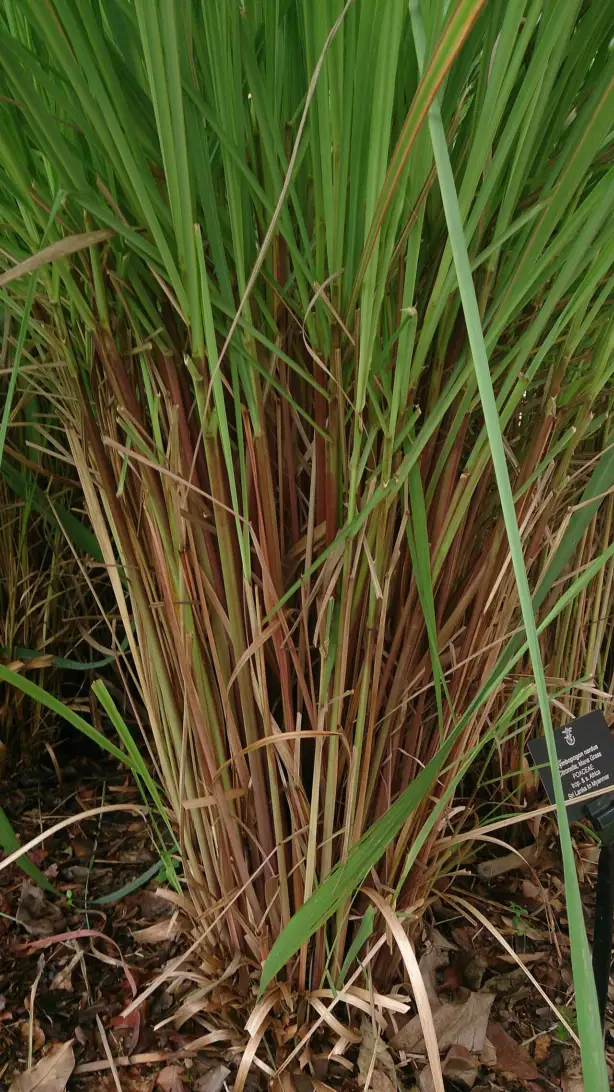
If your plant turns out to be citronella grass, our citronella plant care guide covers its needs and explains how it differs from the scented geranium also sold as “citronella”.
How Much Sun Lemongrass Needs
Lemongrass needs full sun: at least 6 hours of direct light a day, and 8 hours is better. More light means faster growth, thicker stalks and stronger flavor.
Outdoors, choose the sunniest spot you have, even in hot regions. Indoors, a south-facing window in the Northern Hemisphere (north-facing in the Southern Hemisphere) is the best choice. Utah State University Extension notes that indoor lemongrass produces fewer stalks because of low light, so expect slower growth inside.
If your brightest window still gives less than 6 hours of sun in winter, a full-spectrum grow light placed 20 to 30 cm above the leaves for 12 to 14 hours a day helps. Our guide to which light color is best for plant growth explains what to look for in a grow light.
How Often to Water Lemongrass
Water lemongrass when the top 2 to 3 cm (about 1 inch) of soil feels dry. In active summer growth, that can mean every 1 to 3 days for pots and once or twice a week for plants in the ground, depending on heat and wind.
The right amount changes a lot with the season, which is where most watering mistakes happen:
- Spring and summer: keep the soil evenly moist but not soggy. Potted plants in late-summer heat may need water every day.
- Autumn: water less as growth slows and nights cool.
- Winter indoors: water sparingly, letting the top few centimeters dry between waterings. The RHS notes that low winter light slows growth, so the plant uses far less water.
- Dormant plants in storage: water only a few times over the whole winter to keep the roots from drying out completely.
In my experience, checking the soil with a finger before every watering is the simplest way to avoid overwatering, and it works for lemongrass as well as for other potted plants. A summer schedule followed into winter is the most common cause of rot.
Lemongrass also likes humidity. In very dry climates or heated rooms, USU Extension recommends misting and regular watering, and watering at the base rather than with overhead sprinklers.
Best Soil and Pot for Lemongrass
Lemongrass grows best in rich, loamy soil with plenty of organic matter and good drainage. It tolerates poorer soil if moisture is steady, but it will not tolerate waterlogged ground, according to USU Extension.
- In the ground: mix a few centimeters of compost into the planting area. Heavy clay needs extra compost or a raised bed, because water pooling around the base kills plants quickly.
- In pots: use a quality peat-free or compost-rich potting mix and a container with drainage holes.
- Pot size: start with at least 30 cm (12 in) across. Mature clumps do best in a 20-liter (5-gallon) pot or larger, since vigorous roots can crack small containers.
- Soil pH: published ranges run from about 5.0 to 8.4, so lemongrass is not fussy. A pH of 6.0 to 7.0 is a safe target.
Tall plants can tip their pots over in wind, so set large containers in a sheltered spot. For general container basics, see our guide on growing plants in pots.
Feeding Lemongrass for Thick Stalks
Lemongrass is a heavy feeder that needs nitrogen to build leaves and thick stalks. Feed it during active growth and stop in winter.
- Potted plants: the RHS suggests a general-purpose liquid feed every 2 to 3 weeks from spring to late summer, or a slow-release fertilizer mixed into the compost in spring.
- Faster growth in pots: USU Extension recommends a half-strength balanced soluble fertilizer weekly in the warmest months.
- Plants in the ground: feed about once a month in summer, or top-dress with compost.
- Indoors in winter: stop or greatly reduce feeding until growth restarts in spring.
Pale, yellowish leaves in summer often point to a lack of nitrogen, especially in pots where frequent watering washes nutrients out.
Temperature, Humidity and Hardiness
Lemongrass is a tender perennial: it lives for years in warm climates but is killed by frost. The RHS says it needs at least 13°C (55°F) to grow well and should come indoors before nights fall below 7°C (45°F).
Sources quote different hardiness ranges, from USDA zone 8b up to zones 10 and 11. The difference comes from what is being measured. Underground roots may survive brief light frosts in zone 8b or 9, while the leafy top dies back. Staying green and growing all year needs frost-free winters, roughly zones 10 and 11.
| Temperature | What happens to lemongrass |
|---|---|
| Above 25°C (77°F) | Fastest growth if water and feeding keep up |
| 13°C to 25°C (55°F to 77°F) | Steady growth |
| 7°C to 13°C (45°F to 55°F) | Growth slows sharply; time to bring pots in |
| Below 7°C (45°F) | Leaf damage begins |
| Frost (0°C / 32°F) | Leaves killed; roots may die in prolonged cold |
Lemongrass Care by Climate
The same plant needs different care in Toronto, Lahore and Singapore. Use the row that matches your weather.
| Climate | Examples | Main risk | Key care changes |
|---|---|---|---|
| Cold winters | Canada, northern US, UK, northern Europe | Freezing and winter rot | Grow in a pot; move indoors in autumn; cut watering and feeding in winter |
| Mild winters with light frost | US zones 8 and 9, Mediterranean, northern India and Pakistan plains | Occasional frost kills top growth | Plant in the warmest spot; mulch the base; cover or move pots on frosty nights |
| Hot and dry summers | Middle East, Pakistan and India summers, Arizona | Drying out, spider mites | Water deeply and often, possibly daily for pots; mulch; water at the base; mist or group pots in very dry air |
| Tropical and rainy seasons | Southeast Asia, monsoon regions, Florida, West Africa | Waterlogging, rust and leaf blight | Ensure sharp drainage; raise beds; space clumps for airflow; remove spotted leaves |
In monsoon or rainy-season climates, a new plant that browns soon after transplanting is often sitting in wet soil. Raise it, improve drainage, and avoid extra watering until the soil drains.
How to Overwinter Lemongrass
In cold-winter areas you have two reliable choices: keep lemongrass growing indoors as a houseplant, or let it go dormant in a cool, dark place. Both start the same way, before night temperatures drop below 7°C (45°F).
Keep It Growing Indoors
- Pot up the plant, or a healthy division with roots, in fresh potting mix.
- Trim the leaves to about 15 to 30 cm (6 to 12 in) so the plant fits indoors and loses less water.
- Place it in your sunniest window or under a grow light.
- Water only when the top few centimeters are dry, and stop feeding.
- Keep it away from heating vents, which dry the leaves and invite spider mites.
- In spring, move it outdoors gradually once nights stay above about 10°C (50°F).
Let It Go Dormant
- Cut the stalks down to about 10 to 15 cm (4 to 6 in).
- Store the pot in a cool, dark, frost-free place such as a garage or basement.
- Water just a few times over the winter to keep the roots alive.
- In early spring, bring it into bright light and resume normal watering once new shoots appear.
If you have no indoor space, treat lemongrass as an annual: harvest it all before the first frost and start a new plant in spring.
Pruning, Dividing and Repotting
Lemongrass needs little pruning beyond removing dead or tatty leaves. The RHS suggests cutting all leaves down to 5 to 10 cm (2 to 4 in) either in autumn or in early spring, when new growth starts. Wear gloves, because the leaf edges are sharp enough to cut skin.
Divide clumps every year or two in spring. Old, crowded clumps produce thinner stalks, so dividing restores vigor.
- Water the plant the day before.
- Tip it out of the pot or dig it up.
- Cut the root ball into sections with a sharp knife or spade, each with healthy roots and several stalks.
- Replant each section at the same depth and water well.
Repot into a larger container when roots circle the pot or push out of the drainage holes.
How to Propagate Lemongrass
Division is the fastest method, rooting stalks in water is the cheapest, and seed is the slowest.
From Stalks in Water
Fresh stalks with an intact base will often root in a glass of water in about 2 weeks, according to USU Extension. Keep 3 to 5 cm of water around the base, change it every few days, and pot up once roots are a few centimeters long.
One caution: the RHS advises against using supermarket stalks because they can carry plant diseases. Stalks from a nursery, a friend’s healthy plant or your own clump are the safer choice.
By Division
Divide a mature clump in spring as described above. Divisions establish faster than rooted stalks because they already have a working root system.
From Seed
Sow seed indoors in spring on the surface of seed compost and keep it at 20 to 25°C (68 to 77°F). The RHS notes that germination takes about 2 to 3 weeks. Move seedlings outdoors only after nights stay warm.
How to Harvest Lemongrass Without Weakening It
Harvest stalks once the plant is about 30 cm (12 in) tall and individual stalks are at least 1.25 cm (½ inch) thick at the base. Thinner stalks are mostly fiber.
- Choose stalks from the outer edge of the clump.
- Cut at soil level with a sharp knife, or push the stalk sideways and twist it off.
- Trim off the leafy top and keep the lower 10 cm (4 in), which has the best flavor.
- Peel away the tough outer layer to reach the tender core.
- Use the upper leaves for tea or broth, then remove them before eating.
Taking older outer stalks first encourages new shoots. Avoid heavy harvesting from indoor plants in winter, when regrowth is slow.
Lemongrass Problems: Symptoms, Causes and Fixes
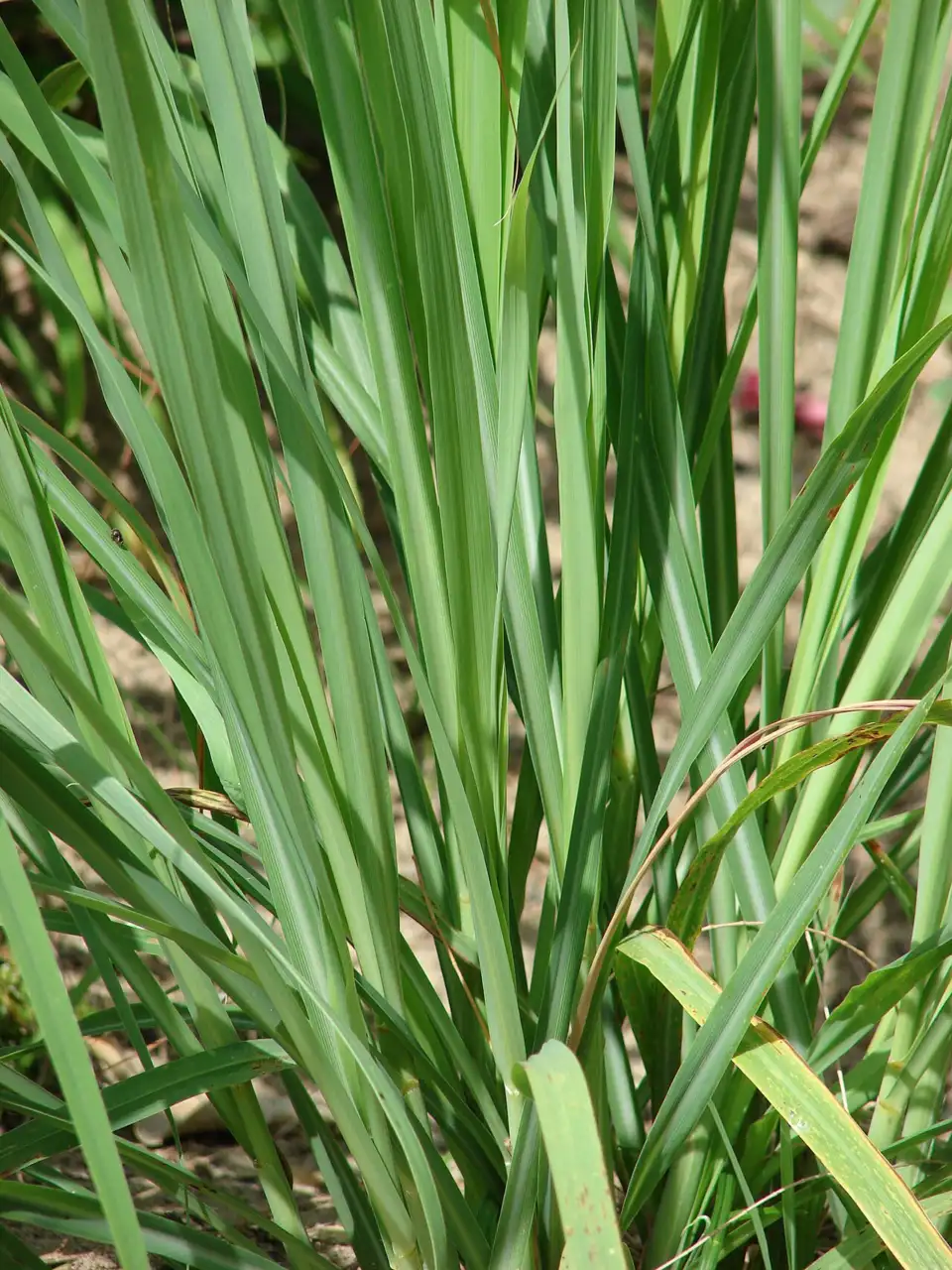
Lemongrass is generally problem-free in warm, bright conditions. When something goes wrong, the leaves usually show it first, so match what you see to the table below.
| Symptom | Likely cause | How to confirm | Fix |
|---|---|---|---|
| Dry, crispy brown tips | Underwatering or dry air | Soil dry several centimeters down | Water deeply; mist or raise humidity; move away from heaters |
| Yellow then brown leaves, soft base | Overwatering or poor drainage | Soil wet, sour smell, mushy stalk base | Let soil dry; repot into fresh mix; cut off rotten parts |
| Pale yellow-green leaves in summer | Low nitrogen | Soil moist, no spots, plant not fed recently | Feed with a nitrogen-rich liquid fertilizer |
| Yellow spots and brown streaks with dark pustules underneath | Lemongrass rust (Puccinia nakanishikii) | Rusty powder rubs off on your finger | Remove infected leaves; improve airflow; avoid wetting leaves |
| Reddish brown spots on tips and edges | Leaf blight | Leaves look scorched from the tips inward | Remove affected leaves; use a labeled fungicide if confirmed |
| Fine pale speckling, faint webbing | Spider mites | Tiny moving dots when you tap a leaf over white paper | Rinse leaves; use insecticidal soap; raise humidity |
| Tiny yellow insects on leaves | Yellow sugarcane aphid (Sipha flava) | Clusters on leaf undersides | Blast off with water; use insecticidal soap or neem oil |
| Brown, collapsed leaves after cold night | Cold or frost damage | Damage follows a cold spell | Move indoors; cut off dead leaves; wait for regrowth |
| Thin stalks, slow growth | Low light, crowding or low feed | Old, dense clump or shady spot | Move to full sun; divide; feed in summer |
Rust and Leaf Blight
Rust is the main disease of lemongrass and spreads most in damp, crowded conditions. Remove infected leaves as soon as you see them, space plants for airflow, and water at the soil rather than over the leaves. USU Extension advises using a fungicide for blight only after it has been positively identified.
Spider Mites and Aphids
Spider mites are mostly an indoor winter problem in warm, dry rooms, according to USU Extension. A strong rinse plus higher humidity often solves light infestations. For aphids, the same rinse-and-soap approach works; our guide on getting rid of aphids on indoor plants covers it step by step. For general leaf yellowing, see why plant leaves turn yellow.
Is Lemongrass Safe for Pets and People?
Lemongrass is a common food herb for people, but the ASPCA lists the plant as toxic to dogs, cats and horses. The toxic compounds named are essential oils and cyanogenic glycosides. In dogs and cats the usual sign is stomach upset; in horses the ASPCA lists difficulty breathing, weakness and, rarely, death.
Some garden guides label lemongrass “non-toxic”. For pets, follow the ASPCA listing. Keep pots out of reach of animals that chew leaves, and keep concentrated lemongrass essential oil well away from pets.
For people, the main hazard is physical: the leaf edges are sharp, so wear gloves when cutting or dividing, and keep tall plants away from small children’s faces. Never eat a wild grass because an article or app says it is lemongrass.
If a person or pet has eaten plant material and shows symptoms, contact your local poison control center or a vet straight away. In the US, the ASPCA Animal Poison Control Center is reachable at (888) 426-4435 (a fee may apply).
How to Check Your Lemongrass Yourself
A short weekly check catches most problems before they spread. I believe watching a plant regularly and adjusting care to what it shows matters more than any fixed schedule, and small changes like these often make a visible difference.
- Soil: push a finger 2 to 3 cm into the soil. Water only if it is dry.
- Leaf color: look for pale leaves (feeding), crispy tips (dryness) or soft yellowing (too wet).
- Leaf undersides: check for rust pustules, mites and aphids.
- Stalk base: squeeze gently; it should feel firm, not mushy.
- Weather: check the night forecast from late summer onward and move pots before nights drop below 7°C (45°F).
- Light: note how many hours of direct sun the plant gets as the seasons change, and move it if it drops below 6.
Key Takeaway
Lemongrass thrives on sun, warmth, steady moisture and nitrogen, and it fails mainly from cold, waterlogging or a summer routine kept up in winter. Match your care to your climate, confirm you have the right plant with our plant identifier, and use the symptom table whenever the leaves change color.
Lemongrass Care FAQs
How often should I water lemongrass in a pot?
Water when the top 2 to 3 cm (about 1 inch) of soil is dry. In hot summer weather that can be every 1 to 3 days or even daily; in winter indoors, water far less and let the surface dry between waterings.
Can lemongrass grow indoors all year?
Yes, if it gets at least 6 hours of direct sun or a grow light, warm room temperatures and careful watering. Expect slower growth and fewer stalks indoors than outdoors in summer.
Will lemongrass come back after winter?
In frost-free climates it stays green all year. In areas with light frost the roots may regrow in spring. In cold climates it only survives if you bring it indoors or store it dormant in a frost-free place.
Why is my lemongrass turning brown?
The most common causes are underwatering, overwatering, dry indoor air, cold damage and rust. Check the soil moisture, the stalk base and the leaf undersides to tell them apart, then use the symptom table above.
Is lemongrass toxic to cats and dogs?
The ASPCA lists lemongrass as toxic to dogs, cats and horses because of its essential oils and cyanogenic glycosides. Dogs and cats usually get stomach upset. Contact a vet or animal poison control if your pet eats it and shows symptoms.
When can I harvest lemongrass?
Harvest once the plant is about 30 cm (12 in) tall and stalks are at least 1.25 cm (half an inch) thick at the base. Cut outer stalks at soil level and leave the center to keep growing.
Featured image: Photo: Undeka 11 / Wikimedia Commons, CC BY-SA 4.0