

Citronella Plant Care: Sun, Water, Winter and Problem Fixes
Most citronella plants sold in pots are not the grass that gives citronella oil. They are scented geraniums with lacy, lemon-scented leaves, and they need different care from the grass. This guide shows you how to tell which one you have, then gives clear rules for light, water, soil, winter protection and the problems that kill most plants.
Quick Answer
Citronella plant care comes down to five rules. Give the plant at least 6 hours of direct sun (with afternoon shade in very hot climates), and water only when the top inch of soil is dry. Grow it in fast-draining soil in a pot with drainage holes, feed it lightly in spring and summer, and pinch the tips for a bushy shape.
It is frost-tender, so bring it indoors when night temperatures fall to about 45°F (7°C). Yellow leaves almost always point to overwatering. The plant itself does not repel mosquitoes, and its leaves are toxic to dogs and cats if eaten.
Which Citronella Plant Do You Have?
Two unrelated plants are sold as “citronella”, and their care is different. Check your plant before you follow any care advice, including the rest of this guide.

| Feature | Citronella geranium | Citronella grass | Lemongrass (look-alike) |
|---|---|---|---|
| Scientific name | Pelargonium ‘Citrosum’ | Cymbopogon nardus | Cymbopogon citratus |
| Family | Geraniaceae | Poaceae (grasses) | Poaceae (grasses) |
| Leaves | Broad, deeply lobed, crinkled, slightly fuzzy, on branching stems | Long narrow blades with parallel veins, growing from a clump | Long narrow blades, similar to citronella grass |
| Base of the stem | Woody, branching stems | Reddish base (pseudostem) | Green base |
| Flowers | Small pink to lavender, 5 petals, in clusters | Grassy flower spikes, rare in cool climates | Rarely flowers in gardens |
| Typical size | About 2 ft in pots, up to 5 ft in frost-free gardens | 1.5 to 2.5 m (5 to 8 ft) clumps | Large clumps, similar height |
| Scent | Lemony when leaves are brushed or crushed | Strong citronella scent when crushed | Lemon scent, used in cooking |
The quickest check is the leaf. A lobed, frilly leaf on a branching stem means a geranium, while a long grass blade means a Cymbopogon. Singapore’s National Parks Board notes that citronella grass has a wider leaf blade and a reddish base, while lemongrass has a green base.
If you are still unsure, take a clear photo of one leaf in daylight and upload it to our leaf identifier or the plant identifier. Photo identification, including our tool, can be wrong, so confirm with a local nursery or extension service when safety matters.
Citronella geranium (Pelargonium ‘Citrosum’)
This is the plant most garden centers label “citronella plant”, “mosquito plant” or “citrosa geranium”. It is a scented geranium in the genus Pelargonium, family Geraniaceae. It is often sold under the invalid name Pelargonium citrosum or as ‘Van Leenii’, after Dutch breeder Dirk van Leenen, who introduced it in the 1980s with claims that it was a hybrid with citronella grass.
That hybrid story is not accepted today. Many sources now treat it as a cultivar of Pelargonium graveolens, the rose geranium, though its exact parentage is still debated. The rest of this guide focuses on this plant, with a separate section for the grass.
Citronella grass (Cymbopogon nardus)
Citronella grass is a tall, clumping tropical grass in the family Poaceae. NParks lists its native range as South Sudan to South Africa and India to Vietnam. Its leaves are the commercial source of citronella oil, and it is a close relative of lemongrass. Its care needs are covered near the end of this article.
Citronella Plant Care at a Glance
| Need | Citronella geranium |
|---|---|
| Light | 6 or more hours of direct sun; afternoon shade above about 85°F (29°C) |
| Water | When the top inch of soil is dry; never on a fixed daily schedule |
| Soil | Fast-draining potting mix, roughly neutral pH (6.0 to 7.0) |
| Temperature | Best between 50°F and 80°F (10°C to 27°C); killed by frost |
| Bring indoors | When nights fall to about 45°F (7°C) |
| Hardiness | Perennial outdoors in USDA zones 9 to 11; grown as an annual or overwintered elsewhere |
| Feeding | Light balanced liquid feed about once a month, spring to late summer |
| Propagation | Stem cuttings in spring or late summer |
| Pets | Toxic to dogs and cats (ASPCA) |
How Much Sun Does a Citronella Plant Need?
A citronella plant needs at least 6 hours of direct sun a day to stay compact and fragrant. With less light, the stems stretch, the leaves space out and the plant looks thin, which gardeners call “leggy”.
In hot summers, morning sun with afternoon shade works better than all-day sun. Scented geraniums tend to struggle when daytime temperatures stay above about 85°F (29°C), and strong afternoon sun can scorch the leaf edges brown.
Indoors, place it in your sunniest window: south-facing in the Northern Hemisphere, north-facing in the Southern Hemisphere. If no window gets several hours of direct light, a full-spectrum grow light 6 to 12 inches above the plant helps. Our guide to which light color is best for plant growth explains what to look for in a grow light.
How to Water a Citronella Plant
Water a citronella plant only when the top inch (2.5 cm) of soil feels dry. Overwatering is the most common reason these plants die, because soggy soil rots the roots of scented geraniums.
From my own time with indoor plants, I have learned that checking the soil before watering is the habit that prevents overwatering. It works far better for this plant than watering on set days, because the right interval changes with heat, pot size and season.
The finger test
- Push one finger into the soil up to the first knuckle, near the edge of the pot.
- If the soil feels dry at your fingertip, water slowly until water runs out of the drainage holes.
- Empty the saucer after 15 minutes so the roots do not sit in water.
- If the soil still feels damp, wait a day and check again.
Pots versus garden beds
Plants in small pots in summer heat may need water every day or two, while the same plant indoors in winter may go a week or more. In garden beds, water when the soil is dry about 2 inches down. Water in the morning and aim at the soil, not the leaves, so the foliage dries quickly and fungal spots are less likely.
| Sign | Too much water | Too little water |
|---|---|---|
| Leaves | Yellow, soft, often starting low on the plant | Dry, crisp, curling, with brown edges |
| Soil | Wet or sour-smelling days after watering | Pulling away from the pot sides, very light pot |
| Stems | Dark or mushy at the base | Drooping but firm |
| Fix | Let soil dry, improve drainage, repot if roots are brown | Water deeply, then return to the finger test |
Soil, Pots and Fertilizer
Use a fast-draining potting mix and a pot with drainage holes. A standard potting mix with about one-third perlite or coarse sand works well, and the soil pH can sit between slightly acidic and neutral (about 6.0 to 7.0).
Start young plants in a 6-inch pot and move up one size each spring as roots fill the pot; a mature plant is comfortable in a 10 to 12 inch pot. Terracotta dries faster than plastic, which suits a plant that dislikes wet roots. For more on choosing containers and mixes, see our guide on how to grow flower plants in pots.
Feed potted plants about once a month from spring to late summer with a balanced liquid fertilizer at half the label strength. Plants in garden beds with decent soil rarely need feeding. Stop feeding in autumn and winter, and never feed a plant that is wilting or sitting in wet soil.

Temperature, Humidity and Your Climate
Citronella geraniums grow best between 50°F and 80°F (10°C to 27°C) and are killed by frost at 32°F (0°C). Average household humidity is fine; they do not need misting, and very humid, still air makes leaf diseases more likely.
Where you live changes how you care for it through the year. The table below gives the main adjustments.
| Climate | Example places | What to do |
|---|---|---|
| Cold winters with frost | Northern US, Canada, UK, northern Europe | Grow outdoors after the last frost; bring indoors when nights reach about 45°F (7°C), or treat as an annual |
| Hot, dry summers and mild winters | Lahore, much of the Middle East, Arizona, inland Australia | Give afternoon shade in summer and check soil daily in pots; move under cover if winter nights approach freezing |
| Humid tropics | Singapore, Malaysia, Florida, coastal India | Use very free-draining mix, keep under shelter during heavy rain, space plants for airflow |
| Frost-free mild climates | Coastal California, parts of South Africa, Mediterranean coasts | Can stay outdoors all year as a shrub; prune lightly after the main bloom |
In the Southern Hemisphere the seasons are reversed, so “bring indoors in autumn” means around April to May rather than September to October.
Pruning and Pinching for a Bushy Plant
Pinching the growing tips is the simplest way to turn a tall, sparse citronella plant into a full, rounded one. Each pinch forces the stem to branch from the leaf joints below it.
- Find the tip of each main shoot and the top pair of leaves.
- Pinch or snip just above the next leaf joint (node) down.
- Repeat on new tips about once a month during the growing season.
- Remove faded flower clusters and any yellow lower leaves as you go.
- Cut the whole plant back by one-third before bringing it indoors in autumn and again in spring if it has stretched.
Save healthy tip cuttings, since they root easily and give you spare plants (see propagation below). Wear gloves if your skin is sensitive, as the sap and leaf oils can irritate some people.
How to Overwinter a Citronella Plant
In any area with frost, a citronella plant must come indoors or be stored dormant to survive. Move it when night temperatures fall to about 45°F (7°C), before the first frost. Check it for pests first, because aphids and whiteflies spread quickly indoors.
The weeks after moving are when owners most often see yellow leaves. The plant drops some leaves grown for strong outdoor light as it adjusts, which is normal; steady yellowing of many leaves, especially with damp soil, means you are watering too much for the lower light.
Keep it growing indoors
- Cut the plant back to about 6 to 8 inches (15 to 20 cm).
- Pot garden plants into fresh, fast-draining mix.
- Place it in the sunniest window you have, ideally in a cool room around 55°F to 65°F (13°C to 18°C).
- Water only when the top inch of soil is dry, which will be much less often than in summer.
- Skip fertilizer until new growth starts in late winter, then move it back outside after your last frost, hardening it off over 1 to 2 weeks.
Store it dormant
- Lift the plant, shake off most of the soil and cut the stems back to about 10 inches (25 cm).
- Store it in a cardboard box or paper bag somewhere dark, dry and cool, around 45°F to 50°F (7°C to 10°C), that never freezes.
- Check once a month; if stems look shriveled, mist them lightly, but do not make them wet.
- About 6 to 8 weeks before your last frost, pot it up, give it light and water, and wait for new shoots.
The same approach works for many tender flowering plants. Our allamanda plant care guide follows a similar winter routine.
How to Propagate Citronella from Cuttings
Citronella geraniums root easily from stem cuttings, which is the fastest way to get new plants. Spring and late summer are the best times.
- Cut a healthy, non-flowering stem about 3 to 4 inches (7 to 10 cm) long, just below a leaf joint, with 2 to 4 joints on the piece.
- Remove all leaves except the top two.
- Dip the cut end in rooting hormone if you have it; it is optional.
- Insert the cutting into moist seed-starting mix or pure perlite.
- Keep it in bright light out of direct sun, with a loose plastic cover if the air is dry. Leave the cover open at the sides, since cuttings rot if kept too damp.
- Tug gently after 2 to 4 weeks. Resistance means roots have formed, and the cutting can move to its own pot.
Seeds are possible but slow, and plants from seed may not match the parent. Cuttings give you an exact copy.
Common Citronella Plant Problems and Fixes
Most citronella plant problems come from water, light or temperature rather than disease. Match the symptom below to its most likely cause.
| Symptom | Most likely cause | Fix |
|---|---|---|
| Yellow lower leaves, damp soil | Overwatering or poor drainage | Let soil dry, check drainage holes, repot into gritty mix |
| Yellow leaves after moving indoors | Adjusting to lower light | Brightest window, water less, remove yellow leaves |
| Brown, crisp leaf edges | Underwatering or afternoon sun scorch | Water deeply when dry, add afternoon shade |
| Long, bare stems | Too little light, no pinching | More sun or a grow light, pinch tips monthly |
| Blackened, mushy stem base | Root or stem rot | Take healthy cuttings, discard the rotted plant and soil |
| Corky bumps under leaves | Edema from too much water in cool weather | Water less often, improve airflow |
| Dark or yellow-ringed leaf spots | Leaf spot or blight, often from wet foliage | Remove spotted leaves, water the soil not the leaves |
| Sticky leaves, tiny insects | Aphids or whiteflies | Hose or rinse off, then insecticidal soap weekly |
| Plant dies after a cold night | Frost damage | Bring in at 45°F next time; take cuttings from green stems |
For general yellowing on other plants too, read why plant leaves turn yellow. If you find small green or black insects clustered on new growth, follow our steps on how to get rid of aphids on indoor plants.
I believe the best defence is simply looking at the plant regularly and adjusting its care to what you see. Catching yellow leaves or a few aphids early is much easier than fixing a rotted root ball.
Does a Citronella Plant Repel Mosquitoes?
No. A living citronella geranium does not keep mosquitoes away, despite the “mosquito plant” name. A field trial in Florida published in the Journal of the American Mosquito Control Association found the plant failed to repel the mosquitoes tested, including the Asian tiger mosquito.
Iowa State University Extension explains why: a plant sitting on a patio releases little if any repellent oil, and even crushed leaves rubbed on skin give only a fraction of the protection of a registered repellent. Citronella oil itself comes from citronella grass, not from the geranium.
What does help, according to the same Iowa State guidance, is practical: empty standing water where mosquitoes breed, avoid being outdoors from an hour before to an hour after sunset, wear light loose clothing, and use a registered personal repellent. Enjoy the citronella plant for its scent and flowers; if you want more fragrant plants for a patio, lavender is another easy choice.
Is a Citronella Plant Safe for Pets and People?
Citronella geraniums are toxic to dogs and cats. The ASPCA lists scented geraniums (Pelargonium species) as toxic to both because of their essential oils. The main signs are vomiting and other stomach upset; larger exposures can cause wobbliness, muscle weakness, depression or low body temperature, and cats are the most sensitive.
Keep the plant where pets cannot chew it, especially indoors in winter when curious cats have more access. Our article on whether snake plants are toxic to cats covers more about keeping houseplants and pets together.
For people, the leaves and sap can irritate sensitive skin, so wear gloves when pruning and do not rub leaves on children. Do not eat the plant or use it as a remedy based on an article or an app result.
If a person or pet eats part of a citronella plant and shows symptoms, contact your local poison control center or a vet right away. In the US, the ASPCA Animal Poison Control line is (888) 426-4435 (a fee may apply).
Caring for Citronella Grass Instead
If your plant has long grass blades and a reddish base, it is citronella grass (Cymbopogon nardus), and it needs more water and more space than the geranium. It is a fast-growing, clump-forming perennial for warm climates.
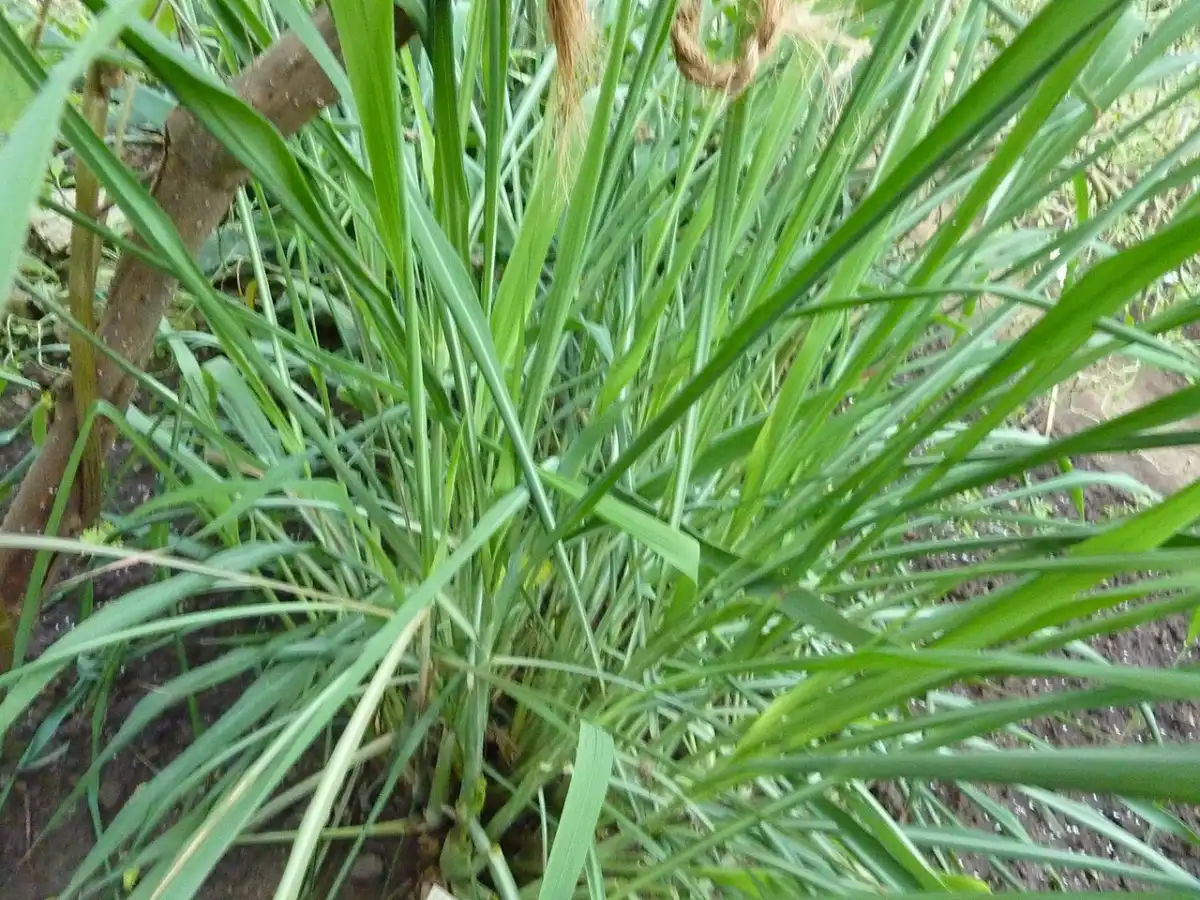
- Light: full sun to light shade; NParks notes intense sun can burn the leaves, so filtered afternoon light helps in the tropics.
- Water: moderate and steady; it tolerates short dry spells but grows best in evenly moist, well-drained soil. Avoid waterlogged ground.
- Space: clumps reach 1.5 to 2.5 m tall and about 1 to 1.5 m wide, so use a large container or plant it with room to spread.
- Temperature: a tropical grass, grown outdoors all year only in frost-free areas (roughly USDA zones 10 to 12). Elsewhere, keep it in a large pot and move it under cover before frost.
- Feeding: a nitrogen-rich fertilizer or a layer of compost in spring.
- Propagation: divide clumps that are 2 to 3 years old in spring; seed is unreliable.
- Problems: crowded clumps can develop leaf blight, so remove dead leaves and divide congested plants to improve airflow.
Unlike lemongrass, citronella grass is not a culinary herb, so do not cook with it.
Bottom Line
Start by confirming you have the citronella geranium, then give it strong sun, water only when the top inch is dry, and protect it from frost. Pinch it monthly for a bushy shape, and use the problem table whenever leaves change color. Treat it as a fragrant ornamental, not a mosquito solution, and keep it away from pets.
Frequently Asked Questions
Is a citronella plant an indoor or outdoor plant?
It grows best outdoors in full sun during warm months. It can live indoors in a very sunny window or under a grow light, and in frost-prone areas it must come indoors when night temperatures fall to about 45°F (7°C).
How often should I water a citronella plant?
Water when the top inch of soil is dry rather than on a fixed schedule. That may be every day or two for a small pot in summer heat and once a week or less indoors in winter.
Is a citronella plant a perennial?
Yes. The citronella geranium is a tender perennial that lives for years outdoors in frost-free areas (roughly USDA zones 9 to 11). In colder climates it is grown as an annual or overwintered indoors.
Why are my citronella plant's leaves turning yellow?
The most common cause is overwatering or poor drainage. Yellowing right after moving the plant indoors is often the plant adjusting to lower light. Let the soil dry, check the drainage holes and give it more light.
Do citronella plants really keep mosquitoes away?
No. A Florida field trial found the citronella geranium failed to repel mosquitoes, and Iowa State Extension notes that a growing plant releases little repellent oil. Removing standing water and using a registered repellent work better.
Is a citronella plant toxic to cats and dogs?
Yes. The ASPCA lists scented geraniums as toxic to dogs and cats because of their essential oils, mainly causing vomiting and stomach upset, with cats the most sensitive. Contact a vet if your pet eats the plant and shows symptoms.
Featured image: Photo: Mokkie / Wikimedia Commons, CC BY-SA 4.0


One Comment