

Alocasia California Care Guide: Light, Water, Winter and Pet Safety
Alocasia ‘California’ is a compact, upright elephant ear with broad green leaves and deeply sunken veins. Store labels for it disagree on almost everything, from height to hardiness, so this Alocasia California care guide sorts out those mixed messages and gives you one routine you can follow indoors or outside, in any climate.
Quick Answer: How to Care for Alocasia California
Give Alocasia ‘California’ bright, indirect light, water when the top 2 to 3 inches of mix are dry, and keep humidity around 50 to 60 percent. It grows best between 60 and 85°F (16 to 29°C) and should not sit below about 50°F (10°C) for long.
- Light: bright indirect light indoors; morning sun or part shade outdoors.
- Water: evenly moist, never soggy; water less in winter.
- Soil: chunky, well-draining mix that still holds some moisture.
- Feeding: half-strength liquid fertilizer once or twice a month in spring and summer.
- Outdoors year-round: generally USDA zones 9 to 11; in colder areas grow it in a pot and bring it in, or lift it for winter.
- Safety: toxic to dogs, cats and horses (ASPCA), so keep it out of reach.
What Is Alocasia ‘California’?
Alocasia ‘California’ is a cultivar of Alocasia odora, the upright elephant ear or night-scented lily, in the arum family (Araceae). It is a smaller, fast-clumping form that Plant Delights Nursery describes as a scaled-down version of both Alocasia odora and Alocasia macrorrhizos, with its origin given as Myanmar (Plant Delights).
Names, Synonyms and Why Labels Differ
You will see this plant sold as Alocasia gageana ‘California’, “gagaena” (a misspelling), Alocasia ‘Californicus Corrugata’ or simply California elephant ear. The aroid reference site Aroidpedia lists these as outdated synonyms and recommends the name Alocasia odora ‘California’, noting that molecular work places the plant within A. odora (Aroidpedia).
This matters for care. When you search “gageana” you often land on generic or conflicting advice, while searching Alocasia odora brings up the information that actually fits this plant.
How to Recognize It
Check these features with your own eyes before you follow any care routine:
- Habit: upright and clumping, with several stems rising from a central rhizome and new offsets (pups) appearing around the base.
- Leaves: broad, rounded to heart-shaped blades held pointing upward, up to about 20 inches long and 15 inches wide on mature plants, with gently wavy (undulate) edges.
- Veins: the midrib and main side veins are sunken into the leaf surface, giving a quilted, corrugated look.
- Leaf attachment: the stalk joins the blade slightly inside the leaf edge (semi-peltate), one of the features Aroidpedia uses to separate it from A. macrorrhizos.
- Size: most growers list 2 to 4 feet tall and wide in containers; in the ground in warm climates it can reach about 4 feet.
- Flowers: mature plants may produce a pale green to cream spathe and spadix in warm weather.
If you are not sure which elephant ear you have, upload a clear daylight photo of a whole leaf to our plant identifier or the leaf identifier. Photo identification, including our tool, can be wrong, so treat the result as a starting point, not a final answer.
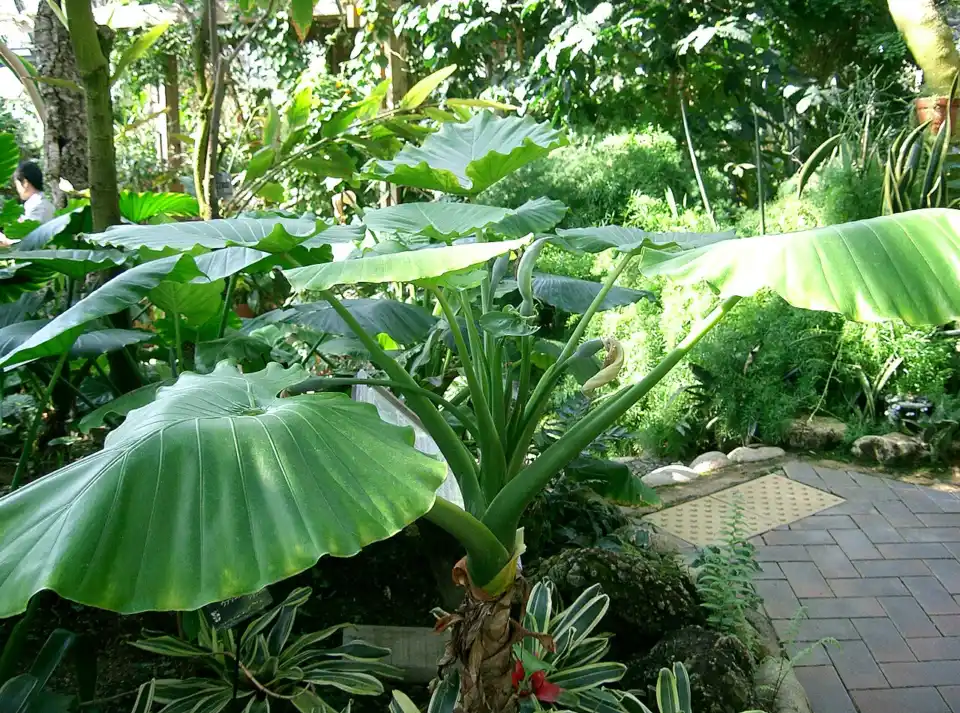
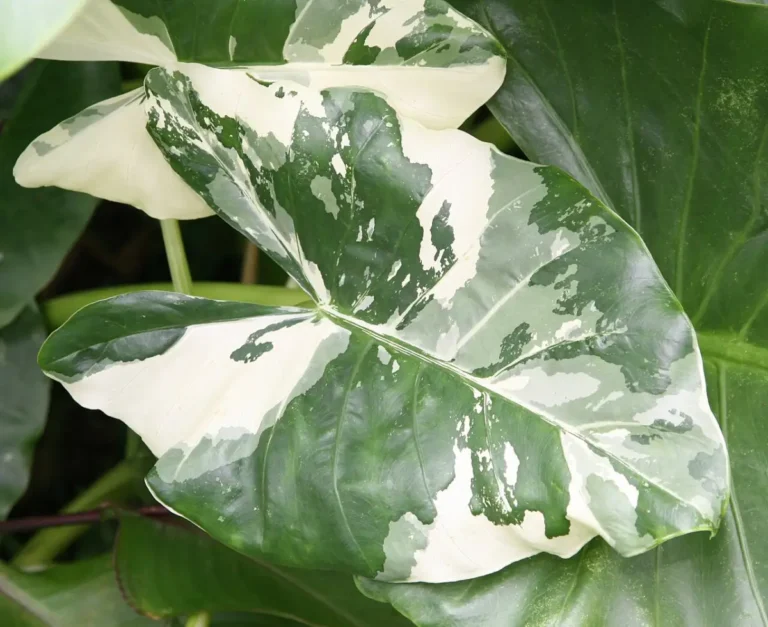
The photo above shows the parent species, Alocasia odora. ‘California’ has the same leaf shape and sunken veins on a smaller, more compact plant.
Alocasia California Care at a Glance
This table pulls together the ranges that the more reliable sources agree on, so you do not have to compare five store labels.
| Care factor | What it needs | Notes |
|---|---|---|
| Light | Bright, indirect | East or west window indoors; part shade outdoors |
| Water | When top 2 to 3 in (5 to 7 cm) is dry | Less often in winter |
| Humidity | About 50 to 60% | Higher is fine with good airflow |
| Temperature | 60 to 85°F (16 to 29°C) | Avoid long spells below 50°F (10°C) |
| Soil | Airy, well-draining, moisture-holding | Bark, perlite and peat or coir |
| Fertilizer | Half strength, 1 to 2 times a month | Spring and summer only |
| Size | 2 to 4 ft (60 to 120 cm) | Larger in the ground in warm climates |
| Hardiness | USDA zones 9 to 11 for most growers | Some report survival in zone 8 with dieback |
| Propagation | Offsets or division | Best in spring or early summer |
| Toxicity | Toxic to dogs, cats and horses | Contains insoluble calcium oxalates |
Light: Bright but Filtered
Alocasia ‘California’ wants bright light without hours of harsh direct sun. Indoors, a spot near an east- or west-facing window works well, which matches the general advice from Proven Winners for the genus.
- Too little light: stems stretch and lean, new leaves are smaller, and growth stalls.
- Too much sun: pale or brown scorched patches appear on the leaf surface.
- Outdoors: morning sun with afternoon shade is the safest choice, especially in hot, dry summers.
In my experience, placing indoor plants in a spot with indirect sunlight makes a real difference to how they grow, and this plant is a good example. If you use grow lights in a dark room, our guide to which light color is best for plant growth explains what to look for.
Watering and Humidity
Water Alocasia ‘California’ when the top 2 to 3 inches of potting mix feel dry, then water until it drains from the bottom. Empty the saucer so the roots never sit in water.
The plant likes steady moisture during active growth, but NC State Extension notes that overwatering Alocasia leads to root rot and leaf spots (NC State Extension). I have learned that checking the soil before watering is the simplest way to prevent overwatering, rather than following a fixed calendar.
How Often to Water by Season
- Spring and summer: check the mix every few days; warm rooms and bright light dry pots faster.
- Autumn: stretch the gaps between waterings as growth slows.
- Winter: water only when the mix is dry a few inches down, but do not let the root ball dry out completely.
Humidity Target
Aim for around 50 to 60 percent humidity, the range Foliage Factory gives for this cultivar. A humidifier, a pebble tray or grouping plants together all help. Misting gives only a brief boost and wet leaves in still air can encourage leaf spots, so good airflow matters as much as moisture.
Soil, Pots and Feeding
Use a chunky mix that drains quickly but still holds some moisture. A practical blend is roughly equal parts quality potting mix, orchid bark and perlite, with a little coir or peat to help it stay evenly damp.
- Pot: choose one with drainage holes, only 1 to 2 inches wider than the root ball. Alocasias tend to prefer being slightly pot bound.
- Repotting: spring is the best time, when new leaves are forming.
- Fertilizer: feed once or twice a month in spring and summer with a balanced liquid fertilizer at half strength, and stop in autumn and winter.
- After repotting: Proven Winners suggests skipping fertilizer for about 3 months to let roots settle.
Temperature, Hardiness Zones and Growing It Outdoors
Alocasia ‘California’ is a warm-climate plant. It grows actively between about 60 and 85°F (16 to 29°C) and slows down or loses leaves when it stays cooler than about 50°F (10°C).

Why Hardiness Zone Claims Disagree
Different sources give different zones for this plant, and each one is measuring something different:
- Most US retailers and the Chicago Botanic Garden list zones 9 to 11 or 10 to 11 for year-round outdoor growth with the leaves intact.
- Plant Delights lists zones 8a to 10b and reports that its plants in North Carolina have survived 7°F in the ground since 2001, dying back each winter and not regrowing until about late June in colder sites.
- UF/IFAS lists the Alocasia genus for zones 8B to 11 and states that freezing temperatures kill the foliage (UF/IFAS Extension).
Put simply: in zones 9 to 11 it can stay leafy outdoors most of the year, while in zone 8 the underground rhizome may survive a mild winter, but the top growth will not. Treat zone 8 survival as a gamble rather than a promise.
Climate Guide by Region
| Climate | Example regions | How to grow it |
|---|---|---|
| Tropical or frost-free | Hawaii, South Florida, coastal Southeast Asia | In the ground or large pots year-round in part shade |
| Mild winter, occasional frost | Gulf Coast, coastal Southern California, much of the Mediterranean | Outdoors in summer; protect or bring pots in on cold nights |
| Hot summer, cool winter | Inland subtropical areas, South Asian plains | Shade from afternoon sun in peak heat; move indoors when nights drop near 50°F (10°C) |
| Cold winter | Northern US, Canada, UK, northern Europe | Houseplant all year, or patio plant in summer only |
When moving a pot outside for summer, wait until nights stay above about 60°F (16°C) and introduce it to brighter light over a week or two, since sudden sun can scorch indoor-grown leaves.
Winter Care and Dormancy
Alocasia ‘California’ may slow down or partly go dormant in winter, depending on how warm and bright it is kept. Indoors in a warm, bright room it often keeps growing slowly; in a cool spot or in the ground in a marginal zone, it can drop leaves and rest.
A plant that loses leaves in winter is not necessarily dead. Gently check the base: a firm rhizome means it is resting, while a soft, mushy one points to rot.
Winter Checklist
- Move pots indoors before nights fall below about 50°F (10°C).
- Place them in your brightest spot away from cold drafts and heater vents.
- Water less often and stop fertilizing until spring.
- Remove leaves that have fully yellowed; leave green ones in place.
- In cold zones, plants grown in the ground can be dug in autumn before temperatures reach about 40°F (4°C), dried for about a week and stored at 50 to 60°F (10 to 16°C), the method Lively Root describes for this cultivar.
Propagating Alocasia California from Offsets
Alocasia ‘California’ is one of the easier elephant ears to multiply because it produces offsets freely. Aroidpedia describes it as easy to propagate and quick to form pups, and NC State Extension recommends division as the main propagation method for Alocasia.
- Wait until spring or early summer, when the plant is actively growing.
- Water the day before so the root ball holds together.
- Slide the plant out of its pot and brush away soil to see where offsets join the main rhizome.
- Choose offsets with at least one leaf and their own roots.
- Separate them with clean hands or a sterilized knife. Wear gloves, as the sap can irritate skin.
- Pot each one in a small pot of the same airy mix and keep it warm, bright and lightly moist.
- Expect a pause of a few weeks before new leaves appear while roots establish.
Troubleshooting Common Problems
Most problems with Alocasia ‘California’ come from water, light or temperature. Use this table to match what you see with the most likely cause.
| Symptom | Likely cause | What to do |
|---|---|---|
| Oldest leaf turns yellow, one at a time | Normal leaf turnover | Remove it once fully yellow; no change needed |
| Several leaves yellow, soil stays wet | Overwatering or poor drainage | Let the mix dry more, check roots, repot into airier mix |
| Yellowing right after purchase or repotting | Transplant stress | Keep conditions steady and avoid feeding for a while |
| Drooping leaves, dry soil | Underwatering | Water thoroughly and check more often |
| Brown, crispy leaf edges | Low humidity or irregular watering | Raise humidity, keep moisture more even |
| Pale or brown scorched patches | Too much direct sun | Move to bright, filtered light |
| Fine speckling and webbing under leaves | Spider mites | Wash leaves, raise humidity, treat (see below) |
| Leaves dropping in autumn or winter | Cold or seasonal slowdown | Move somewhere warmer, reduce water |
| Soft, mushy stem base | Root or rhizome rot | Cut away rotten parts, repot in fresh mix, water less |
For a wider look at causes that apply to most houseplants, see our guide on why plant leaves turn yellow.
Pests to Watch For
Spider mites are the pest most often reported on Alocasia; NC State Extension notes that the genus is prone to them. Foliage Factory also lists thrips on new shoots of this cultivar, and aphids and mealybugs turn up on stressed plants.
- Spider mites: tiny dots, pale speckling and fine webbing, mostly on leaf undersides. Dry indoor air makes them worse.
- Thrips: silvery streaks and distorted new leaves.
- Aphids: clusters of soft insects on new growth and sticky residue.
Isolate the plant, wipe or rinse both sides of the leaves, and repeat treatment with insecticidal soap or horticultural oil according to the label. Our article on getting rid of aphids on indoor plants walks through the same gentle steps.
Is Alocasia California Toxic to Pets and People?
Yes. The ASPCA lists Alocasia as toxic to dogs, cats and horses because it contains insoluble calcium oxalates (ASPCA).
- Signs in pets: mouth irritation, pain and swelling of the mouth, tongue and lips, heavy drooling, vomiting (not in horses) and difficulty swallowing, according to the ASPCA.
- People and children: NC State Extension rates Alocasia as medium severity, with painful irritation of the lips, mouth and throat after chewing, and notes it can cause contact dermatitis.
Keep the plant where pets and young children cannot chew it, and wear gloves when dividing or pruning. If a person or pet has eaten part of the plant and shows symptoms, contact a poison control center or your vet straight away (in the US, ASPCA Animal Poison Control is (888) 426-4435). For another common houseplant question, see whether snake plants are toxic to cats.
Look-Alikes and How to Tell Them Apart
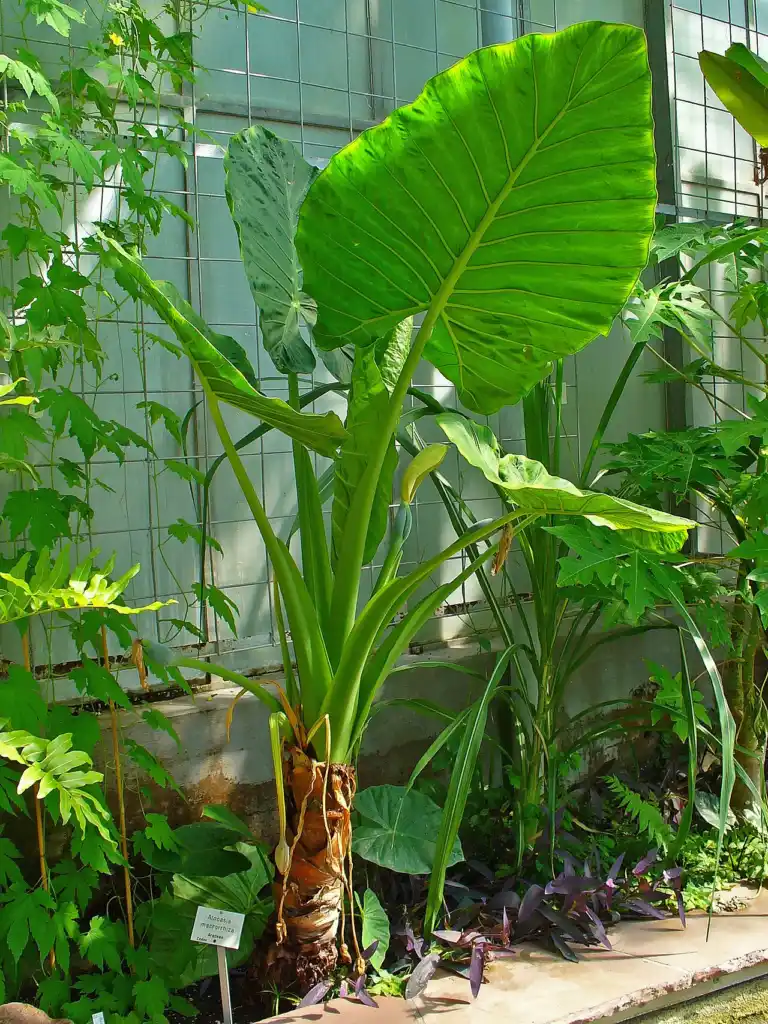
Several elephant ears are sold with similar names or look similar in a garden center. Leaf direction, size and leaf attachment are the quickest features to check.
| Plant | Scientific name and family | Leaf and habit | Typical size | Key difference |
|---|---|---|---|---|
| Alocasia ‘California’ | Alocasia odora ‘California’, Araceae | Upright, rounded leaves with sunken veins; clumps quickly | 2 to 4 ft | Compact, wavy-edged, quilted leaves |
| Upright elephant ear (species) | Alocasia odora, Araceae | Upright, large, wavy-edged leaves | Larger than ‘California’ | Same leaf style on a bigger plant |
| Giant taro | Alocasia macrorrhizos, Araceae | Very large, upright, arrow-shaped leaves with flatter veins | Much taller, can form a trunk | Bigger, narrower leaves; veins less sunken |
| Alocasia ‘Calidora’ | Hybrid involving A. odora, Araceae | Upright, glossy, large leaves | Larger than ‘California’ | Bigger, shinier leaves; Aroidpedia lists it as an A. odora hybrid |
| Taro, elephant ear | Colocasia esculenta, Araceae | Matte, heart-shaped leaves that hang downward | Varies widely | Leaf tips point down; Alocasia leaves point up or outward |
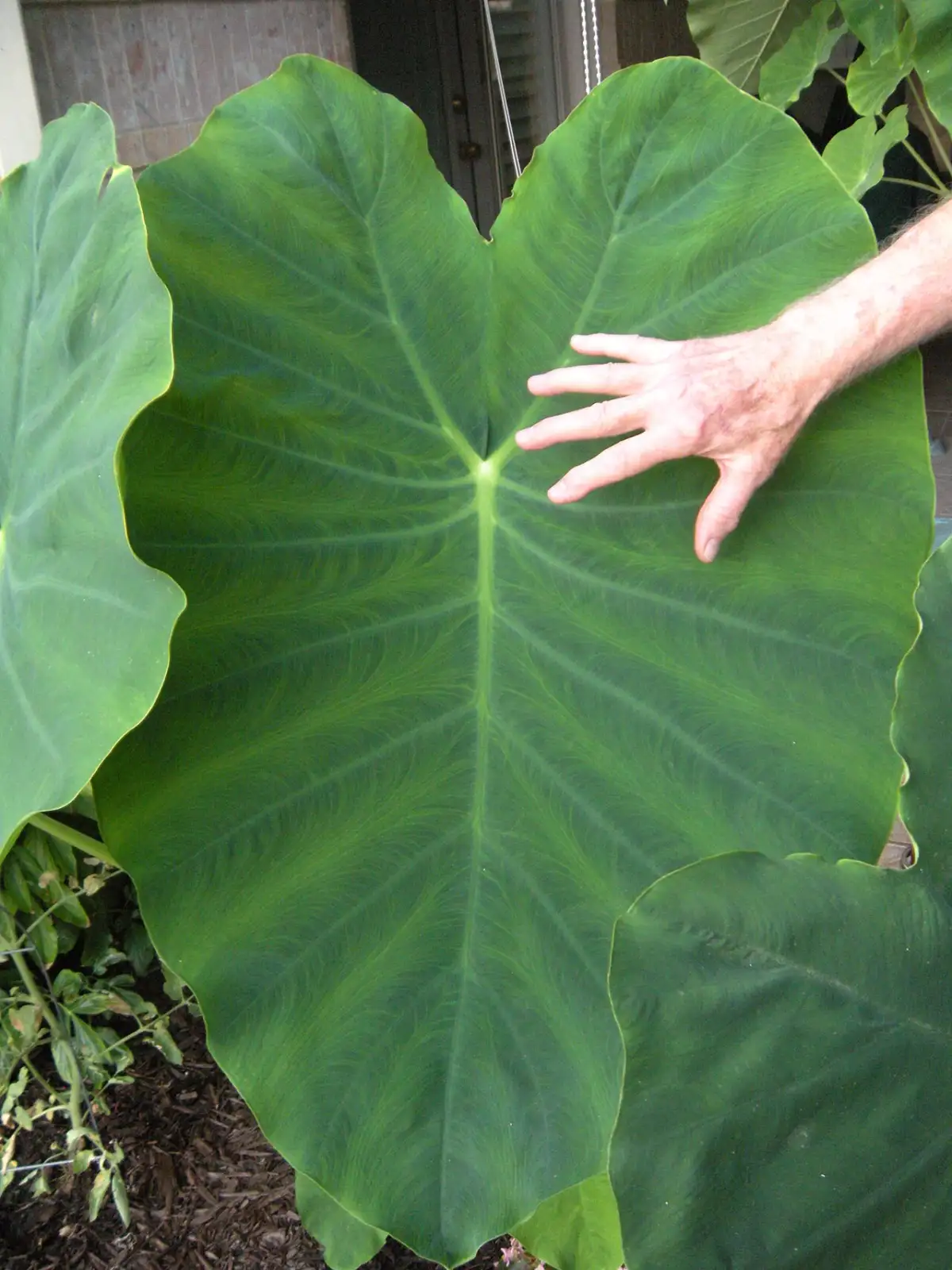
Because care differs (Colocasia tolerates much wetter soil, for example), it is worth confirming which plant you have. A clear photo of one full leaf and the point where its stalk joins the blade gives the plant identifier the best chance of a correct match.
How to Check Your Plant’s Needs Yourself
I believe observing plants regularly and adjusting care to what they show you matters more than any fixed schedule. Growing indoor plants has taught me how small changes in care can support healthier growth, and Alocasia ‘California’ responds quickly to those small changes.
- Weekly soil check: push a finger 2 to 3 inches into the mix before watering.
- Leaf check: look at new leaves; if each one is larger than the last, light and feeding are on track.
- Underside check: turn a few leaves over to catch spider mites early.
- Base check: look for new pups and feel that the stems are firm at soil level.
- Seasonal check: when nights cool in autumn, adjust watering and plan where the plant will spend winter.
Final Thoughts
Alocasia ‘California’ rewards steady, simple care: bright filtered light, water when the top few inches dry, warmth above 60°F and decent humidity. Most problems trace back to soggy soil, harsh sun or cold, so fix those first. Keep it away from pets and children, confirm its identity if your label is unclear, and it will keep producing upright, quilted leaves and new pups for years.
Frequently Asked Questions
Is Alocasia California the same as Alocasia gageana?
Yes, it is the same plant sold under an older name. Aroidpedia lists gageana as an outdated synonym and recommends the name Alocasia odora ‘California’.
How big does Alocasia California get?
Most growers list 2 to 4 feet tall and wide in containers. Planted in the ground in a warm climate it can reach about 4 feet, which is still much smaller than giant taro (Alocasia macrorrhizos).
Does Alocasia California go dormant in winter?
It can. In a warm, bright room it usually keeps growing slowly, but in cool conditions or in the ground in zone 8 it may lose its leaves and rest until warm weather returns. A firm rhizome means the plant is still alive.
How often should I water Alocasia California?
Water when the top 2 to 3 inches of potting mix feel dry, rather than on a fixed schedule. In summer that may be every few days; in winter, much less often.
Can Alocasia California grow outdoors?
Yes, year-round in roughly USDA zones 9 to 11 in part shade. In colder areas, grow it in a pot outdoors in summer and bring it inside before nights drop near 50°F (10°C).
Is Alocasia California safe for cats and dogs?
No. The ASPCA lists Alocasia as toxic to dogs, cats and horses because it contains insoluble calcium oxalates, which can cause mouth pain, drooling, vomiting and trouble swallowing. Contact your vet if a pet chews it and shows symptoms.
Featured image: Photo: Photograph by Mike Peel (www.mikepeel.net). / Wikimedia Commons, CC BY-SA 4.0


One Comment