Chinese Fan Palm Care: Light, Water, Feeding and Brown Frond Fixes
The Chinese fan palm (Livistona chinensis, family Arecaceae) is one of the easiest palms to keep, but it sends clear signals when something is off: brown tips, yellow lower fronds or a crown that looks thin. This guide gives you the full care routine for growing it indoors or outdoors, then shows how to read those signals and fix them.
Quick Answer
Chinese fan palm care comes down to five habits. Give it bright, indirect light indoors (young plants burn in hot direct sun), and water when the top 2 to 3 inches of mix are dry. Grow it in a free-draining, loam-based mix in a pot with holes.
- Light: bright indirect light indoors; full sun to part shade outdoors once established.
- Water: soak, drain fully, then wait until the top 2 to 3 inches are dry. Water less in winter.
- Temperature: about 13 to 27 °C (55 to 80 °F) indoors; established outdoor palms are cold hardy to about 20 °F (−7 °C).
- Feeding: balanced liquid feed monthly in spring and summer for pots; an 8-2-12 palm fertilizer with magnesium for palms in the ground.
- Pruning: remove only fronds that are completely brown. Yellowing older fronds still feed the palm.
Not sure your palm is a Chinese fan palm? Upload a clear photo of one frond to our Leaf Identifier before you follow any care advice.
Chinese Fan Palm at a Glance
The Chinese fan palm is a slow-growing, single-trunk palm with large, round fans whose segment tips hang down like a fountain. That drooping habit gives it its other common names, fountain palm and Chinese fountain palm.
| Feature | Details |
|---|---|
| Scientific name | Livistona chinensis (old names include Latania chinensis and Chamaerops biroo) |
| Family | Arecaceae (palm family) |
| Native range | Southern Japan, Taiwan, the Ryukyu Islands, southeastern China and Hainan (Wikipedia) |
| Leaves | Fan-shaped (costapalmate), 3 to 4 feet across, split into about 75 segments with drooping tips |
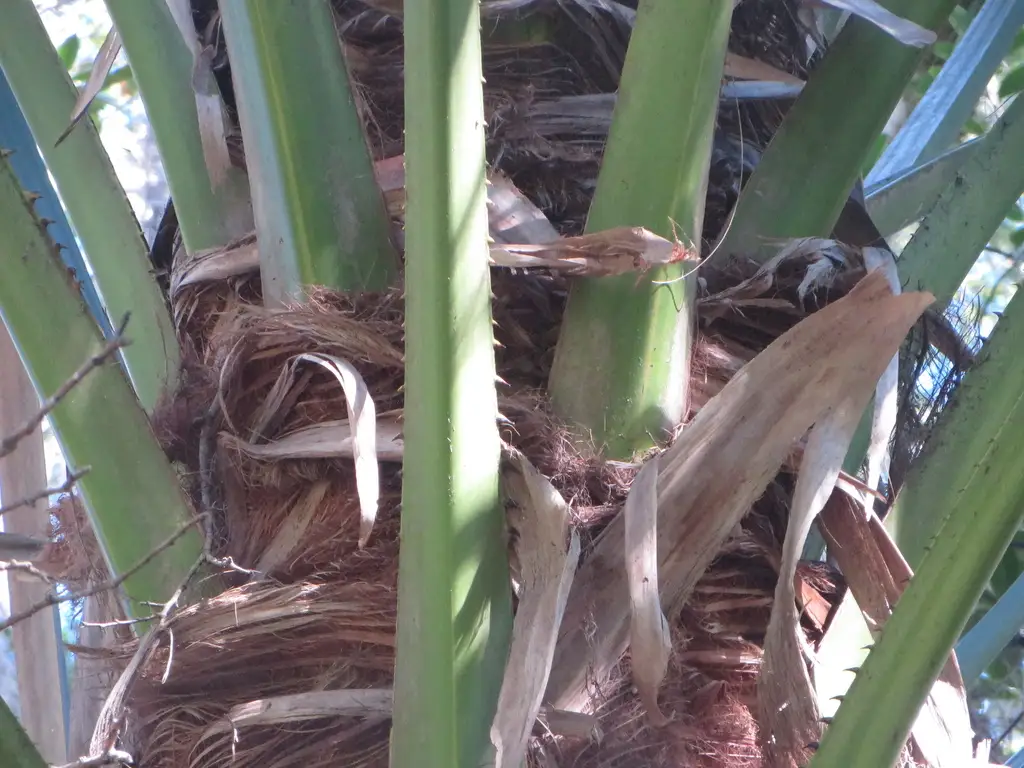
| Leaf stalk (petiole) | Spiny on young palms; adult palms have few or no spines |
| Height | About 30 feet in Florida landscapes, up to 50 feet in the wild; usually 3 to 6 feet in a pot indoors |
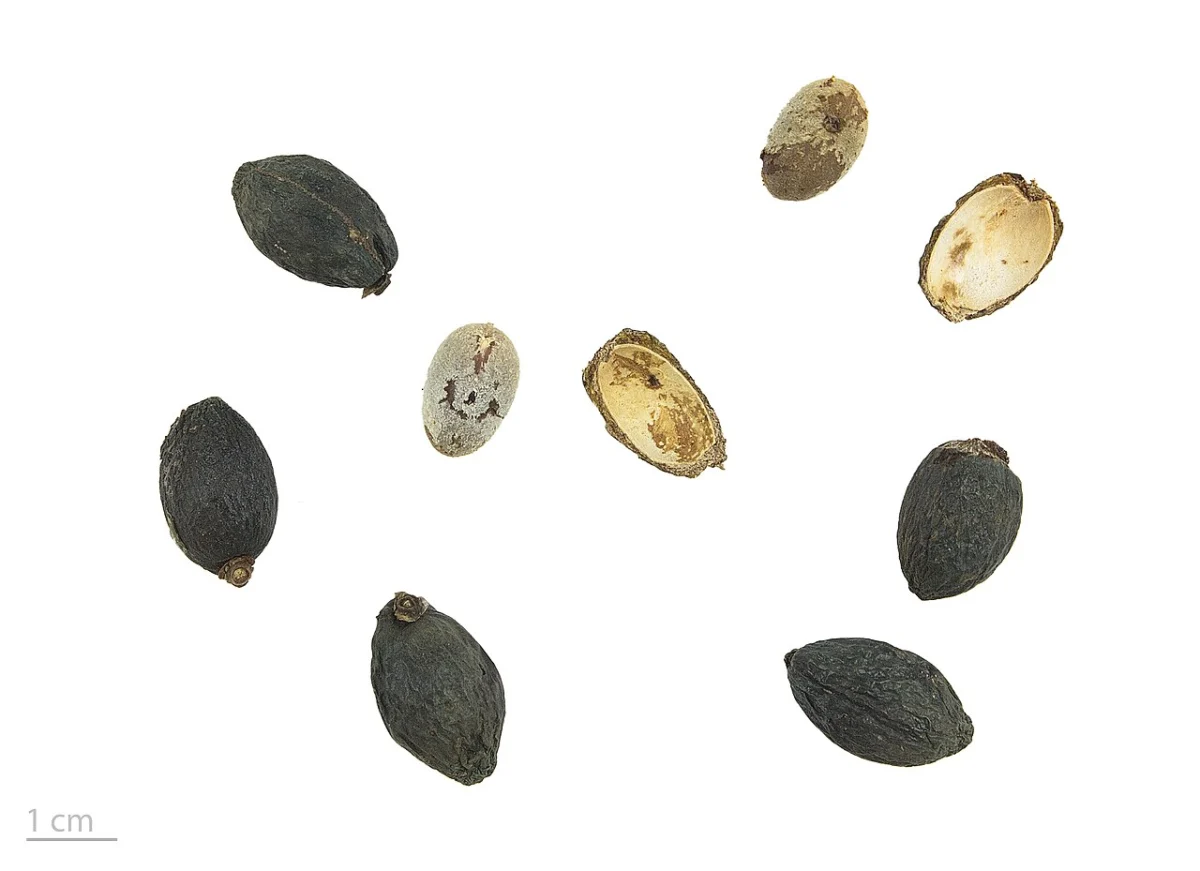
| Flowers and fruit | Cream flowers on long stalks in summer, followed by blue-green to dark blue oval fruits |
| Hardiness | USDA zones 9A to 11; RHS rating H2 in the UK (needs winter protection) |
| Growth rate | Slow; young plants take years to form a visible trunk |
Size, spine and hardiness figures above come from the University of Florida IFAS fact sheet ST365 and the RHS plant profile. Leaf segment counts come from NParks Singapore.
Chinese Fan Palm vs Round-Leaf Fan Palm
The palm most often confused with the Chinese fan palm in garden centers is the round-leaf fan palm (Saribus rotundifolius, formerly Livistona rotundifolia, also Arecaceae). Both have round fans and spiny stalks, but their care differs, so it pays to check which one you own.
| Feature | Chinese fan palm (Livistona chinensis) | Round-leaf fan palm (Saribus rotundifolius) |
|---|---|---|
| Segment tips | Long segments that hang down, giving a weeping fountain look | Shallower splits; the fan looks flatter and stiffer |
| Leaf stalk | Spiny when young, few spines on adults | Sharp thorns form on mature fronds (UK Houseplants) |
| Cold tolerance | Established palms to about 20 °F (−7 °C) | Tropical; keep above 12 °C (54 °F) |
| Best indoor light | Bright indirect light, some gentle sun | Bright light with little direct sun |
| Mistake to avoid | Putting a young plant in hot midday sun | Leaving it outdoors in cool autumn nights |
The windmill palm (Trachycarpus fortunei) is also sometimes called a “Chinese fan palm,” as the Tropical Plant Party channel points out. It is a different, more cold-hardy plant, so check the botanical name on the plant tag.
Light Needs Indoors and Outdoors
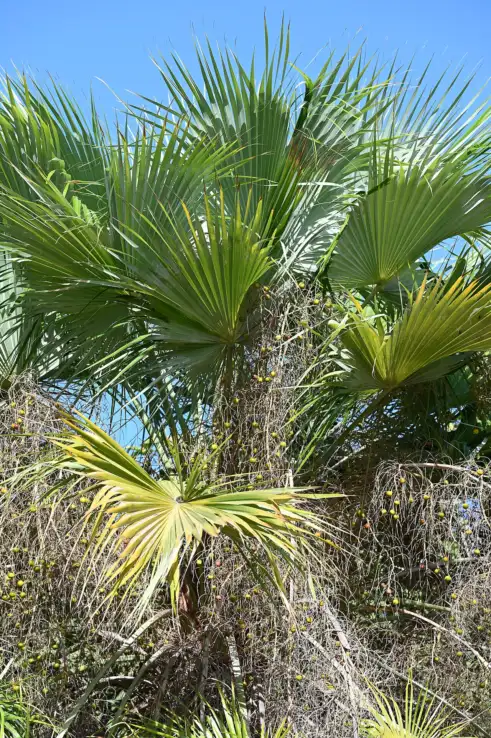
A Chinese fan palm needs bright light, but how much direct sun it can take depends on its age. Young palms grow naturally in the shade of taller plants, so they scorch in strong midday sun, while mature palms outdoors handle full sun.
- Indoors: place it within a few feet of an east or west window, or behind a sheer curtain at a south-facing window. The Tropical Plant Party channel suggests at least four to five hours of bright light a day in a well-lit room.
- Low light: it survives medium light but grows more slowly, so water less there.
- Outdoors: full sun to light shade. Top Tropicals notes that young plants look better in part shade.
From my own experience with indoor plants, a spot with bright, indirect sunlight makes a visible difference in growth. Turn the pot a quarter turn every few weeks so the crown fills out evenly instead of leaning toward the window.
How Often to Water a Chinese Fan Palm
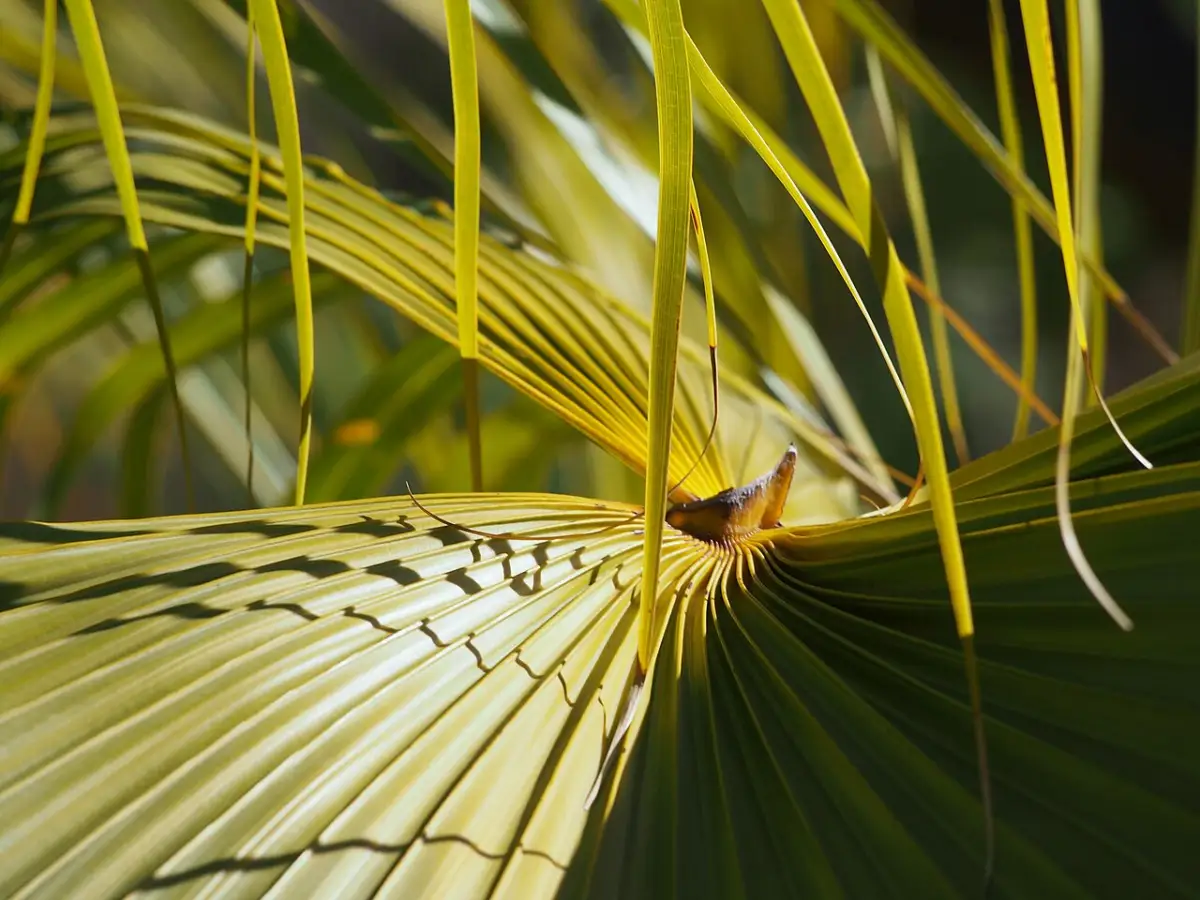
Water a Chinese fan palm when the top 2 to 3 inches of potting mix feel dry, not on a fixed calendar. In a warm, bright room that is often about once a week in summer; in a cool room in winter it can stretch to every two or three weeks.
- Push a finger or wooden skewer 2 to 3 inches into the mix.
- If it comes out dry, water slowly until water runs out of the drainage holes.
- Empty the saucer after 15 minutes. Roots that sit in water lose oxygen and rot.
- If the mix is still damp, wait and check again in two or three days.
I have learned that checking the soil before watering is the simplest way to prevent overwatering, and it matters even more with a palm that grows as slowly as this one. Palms in the ground are more forgiving: UF/IFAS describes the Chinese fan palm as tolerant of drought once established, and Top Tropicals notes that it forms a long tap root.
If your tap water is hard, use rainwater or filtered water now and then. Salt buildup from hard water is one of the causes of brown leaf tips listed by The Palm Centre.
Soil, Pot Size and Repotting
Use a free-draining, loam-based potting mix. The RHS recommends a peat-free, loam-based compost for container palms. Adding about one part perlite or coarse grit to three parts mix helps water move through quickly.
- Choose a pot with drainage holes. Terracotta dries faster and suits people who tend to overwater.
- Repot only when roots circle the pot or push out of the holes, usually every 2 to 5 years, in spring or early summer.
- Go up just one pot size (about 2 inches wider). A pot that is too large holds extra wet soil around the roots.
- Wear thick gloves: the spines on young leaf stalks can scratch skin.
For more general potting advice, see our guide on how to grow plants in pots.
Humidity and Temperature
Indoors, a Chinese fan palm is comfortable at normal room temperatures of about 13 to 27 °C (55 to 80 °F) with medium humidity. Keep it at least a few feet from radiators, heaters and air-conditioning vents, because dry, moving air is a common cause of crispy tips.
Misting briefly raises humidity but does not last. Grouping plants together or standing the pot on a tray of wet pebbles (with the pot above the water line) works better in a dry room.
How Much Cold Can It Take?
Established Chinese fan palms in the ground are cold hardy to about 20 °F (−7 °C), according to UF/IFAS, and grow outdoors in USDA zones 9A to 11. Young palms are more tender, so protect them from any frost.
| Your climate | What to do |
|---|---|
| Tropical and subtropical (USDA 10 to 11, South Florida, South and Southeast Asia, coastal Brazil) | Grow outdoors all year in full sun to light shade. |
| Mild winters with light frost (USDA 9, Gulf Coast, Mediterranean) | Plant established palms outdoors; cover young plants on nights below about 28 °F (−2 °C). |
| Cold winters (USDA 8 and below, most of the UK and northern Europe) | Grow in a pot; move it outdoors in summer and back inside before the first frost. The RHS rates it H2, meaning it does not survive being frozen. |
| Hot, dry summers (for example the plains of Pakistan and northern India) | Give afternoon shade to young plants and check the soil more often during heat waves. |
Sources disagree on the exact limit (figures range from about 15 °F to 25 °F). Wind, wet soil and how long the cold lasts all change the outcome, so treat these numbers as guides, not guarantees.
Fertilizer and Potassium Deficiency
Feed potted Chinese fan palms with a balanced liquid fertilizer once a month in spring and summer, and stop in autumn and winter, as the RHS advises. A fertilizer that also lists micronutrients such as magnesium, manganese and iron suits palms best.
Palms in the ground do best with a controlled-release palm maintenance fertilizer such as 8-2-12 with 4% magnesium (8-2-12+4Mg). UF/IFAS recommends this formula because potassium deficiency is “fairly common” in this species.
How to spot potassium deficiency: it shows on the oldest (lowest) fronds first as yellow or orange discoloration and translucent spots, followed by dead brown leaflet tips. It starts at the bottom because the palm moves potassium out of old fronds to feed new growth.
The fix is to feed, not to cut. The UF/IFAS publication Potassium Deficiency in Palms warns that regularly removing discolored older fronds speeds up the decline, because those fronds still hold potassium the palm can reuse.
Pruning: Remove Only Fully Dead Fronds
Prune a Chinese fan palm only to remove fronds that are completely brown and dry, plus flower stalks if you do not want seedlings. A healthy palm should have a full, round crown of green leaves; UF/IFAS describes this as a 360° crown, and a crown smaller than that is a sign of potassium deficiency.
- Wear gloves and long sleeves to protect against the spiny leaf stalks.
- Cut the dead frond close to the trunk with clean, sharp loppers, without tearing or wounding the trunk. Trunk wounds let in Thielaviopsis trunk rot.
- Never cut the growing point at the top of the palm. Palms grow from that single bud and cannot replace it.
- Leave yellowing or half-brown fronds in place until they are fully dead.
Troubleshooting Brown Tips, Yellow Fronds and Pests
Most Chinese fan palm problems trace back to water, dry air, nutrients or a few sap-sucking pests. Match the symptom to its likely cause below, starting with the simplest fix.
| Symptom | Likely cause | What to do |
|---|---|---|
| Brown, crispy tips on many fronds | Dry air, soil drying out completely, or salts from hard water | Move away from heaters, water more evenly, flush the pot with rainwater or filtered water |
| Yellow or orange spots on the lowest fronds | Potassium deficiency | Use a palm fertilizer with potassium and magnesium; do not cut the fronds off |
| Yellowing fronds plus soggy, sour-smelling soil | Overwatering and root rot | Let the mix dry, check the drainage holes, repot into fresh mix if roots are brown and mushy |
| Bleached or scorched patches | Sudden strong sun on a young plant | Move to bright indirect light; damaged areas will not recover, but new fronds will grow normally |
| Fine webbing and speckled leaves | Spider mites | Wipe the leaves, rinse the plant, treat with insecticidal soap or neem oil |
| Brown bumps and sticky leaves | Scale insects | Scrape off gently, then treat with neem oil or horticultural oil |
| White cottony spots | Mealybugs | Dab with rubbing alcohol on a cotton swab, then treat with insecticidal soap |
| Shelf-like mushroom (conk) at the trunk base (outdoors) | Ganoderma butt rot | No cure exists; UF/IFAS advises removing the palm |
The RHS lists red spider mite and scale as the main pests. For a step-by-step treatment plan for sap-sucking insects, see how to get rid of aphids on indoor plants; the same soap and neem methods work on mites and mealybugs. If you are seeing yellowing across many of your plants, our guide on why plant leaves turn yellow covers the wider causes.
The Roots & Roasts channel covers indoor light, watering, potting and pests in a short video:
Is the Chinese Fan Palm Safe for Pets and Children?
The Chinese fan palm is not known as a toxic plant, but sources are not unanimous, and its spines are a real hazard. The Hawaii-Pacific Weed Risk Assessment lists it as non-toxic, while the UK retailer Patch labels it “mildly toxic if ingested.”
I could not find a Chinese fan palm entry in the ASPCA toxic and non-toxic plants list. The ASPCA notes that eating any plant material can cause vomiting and stomach upset in dogs and cats.
- Keep young plants, which have the sharpest spines on their leaf stalks, out of reach of curious pets and toddlers.
- Do not let pets chew the fronds or eat fallen fruit.
- If a person or pet has eaten part of a plant and shows symptoms, contact your local poison control center or a vet straight away.
For a plant with a clearer pet safety record, compare our article on whether snake plants are toxic to cats.
Growing It Outdoors Without Spreading Seedlings
In warm climates the Chinese fan palm can escape gardens, so plant it responsibly. Birds and small mammals spread its fruit and the seeds germinate readily, which is why UF/IFAS lists it as a plant to use with caution in central and south Florida.
The Hawaii-Pacific Weed Risk Assessment rates it High Risk. It has become invasive in Bermuda, Florida wetlands, Mauritius, Réunion and New Caledonia. If you live in a frost-free region:
- Check your local invasive plant list before planting.
- Cut off flower stalks before fruit forms. UF/IFAS notes this also prevents the heavy fruit clusters from splitting the crown.
- Pull up seedlings under the palm while they are small.
In Florida, the Gulf Coast and Hawaii, lethal yellowing is another concern. UF/IFAS rates the Chinese fan palm as moderately susceptible, so ask your local extension office if the disease is active in your area.
A Weekly Check Routine for Your Palm
I believe the most useful habit with any indoor plant is to look at it regularly and adjust care to what it shows you. Small changes, made early, support healthier growth. This five-minute weekly routine catches most problems before they spread.
- Soil: test the top 2 to 3 inches. Water only if dry.
- Newest frond: it should open green and clean. Brown edges on new growth point to dry air or uneven watering.
- Lowest fronds: look for yellow or orange spotting, the first sign of potassium shortage.
- Undersides: check for webbing, brown bumps or white fluff.
- Position: make sure it still gets bright light and is not next to a heater or cold draft.
Photo identification, including our Leaf Identifier, can be wrong. Use it as a starting point, and ask a local nursery or extension service when a diagnosis or safety question really matters.
Propagating Chinese Fan Palm From Seed
The Chinese fan palm grows only from seed; it does not produce offsets or grow from cuttings. The RHS recommends sowing seed in containers at about 23 °C (73 °F) in spring.
- Collect ripe, dark blue fruits and remove the flesh.
- Sow the seed just below the surface of a moist mix of potting compost and perlite or sand.
- Keep it warm and evenly moist, in bright indirect light.
- Expect slow progress: seedlings take years to reach a decorative size.
If you enjoy palms, our Adonidia palm care guide covers another popular landscape and container palm.
The Bottom Line
Good Chinese fan palm care means bright but gentle light, watering only when the top few inches are dry, a monthly feed in the growing season and as little pruning as possible. When fronds change color, read the symptom before you reach for the pruners: yellowing older fronds usually need potassium, not removal. Get those basics right and this slow, elegant palm will stay full and green for many years.
Frequently Asked Questions
How often should I water a Chinese fan palm?
Water when the top 2 to 3 inches of potting mix are dry. Indoors this is often about once a week in summer and every two to three weeks in winter, but always check the soil first and empty the saucer afterwards.
Why are the tips of my Chinese fan palm turning brown?
Brown tips usually come from dry air near heaters or vents, soil drying out completely between waterings, or salt buildup from hard tap water. Move the palm away from heat, water more evenly and flush the pot now and then with rainwater or filtered water.
Should I cut off yellow fronds on my Chinese fan palm?
No. Yellowing older fronds are usually a sign of potassium deficiency, and UF/IFAS research shows that removing them speeds up the decline. Feed with a palm fertilizer and remove fronds only once they are completely brown.
Can a Chinese fan palm grow indoors?
Yes. It is a popular indoor palm that stays about 3 to 6 feet tall in a pot. Give it bright, indirect light, room temperatures of about 13 to 27 °C (55 to 80 °F) and a free-draining mix.
How cold can a Chinese fan palm tolerate?
Established palms in the ground are cold hardy to about 20 °F (−7 °C) according to UF/IFAS and grow outdoors in USDA zones 9A to 11. Young plants are more tender and should be protected from frost.
Is a Chinese fan palm toxic to cats and dogs?
It is not known as a toxic plant: the Hawaii-Pacific Weed Risk Assessment lists it as non-toxic, though one retailer labels it mildly toxic. The spiny leaf stalks on young plants are the bigger hazard. Contact a vet if your pet eats it and shows symptoms.
Featured image: Photo: Krzysztof Ziarnek, Kenraiz / Wikimedia Commons, CC BY-SA 4.0